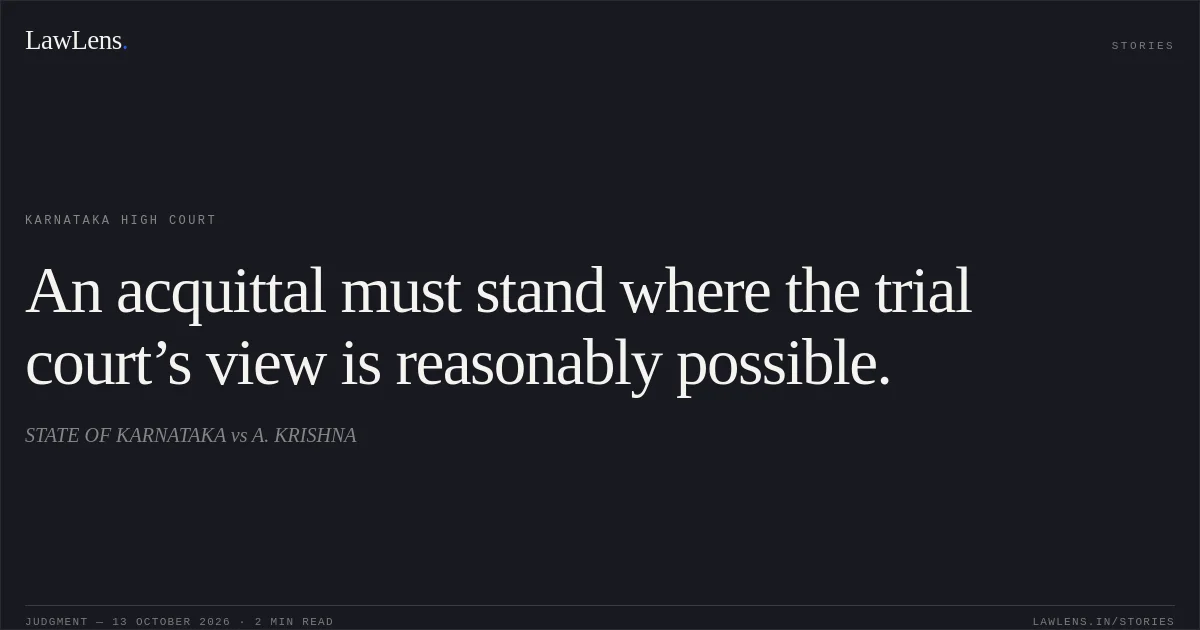
Facts
The prosecution alleged that, on 12 October 2012, the respondent, driving a Kerala State Road Transport Corporation bus, drove rashly and negligently on the wrong side of the road and collided with a Maruti Alto car.
Source reference: p. 2–3, paras. 2–3The car’s driver and his three-year-old daughter sustained grievous injuries; the child died while being taken to hospital, and a bus passenger sustained simple injuries.
Source reference: p. 2–3, paras. 2–3The trial court acquitted the respondent of offences under Sections 279, 337, 338 and 304A of the Indian Penal Code (IPC).
Source reference: p. 1, para. 1The State appealed under Section 378 of the Code of Criminal Procedure (CrPC), challenging the acquittal.
Source reference: p. 4, para. 5Issues
1. Whether the State had established grounds for appellate interference with the trial court’s judgment of acquittal
Source reference: p. 5, para. 92. What order should follow from the Court’s determination of the appeal
Source reference: p. 5, para. 9Law Applied
The alleged offences were under IPC Sections 279, 337, 338 and 304A.
Source reference: p. 1–2, para. 2In an appeal against acquittal under CrPC Section 378, the appellate court may reappreciate the evidence, but the acquittal reinforces the presumption of innocence. It must determine whether the trial court’s view was a possible view on the evidence; if so, the acquittal cannot be reversed merely because another view is also possible. Interference is warranted where the acquittal is perverse, rests on a misreading of or omission to consider material evidence, and the evidence permits no reasonable view other than guilt.
Source reference: p. 6–7, para. 10The Court referred to Constable 907 Surendra Singh v. State of Uttarakhand, (2025) 5 SCC 433; Babu Sahebgouda Rudragoudar v. State of Karnataka, (2024) 8 SCC 149; Chandrappa v. State of Karnataka, (2007) 4 SCC 415; and H.D. Sundara v. State of Karnataka, (2023) 9 SCC 581.
Source reference: p. 6, para. 10Reasoning
The Court found that the trial court had reasonably assessed the evidence.
Source reference: p. 11–12, paras. 22, 24The complainant (PW1) did not testify to rash or negligent driving by the bus driver, and the bus passenger and eyewitness (PW3) likewise did not establish such conduct.
Source reference: p. 11–12, paras. 22, 24The trial court also considered the vehicle photographs and the location of the damage and metal marks, which it viewed as inconsistent with the prosecution claim that the bus crossed onto the wrong side; PW1 and PW3 admitted the relevant photograph.
Source reference: p. 12–13, paras. 23–24In light of this evidence, the acquittal represented a possible view, and the State had not shown perversity or another basis for appellate interference.
Source reference: p. 13, para. 25Holding
The Court answered the first issue in the negative, holding that the State had not established grounds to interfere with the acquittal.
It dismissed the appeal, leaving the respondent’s acquittal intact.
Source reference: p. 13, para. 26Acts & Sections Cited
5 provisions across 2 statutes referred to in this judgment. Each provision opens on LawLens.
Code of Criminal Procedure, 19732
Indian Penal Code, 18603
Original Court PDF
STATE OF KARNATAKAvsA. KRISHNA
Click to open original judgment
Original judgment, available to read, download and summarize on LawLens.in
![Railway pensioners qualify for additional pension only upon completing 80 years of age.. OM PRAKASH MISHRA vs NORTH EASTERN RAILWAY. CAT - ['Allahabad']. LawLens](/stories/thumbnails/railway-pensioners-qualify-for-additional-pension-only-upon-completing-80-years-of-age-e4a0c68f01cd4886b5cdc93e3a4b5e33.webp)