Facts
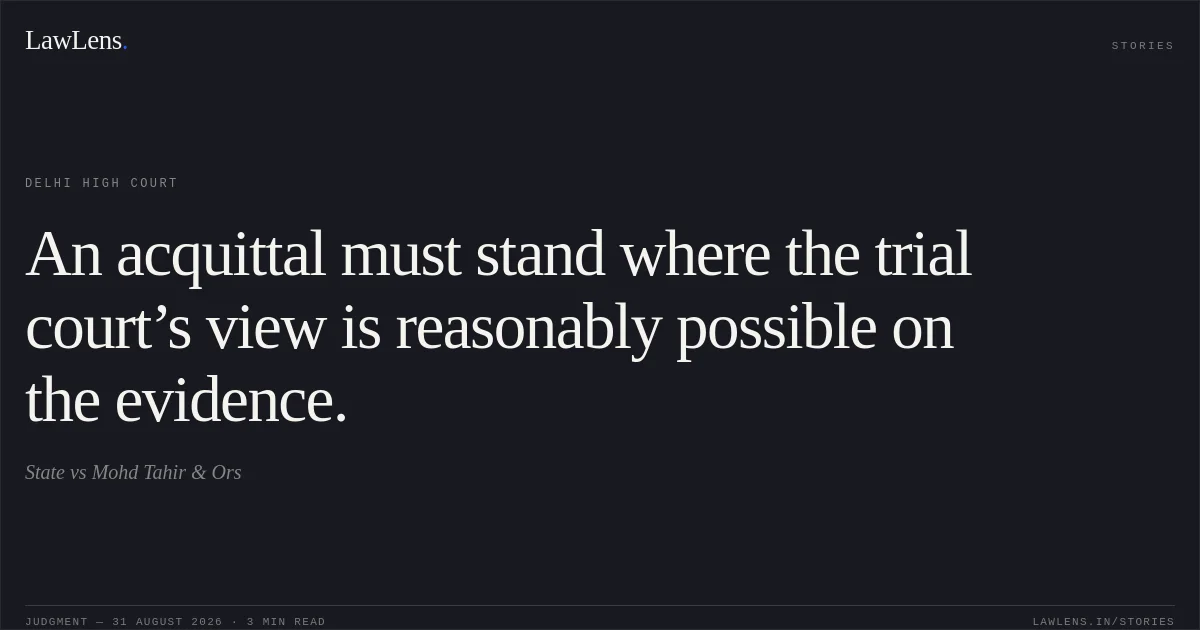
The State sought leave to appeal against the judgment dated 31.03.2017 of the Special Judge (POCSO Act), Tis Hazari Courts, Delhi, whereby the respondents were acquitted of offences under Sections 452, 308 and 34 IPC arising from FIR No. 83/2012, Police Station Chandni Mahal.
Source reference: p.1, para.1The prosecution relied principally on the testimony of the injured witness, Mohd. Zahid, and supporting medical and other evidence.
Source reference: p.1–2, para.2The Trial Court found the prosecution case doubtful due to delay in registration of the FIR, inconsistent accounts regarding recording of the injured’s statement and his removal to hospital, non-seizure of blood-stained clothes, the existence of a cross-case, and contradictions concerning the presence of the injured’s family members and the possession of the premises.
Source reference: p.7–9, para.15Before the High Court, the respondents stated that the dispute arose from a family property dispute and had been amicably settled.
Source reference: p.2, para.3Issues
Whether the Trial Court’s acquittal of the respondents under Sections 452, 308 and 34 IPC was palpably wrong, manifestly erroneous, or demonstrably unsustainable so as to warrant appellate interference?
Source reference: p.5–6, paras.10–14Whether the High Court should interfere with the acquittal merely because another view of the prosecution evidence could be reasonably taken?
Source reference: p.3–6, paras.5–13Law Applied
The Court applied Sections 452, 308 and 34 IPC, under which the prosecution was required to establish the respondents’ guilt beyond reasonable doubt.
Source reference: no citationOn an appeal against acquittal, the appellate court possesses full power to review, reappreciate and reconsider the evidence, and the Cr.P.C. imposes no limitation on that power, as held in Chandrappa v. State of Karnataka.
Source reference: p.4, para.8However, the accused enjoy a double presumption of innocence, and where two reasonable conclusions are possible, the acquittal ordinarily should not be disturbed.
Source reference: p.4–5, para.8The Court relied on Sheo Swarup v. King Emperor, M.G. Agarwal v. State of Maharashtra, Siju Kurian v. State of Karnataka, and Ghurey Lal v. State of Uttar Pradesh for the requirement of judicial restraint in appeals against acquittal.
Source reference: p.2–7, paras.5–12Under Ramesh Babulal Doshi v. State of Gujarat, the appellate court must first determine whether the Trial Court’s findings are palpably wrong, manifestly erroneous, legally perverse, or wholly untenable; only then may it undertake an independent reappraisal of the evidence.
Source reference: p.5–6, paras.10–11Reasoning
The High Court held that the Trial Court’s acquittal was based on material evidentiary deficiencies rather than conjecture.
Source reference: no citationThe unexplained delay in lodging the FIR and the inconsistent versions regarding when the injured’s statement was recorded and how he was taken to hospital created doubt about the prosecution narrative.
Source reference: p.7–8, paras.15–17The prosecution also failed to seize the alleged blood-stained clothes despite the claim of bleeding injuries, and the Investigating Officer gave inconsistent explanations regarding those clothes.
Source reference: p.7–8, para.15Further, the existence of a cross-case arising from the same occurrence, the conflicting evidence regarding injuries to accused Tahir, and contradictions concerning the presence of the injured’s wife and daughters undermined the reliability of the prosecution witnesses and the alleged possession of the premises.
Source reference: p.8–9, paras.15–17Applying the principles governing appellate review of acquittals, the Court found the Trial Court’s view to be a reasonably possible view and not palpably wrong, manifestly erroneous, or demonstrably unsustainable.
Source reference: p.9–10, paras.18–19Holding
The High Court answered the issues against the State.
It held that the prosecution had not demonstrated any legally recognised ground for disturbing the acquittal and that the possibility of an alternative view was insufficient for appellate interference.
Source reference: p.10, paras.19–20The State’s application for leave to appeal was accordingly dismissed, and any pending application was also disposed of.
Source reference: p.10, paras.21–22Acts & Sections Cited
3 provisions across 1 statute referred to in this judgment. Each provision opens on LawLens.
Indian Penal Code, 18603
Original Court PDF
StatevsMohd Tahir & Ors
Click to open original judgment
Original judgment, available to read, download and summarize on LawLens.in