Facts
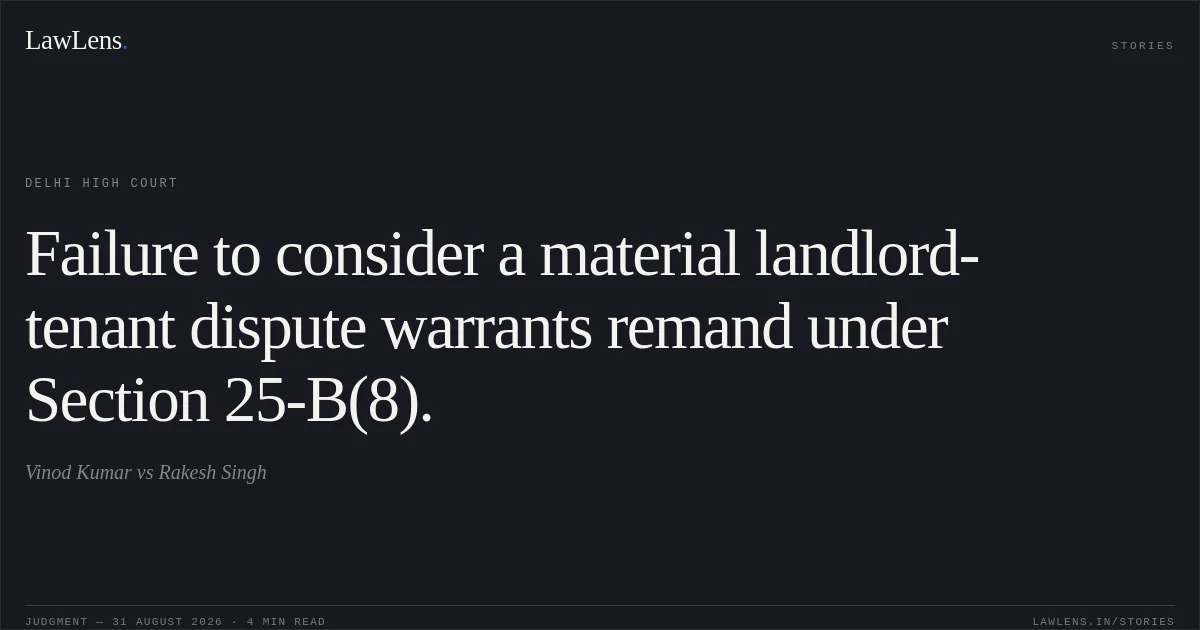
The petitioner, Vinod Kumar, challenged under the proviso to Section 25-B(8) of the Delhi Rent Control Act, 1958 (“DRC Act”) the order dated 27 February 2026 passed by the learned ARC in RC ARC No. 28/2023, whereby his application for leave to defend was rejected and an eviction order was passed in favour of Rakesh Singh concerning Shop No. 6, CB-385, Khasra No. 1068/2, Ring Road, Naraina, New Delhi.
Source reference: para. 1–2The challenge before the High Court was confined to the finding regarding the existence of a landlord–tenant relationship.
Source reference: para. 3–6The petitioner disputed the authenticity and evidentiary value of the rent receipts relied upon by the respondent, contending that they appeared to have been generated contemporaneously, were all dated identically, and were inconsistent with the respondent’s claim regarding the period up to which rent had been paid.
Source reference: para. 3–6, 17–19The respondent conceded that this challenge had not been considered by the learned ARC, but argued that the omission was immaterial because the petitioner had also pleaded adverse possession.
Source reference: para. 7–8, 18Issues
1. Whether the learned ARC’s failure to consider the petitioner’s specific challenge to the authenticity, dates, and evidentiary value of the rent receipts constituted a material defect in the decision-making process warranting interference under the proviso to Section 25-B(8) of the DRC Act?
Source reference: para. 17–212. Whether the matter should be remanded for fresh consideration of the landlord–tenant relationship and the petitioner’s connected contentions, without the High Court undertaking an independent appreciation of the evidence?
Source reference: para. 20–23Law Applied
The Court applied the proviso to Section 25-B(8) of the DRC Act, under which the High Court exercises limited supervisory and revisional jurisdiction over the order of the Rent Controller rather than appellate jurisdiction.
Source reference: para. 10–15Relying on Sarla Ahuja v. United India Insurance Co. Ltd., (1998) 8 SCC 119, Hindustan Petroleum Corporation Ltd. v. Dilbahar Singh, (2014) 9 SCC 78, and Abid-Ul-Islam v. Inder Sain Dua, (2022) 6 SCC 30, the Court held that it must scrutinise the legality and propriety of the decision-making process and should not substitute its own view merely because another view is possible.
Source reference: para. 11–13The Court also relied on Pankaj Pahwa v. Prem Wati & Ors., 2024:DHC:9322, and Sanjeev Hiranandani v. Sunny Grover, 2025:DHC:11285, for the principle that interference is justified where there is an error apparent on the face of the record, material irregularity, perversity, or absence of adjudication on a material contention.
Source reference: para. 12, 14–15A material issue directly bearing on the controversy, if left wholly unconsidered, constitutes a defect in the decision-making process warranting revisional interference.
Source reference: para. 20Reasoning
The existence of a landlord–tenant relationship was material to the eviction proceedings, particularly because the petitioner had specifically disputed that relationship and challenged the rent receipts relied upon by the respondent.
Source reference: para. 17–19The rent receipts directly bore upon the issue, while the petitioner had identified alleged inconsistencies between the respondent’s claim that rent had been paid up to 2017 and references to rent allegedly paid in 2019, as well as the fact that the receipts bore the same date.
Source reference: para. 19Although the High Court could not determine the genuineness of the receipts or reappreciate the evidence in revision, the learned ARC was required to consider these contentions before deciding the application for leave to defend.
Source reference: no citationThe respondent’s concession that the issue had not been addressed established an absence of adjudication on a material contention.
Source reference: no citationThe argument that the petitioner’s plea of adverse possession rendered the omission immaterial was rejected because the ARC had to independently examine whether the material disclosed a landlord–tenant relationship.
Source reference: para. 18–21Holding
The High Court held that the impugned order dated 27 February 2026 could not be sustained because the learned ARC had failed to consider the petitioner’s material challenge to the rent receipts and, consequently, to the alleged landlord–tenant relationship.
The eviction order and the order rejecting leave to defend were set aside, and the matter was remanded to the learned ARC for de novo consideration on the basis of the pleadings and material already on record.
Source reference: para. 22The Court clarified that it had expressed no opinion on the genuineness or evidentiary value of the rent receipts, the existence of the landlord–tenant relationship, or the merits of the plea of adverse possession.
Source reference: para. 23The matter was directed to be listed before the learned ARC on 8 September 2026, and the High Court hearing fixed for 6 October 2026 was cancelled.
Source reference: para. 24–26Acts & Sections Cited
2 provisions across 1 statute referred to in this judgment. Linked provisions open on LawLens.
Delhi Rent Control Act, 19582
Original Court PDF
Vinod KumarvsRakesh Singh
Click to open original judgment
Original judgment, available to read, download and summarize on LawLens.in