Facts
Sukesh Kumar was appointed by Panasonic India Pvt. Ltd. as an Area Sales Manager–CED, in the grade of Assistant Manager, with effect from 03.07.2012 and was posted at Jamshedpur under the employer’s Ranchi establishment.
Source reference: para. 7His stated duties included procuring purchase orders, raising bills, collecting payments and forwarding the relevant material to the Ranchi branch.
Source reference: para. 7After allegations of unauthorised absence and failure to resume duty despite show-cause notices, his services were terminated on 18.03.2014.
Source reference: paras. 7–8No disciplinary enquiry was conducted, and the employer did not adduce oral or documentary evidence before the Labour Court.
Source reference: paras. 10–15The employee filed a complaint under Section 26(2) of the Bihar Shops and Establishments Act, 1953, as applicable in Jharkhand.
Source reference: para. 1The Labour Court, Jamshedpur rejected the employer’s objection regarding territorial jurisdiction on 23.11.2016 and, by order dated 20.04.2019, set aside the termination and directed reinstatement with continuity of service and 25% back wages, with 6% interest if payment was delayed beyond two months.
Source reference: paras. 1, 3, 12–17Issues
Whether the complaint under Section 26(2) of the Bihar/Jharkhand Shops and Establishments Act was not maintainable because the employee was a “sales promotion employee” under Section 2(d) of the Sales Promotion Employees (Conditions of Service) Act, 1976.
Source reference: paras. 18–23Whether the Labour Court at Jamshedpur possessed territorial jurisdiction when the employer’s registered establishment was situated at Ranchi and there was no separate office at Jamshedpur.
Source reference: paras. 18, 23–30Whether the employee’s designation as “Area Sales Manager” placed him within the managerial or supervisory exclusion under Section 4(2), read with Schedule I, of the Bihar Shops and Establishments Act.
Source reference: paras. 30–34Whether the termination could be sustained on the ground of loss of confidence or unauthorised absence without a disciplinary enquiry, and whether the employee was entitled to full or only partial back wages.
Source reference: paras. 35–37Law Applied
The Court applied Section 26(2) of the Bihar Shops and Establishments Act, 1953, which provides a remedy against termination for employees covered by the Act, subject to the statutory exclusions under Section 4(2) and Schedule I.
Source reference: paras. 19, 30–34The nature of an employee’s work, rather than the designation assigned by the employer, determines whether the employee occupies a managerial, supervisory or sales-promotion role.
Source reference: paras. 21, 31Section 2(d) of the Sales Promotion Employees (Conditions of Service) Act, 1976 and Section 6(2) thereof govern employees who factually fall within the statutory definition of sales promotion employees; that status is a question of fact.
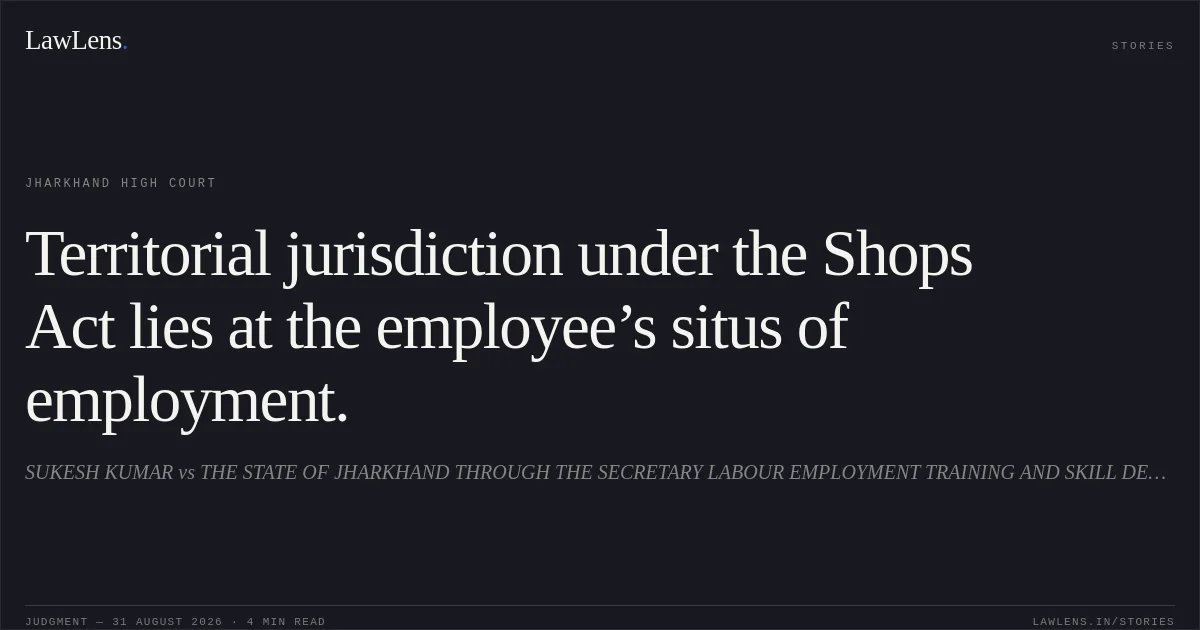
Source reference: paras. 19–23Territorial jurisdiction is determined by Section 20 of the Code of Civil Procedure where the special statute contains no specific provision, and the situs of employment or place where part of the cause of action arose may confer jurisdiction.
Source reference: paras. 24, 28–30A termination founded on misconduct or unauthorised absence ordinarily requires a disciplinary enquiry; where no enquiry is held, the employer may prove the misconduct before the adjudicating court, but failure to lead evidence leaves the termination unsupported.
Source reference: paras. 14–16The doctrine of bona fide loss of confidence may justify denial of reinstatement in appropriate cases, but it must be established on the facts and cannot be invoked merely as an afterthought.
Source reference: para. 35Back wages are discretionary; gainful employment includes self-employment or income from a partnership, and the employee’s entitlement depends on the evidence regarding employment and income.
Source reference: para. 36Reasoning
The employer had not pleaded before the Labour Court that Sukesh was governed by the Sales Promotion Employees Act or that he was excluded from the Shops and Establishments Act.
Source reference: paras. 19–22Since that contention involved factual determination of his actual duties, it could not be raised for the first time in writ jurisdiction.
Source reference: paras. 19–22His duties of procuring orders, billing and collecting payments did not, by themselves, establish that he was a statutory sales promotion employee.
Source reference: para. 21Similarly, the designation “Area Sales Manager” was not conclusive of managerial status.
Source reference: paras. 31–34The employer neither pleaded nor proved that Sukesh exercised managerial or supervisory authority, and the registration record showed that the Ranchi establishment employed four persons.
Source reference: paras. 31–34On territorial jurisdiction, although the establishment was registered at Ranchi, Sukesh had been posted and worked at Jamshedpur, and the show-cause and termination communications were served there.
Source reference: paras. 24–30Applying Section 20(c) CPC and the situs-of-employment principle, the Court held that a part of the cause of action arose at Jamshedpur.
Source reference: paras. 24–30The loss-of-confidence argument was rejected because the termination letter relied on absence and failure to join duty, not loss of confidence, and the employer neither conducted an enquiry nor led evidence to prove the alleged misconduct.
Source reference: para. 35However, full back wages were declined because Sukesh admitted that he was a partner in his brother’s firm and had filed income-tax returns, without disclosing the income derived therefrom.
Source reference: para. 36In these circumstances, the Labour Court’s award of 25% back wages was considered a reasonable exercise of discretion.
Source reference: para. 36Holding
The Court dismissed both writ petitions.
It held that the complaint under Section 26(2) of the Bihar/Jharkhand Shops and Establishments Act was maintainable; the Jamshedpur Labour Court had territorial jurisdiction; and the employee’s designation and unproved managerial or sales-promotion status did not exclude him from the Act.
Source reference: paras. 22–23, 29–34The termination was held illegal because it was imposed for alleged unauthorised absence without a disciplinary enquiry and without the employer proving the charge before the Labour Court.
Source reference: paras. 15–16, 35The direction for reinstatement with continuity of service and 25% back wages, subject to 6% interest for delayed payment, was upheld.
Source reference: paras. 17, 36–38The employee’s claim for 100% back wages was rejected.
Source reference: paras. 36–38Acts & Sections Cited
4 provisions across 2 statutes referred to in this judgment. Each provision opens on LawLens.
Bihar Shops & Establishments Act, 19533
Code of Civil Procedure, 19081
Original Court PDF
SUKESH KUMARvsTHE STATE OF JHARKHAND THROUGH THE SECRETARY LABOUR EMPLOYMENT TRAINING AND SKILL DEVELOPMENT DEPTT
Click to open original judgment
Original judgment, available to read, download and summarize on LawLens.in