Facts
The deceased, Binaben, married respondent-accused No. 1 on 3 November 2010 after eloping with him against her parents’ wishes; respondents Nos. 2 and 3 were her parents-in-law and respondent No. 4 was the father of her mother-in-law
Source reference: p. 5, para. 11On 20 May 2011, approximately six months after the marriage, Binaben died in unnatural circumstances after being found on a railway track.
Source reference: p. 5, para. 11An accidental-death inquiry was initially registered by the Railway Police, followed by the complainant’s registration of C.R. No. I-18/2011 alleging offences under Sections 306, 498A, 323, 504, 506(2) and 114 of the IPC
Source reference: p. 5, para. 11The prosecution alleged that the accused had subjected the deceased to physical and mental cruelty, harassment, torture and dowry-related demands.
Source reference: no citationAfter investigation, a charge-sheet was filed and the matter was tried as Sessions Case No. 135 of 2011.
Source reference: no citationThe trial court acquitted all four accused on 31 August 2012, principally finding material contradictions and omissions in the prosecution evidence
Source reference: pp. 1–2, paras. 1–5; p. 6, para. 12The State preferred the present appeal against acquittal.
Source reference: no citationIssues
1. Whether the trial court was justified in acquitting the respondents of the offences under Sections 323, 504, 506(2), 498A and 306 read with Section 114 of the IPC?
Source reference: p. 5, para. 10(1)2. Whether the trial court properly appreciated the oral and documentary evidence led by the prosecution?
Source reference: p. 5, para. 10(2)3. Whether the judgment of acquittal suffered from illegality, irregularity or perversity warranting appellate interference?
Source reference: p. 5, para. 10(3)Law Applied
The Court considered Sections 323, 504, 506(2), 498A, 306 and 114 of the IPC, requiring the prosecution to prove the alleged acts of hurt, intentional insult, criminal intimidation, cruelty, abetment of suicide and common participation beyond reasonable doubt
Source reference: pp. 1, 5In relation to suicide by a married woman, the Court referred to Section 113A of the Evidence Act, under which the Court may presume abetment where the woman commits suicide within seven years of marriage and was subjected to cruelty; it distinguished Section 113B, which concerns the statutory presumption of dowry death
Source reference: pp. 8–9, para. 13.1Relying on Ramesh Kumar v. State of Chhattisgarh and Ram Pyarey v. State of Uttar Pradesh, the Court held that abetment of suicide requires reliable evidence of cruelty and instigation or conduct sufficiently connected with the suicide
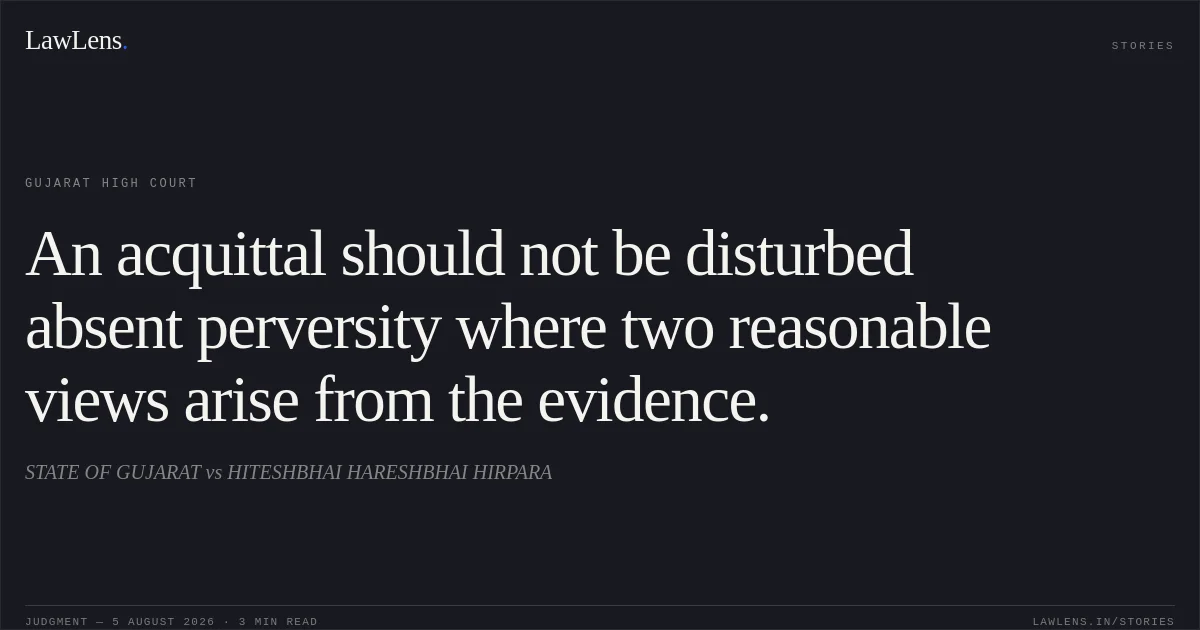
Source reference: p. 8, para. 13; pp. 8–9, paras. 13.1–13.2In an appeal against acquittal, the appellate court may reappreciate the evidence, but the accused carry a reinforced double presumption of innocence; where two reasonable views are possible, the acquittal should not be disturbed unless the trial court’s view is manifestly illegal or perverse, as explained in Chandrappa v. State of Karnataka, Rajesh Prasad v. State of Bihar, Babu Sahebagouda Rudragoudar v. State of Karnataka and Ramesh v. State of Karnataka
Source reference: pp. 9–12, paras. 14–17Reasoning
The High Court found that the prosecution case substantially depended on PW-4, whose deposition contained material omissions and contradictions, with several allegations against the accused being introduced for the first time during trial and duly proved through the Investigating Officer
Source reference: p. 6, para. 12The deceased’s mother, who allegedly received information from Binaben by telephone, was not examined, and PW-4 lacked direct personal knowledge of the alleged ill-treatment
Source reference: p. 6, para. 12PW-5, the complainant’s brother, did not provide incriminating evidence and instead indicated that the complainant’s family had opposed the deceased’s marriage and had not attended the reception organised after it
Source reference: p. 7, para. 12The evidence of PW-9, PW-10 and PW-11 also disclosed contradictions concerning the circumstances of the death
Source reference: p. 7, para. 12In the absence of credible proof of cruelty, dowry harassment, instigation or intentional conduct amounting to abetment, the statutory presumption under Section 113A could not be appropriately invoked.
Source reference: no citationApplying the restricted standard governing appeals against acquittal, the Court held that the trial court’s assessment was a reasonable view of the evidence and was neither perverse nor manifestly erroneous
Source reference: pp. 8–12, paras. 13.2–19Holding
The High Court answered all issues against the State.
It held that the prosecution had failed to establish the alleged offences beyond reasonable doubt and that the trial court had correctly appreciated the evidence and acquitted the respondents
Source reference: pp. 12–13, paras. 18–19The State’s appeal was dismissed, the judgment and order of acquittal dated 31 August 2012 were confirmed, the accused’s bail bonds were cancelled, and the record and proceedings were directed to be returned to the trial court
Source reference: p. 13, para. 20Acts & Sections Cited
7 provisions across 2 statutes referred to in this judgment. Each provision opens on LawLens.
Code of Criminal Procedure, 19732
Indian Penal Code, 18605
Original Court PDF
STATE OF GUJARATvsHITESHBHAI HARESHBHAI HIRPARA
Click to open original judgment
Original judgment, available to read, download and summarize on LawLens.in