Facts
The State appealed the acquittal of the respondent, who had been charged under Sections 498A, 306 and 201 of the Indian Penal Code (IPC) in connection with his wife’s death
Source reference: para. 1–2The prosecution alleged that the respondent had subjected her to cruelty, causing her to consume poison, and had her body cremated without a post-mortem examination
Source reference: para. 2The trial court acquitted him after trial; the State challenged that decision
Source reference: para. 3–7Issues
Whether the trial court was justified in acquitting the respondent
Source reference: para. 10Whether the trial court properly appreciated the prosecution evidence, and whether its decision disclosed any illegality, irregularity or perversity warranting appellate interference
Source reference: para. 10Law Applied
Sections 498A, 306 and 201 IPC were the offences charged; Section 107 IPC was relevant to whether the respondent had abetted the alleged suicide
Source reference: para. 1, 14–15The prosecution had to prove the essential ingredients of the charged offences beyond reasonable doubt
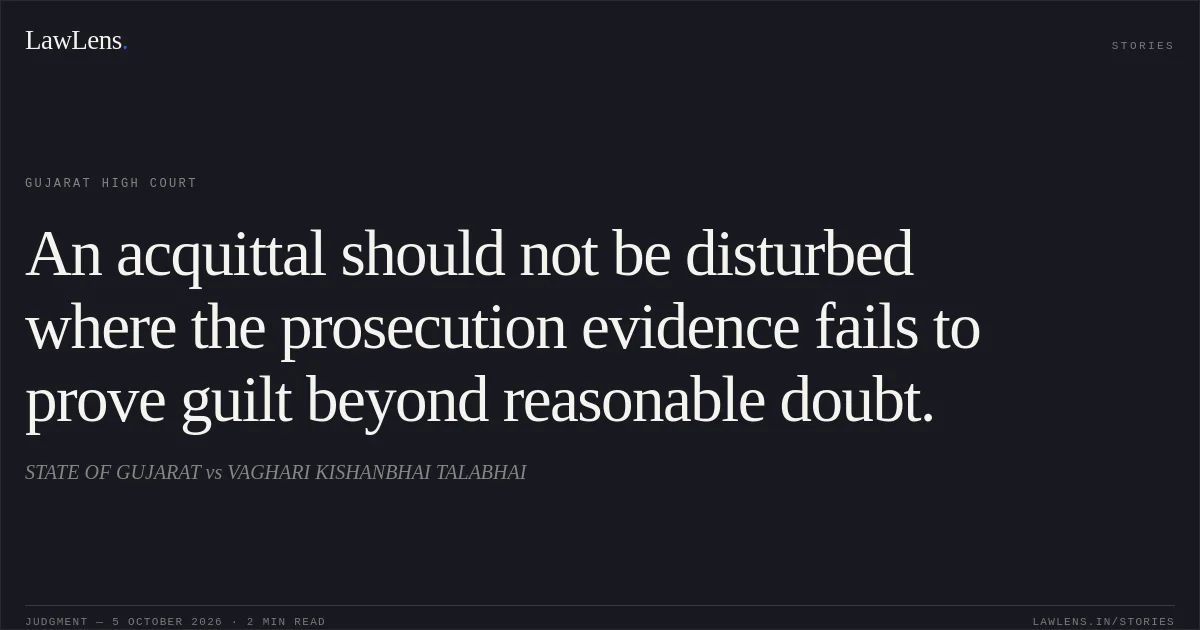
Source reference: para. 14On an appeal against acquittal, the appellate court may review and reappreciate the evidence, but must account for the reinforced presumption of innocence; where two reasonable conclusions are available, it should not disturb the acquittal
Source reference: para. 16–17The court relied on Chandrappa v. State of Karnataka, (2007) 4 SCC 415; Rajesh Prasad v. State of Bihar, (2022) 3 SCC 471; Babu Sahebagouda Rudragoudar v. State of Karnataka, (2024) 8 SCC 149; and Ramesh v. State of Karnataka, (2024) 9 SCC 169, as to appellate review of acquittals
Source reference: para. 18–19Reasoning
The deceased’s statement recorded in hospital attributed her act to an altercation with her husband over money for tea, but contained no allegation of prior cruelty or harassment
Source reference: para. 12Her father and brother likewise gave no evidence of cruelty during the marriage
Source reference: para. 13The doctor observed no symptoms suggestive of poisoning, and no post-mortem examination was conducted; accordingly, the cause and nature of death were not established
Source reference: para. 13–14The court held that the evidence did not prove the essential elements of cruelty, abetment or the other charges beyond reasonable doubt, and found no error or perversity in the trial court’s assessment that could justify reversing the acquittal
Source reference: para. 14–15, 20–21Holding
The High Court answered the issues in favour of the respondent, holding that the trial court had committed no error of fact or law and that the acquittal did not warrant appellate interference
The State’s appeal was dismissed, the acquittal was confirmed, and the respondent’s bail bond was cancelled; the record and proceedings were ordered to be returned to the trial court
Source reference: para. 22Acts & Sections Cited
6 provisions across 2 statutes referred to in this judgment. Each provision opens on LawLens.
Code of Criminal Procedure, 19733
Indian Penal Code, 18603
Original Court PDF
STATE OF GUJARATvsVAGHARI KISHANBHAI TALABHAI
Click to open original judgment
Original judgment, available to read, download and summarize on LawLens.in