Facts
The prosecution alleged that the accused obstructed a village waterman, Krishnamurthy, while he was regulating water supply, abused and assaulted him, causing injuries including the loss of three teeth, and threatened him.
Source reference: para. 2–6The accused was charged under Sections 323, 324, 325, 333, 353, 504 and 506 of the IPC.
Source reference: para. 2The trial court acquitted him; the State appealed under Section 378(1) and (3) CrPC.
Source reference: para. 2–6The High Court noted discrepancies concerning the date of the alleged incident: the prosecution narrative referred to 22 December 2013, while the court’s later discussion described it as 21 December 2013.
Source reference: para. 3, 19Issues
1. Whether the State had established grounds for appellate interference with the trial court’s judgment of acquittal
Source reference: para. 9Law Applied
The appeal was brought under Section 378(1) and (3) CrPC, which provides for an appeal against acquittal subject to the statutory leave requirement.
Source reference: p. 1–2; para. 3The charged offences were under Sections 323, 324, 325, 333, 353, 504 and 506 IPC.
Source reference: para. 2In considering the scope of review of an acquittal, the Court noted the authorities cited by the amicus curiae: Constable 907 Surendra Singh v. State of Uttarakhand, (2025) 5 SCC 433; Babu Sahebgouda Rudragouda v. State of Karnataka, (2024) 8 SCC 149; Chandrappa v. State of Karnataka, (2007) 4 SCC 415; and H.D. Sundara v. State of Karnataka, (2023) 9 SCC 581.
Source reference: para. 8The Court applied the principle that an acquittal should not be disturbed where, on reconsideration of the record, no legal or factual error warrants appellate intervention.
Source reference: para. 8, 19Reasoning
The Court found that the complainant’s account was not corroborated by the alleged eyewitnesses, who did not support the prosecution.
Source reference: para. 13, 16, 19It also noted that the complainant did not seek treatment on the day of the alleged assault, the wound certificate did not state the age of the injuries, and the prosecution produced no material supporting his account of inpatient treatment.
Source reference: para. 13, 16, 19The complainant acknowledged that another person wrote the complaint, but the prosecution did not identify that person.
Source reference: para. 13, 16, 19Further, the investigating officer collected no material showing that the complainant was assaulted while performing his duties.
Source reference: para. 13, 16, 19In light of these evidentiary gaps, the Court found the prosecution evidence insufficiently cogent and trustworthy and saw no legal or factual error in the acquittal.
Source reference: para. 13, 16, 19Holding
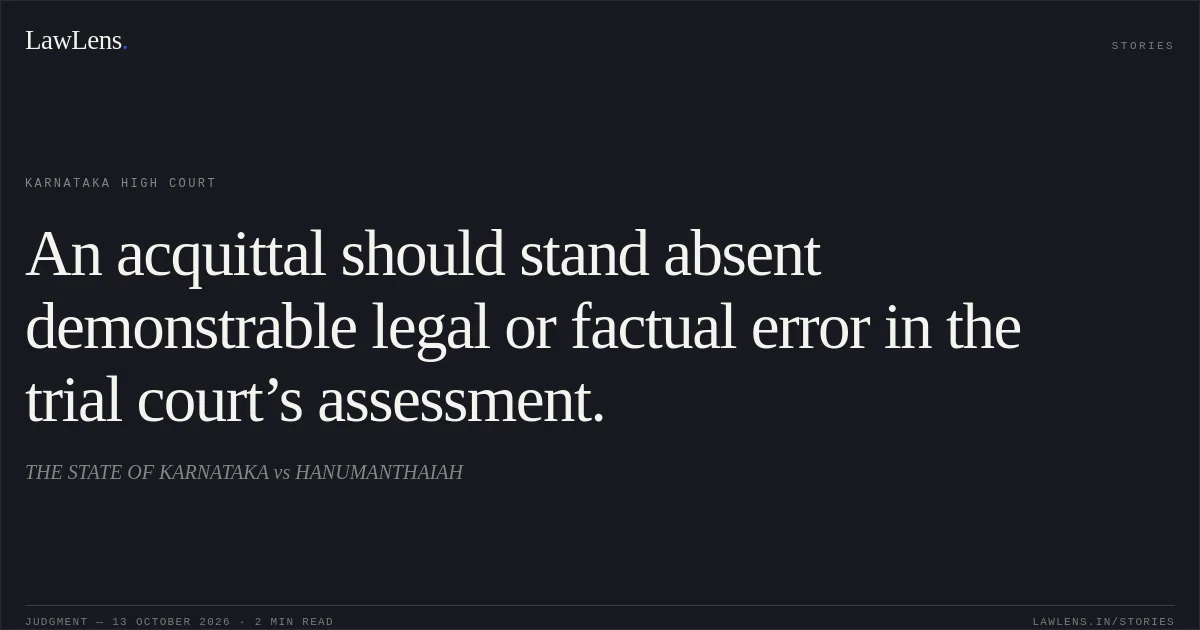
The Court answered the question of interference in the negative and dismissed the State’s appeal, leaving the acquittal undisturbed.
It directed the Registry to pay the amicus curiae Rs. 10,000 and placed his assistance on record.
Source reference: final orderActs & Sections Cited
9 provisions across 2 statutes referred to in this judgment. Each provision opens on LawLens.
Code of Criminal Procedure, 19732
Indian Penal Code, 18607
Original Court PDF
THE STATE OF KARNATAKAvsHANUMANTHAIAH
Click to open original judgment
Original judgment, available to read, download and summarize on LawLens.in
![Railway pensioners qualify for additional pension only upon completing 80 years of age.. OM PRAKASH MISHRA vs NORTH EASTERN RAILWAY. CAT - ['Allahabad']. LawLens](/stories/thumbnails/railway-pensioners-qualify-for-additional-pension-only-upon-completing-80-years-of-age-e4a0c68f01cd4886b5cdc93e3a4b5e33.webp)