Facts
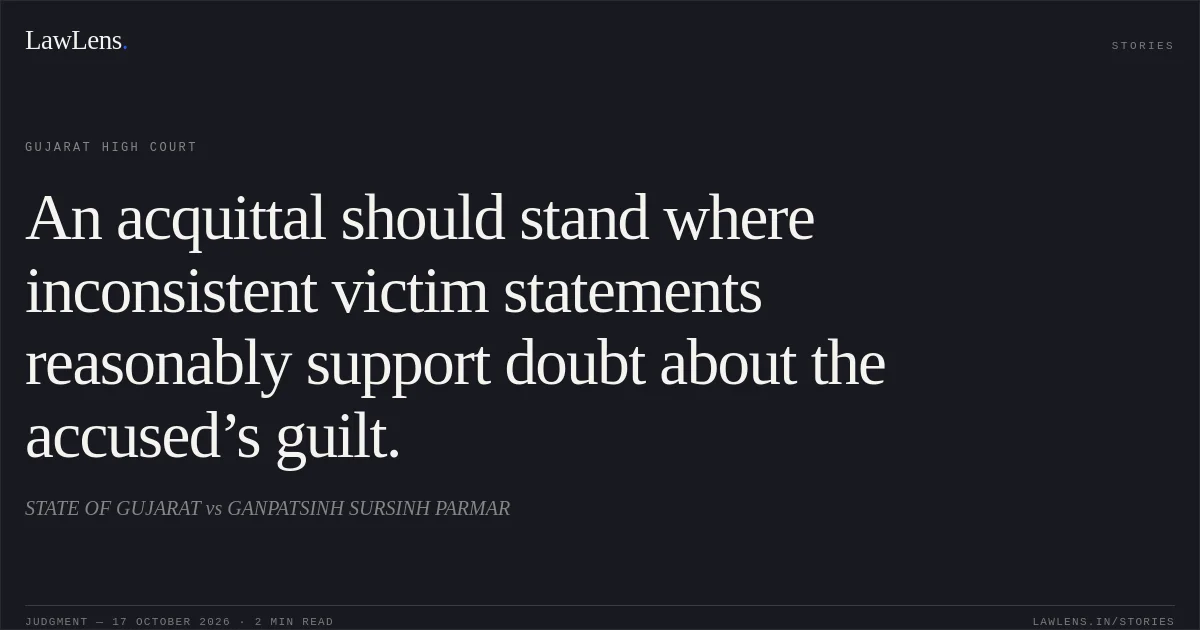
The respondent was tried under Sections 307 and 498A of the Indian Penal Code (IPC) and acquitted by the Additional Sessions Judge, Kheda at Nadiad.
Source reference: p.1The State appealed under Section 378 of the Code of Criminal Procedure, 1973 (CrPC).
Source reference: p.1The complainant, the respondent’s wife, gave several accounts of how she was burned: early accounts attributed the burns to cooking or an accidental fire, while later statements to an Executive Magistrate and police alleged that her husband poured kerosene on her and set her alight.
Source reference: pp.2–3The State argued that the Magistrate-recorded statement and other testimony supported conviction.
Source reference: p.2Issues
1. Whether the trial court’s acquittal, based on inconsistencies in the complainant’s accounts of the cause of her burns, should be overturned on appeal.
Source reference: pp.2–3, 62. Whether the evidence, including the complainant’s statement before the Executive Magistrate, established the respondent’s guilt beyond reasonable doubt.
Source reference: pp.2, 6Law Applied
Section 378 CrPC permits an appellate court to review and reappreciate evidence in an appeal against acquittal.
Source reference: pp.4–5Under Chandrappa v. State of Karnataka, (2007) 4 SCC 415, an acquittal reinforces the presumption of innocence; where two reasonable views are possible, the appellate court should not disturb the acquittal.
Source reference: pp.4–5H.D. Sundara v. State of Karnataka, (2023) 9 SCC 581, likewise holds that an acquittal may be reversed only where the evidence permits no conclusion other than guilt beyond reasonable doubt.
Source reference: p.5The respondent had been charged under IPC Sections 307 and 498A.
Source reference: p.1Reasoning
The Court found that the complainant’s accounts materially differed: the earlier versions described burns sustained while cooking or from an accidental fire, whereas later statements alleged that the respondent had deliberately burned her.
Source reference: pp.3, 6It concluded that the inconsistencies prevented the prosecution evidence from inspiring confidence and did not establish the respondent’s criminal act beyond reasonable doubt.
Source reference: p.6Applying the principles governing appeals against acquittal, the Court found no basis to displace the trial court’s assessment.
Source reference: pp.4–6The judgment also stated that, because the complainant survived, the statement before the Executive Magistrate would lose its value and her testimony before the court would prevail.
Source reference: p.6Holding
The Court answered the issues against the State, finding no reason to disturb the acquittal in light of the inconsistent accounts and the applicable restraint on appellate interference.
It dismissed the criminal appeal and directed that the record and proceedings be returned to the trial court.
Source reference: p.6Acts & Sections Cited
2 provisions across 2 statutes referred to in this judgment. Each provision opens on LawLens.
Code of Criminal Procedure, 19731
Indian Penal Code, 18601
Original Court PDF
STATE OF GUJARATvsGANPATSINH SURSINH PARMAR
Click to open original judgment
Original judgment, available to read, download and summarize on LawLens.in