Facts
Respondent No. 3 and the appellant were initially appointed temporarily as Staff Nurses and were regularised with effect from 3 September 1994.
Source reference: p. 2–4A provisional gradation list issued in 1999 placed the appellant above Respondent No. 3; Respondent No. 3 objected, but the objection was rejected and the final list was published on 30 December 1999.
Source reference: p. 2–4In 2006, the Staff Selection Committee recommended the appellant for promotion to Nursing Sister on grounds of eligibility and suitability.
Source reference: p. 2–4Respondent No. 3 later challenged both the gradation list and the promotion in a writ petition.
Source reference: p. 2–4The Single Judge allowed the petition and directed that Respondent No. 3 be placed above the appellant and granted notional promotion from 13 December 2006.
Source reference: p. 2–4The appellant appealed.
Source reference: p. 2–4The Single Judge had noted that the gradation list and promotion were challenged approximately eleven and four years, respectively, after their publication or grant.
Source reference: p. 4–5Issues
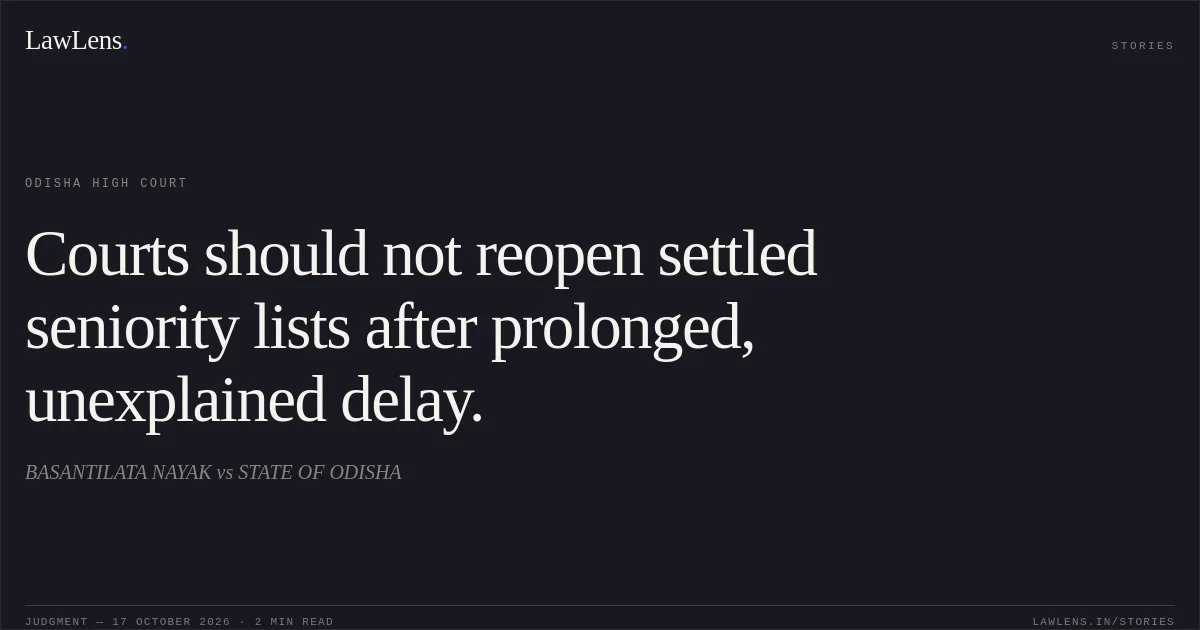
Whether the writ petition challenging the 1999 final gradation list and the appellant’s 2006 promotion should have been entertained despite the delay and laches.
Source reference: p. 6Whether the promotion made on the Staff Selection Committee’s recommendation, in accordance with the institution’s bylaws, warranted interference.
Source reference: p. 7–8, 15Law Applied
In exercising its discretionary jurisdiction under Article 226 of the Constitution, a court may refuse relief where a claimant delays unreasonably in challenging seniority arrangements or promotions, particularly where the delay would unsettle an established position.
Source reference: p. 9–13P.S. Sadasivaswamy v. State of Tamil Nadu, (1975) 1 SCC 152, states that a person aggrieved by a junior’s promotion should ordinarily approach the court promptly; K.R. Mudgal v. R.P. Singh, (1986) 4 SCC 531, and B.S. Bajwa v. State of Punjab, (1998) 2 SCC 523, caution against reopening settled seniority after a prolonged period.
Source reference: p. 9–13As discussed in Ajay Kumar Shukla v. Arvind Rai, (2022) 12 SCC 579, drawing on Shiba Shankar Mohapatra v. State of Odisha, a seniority list unchallenged for three to four years should generally not be disturbed absent a satisfactory explanation for delay.
Source reference: p. 9–13The institution’s bylaw clause 22.8 authorised promotion to Class-III and Class-IV posts from eligible employees on the Staff Selection Committee’s recommendation, with the criteria determined in light of prevailing State rules.
Source reference: p. 7–8Reasoning
Respondent No. 3 knew of the appellant’s placement when she objected to the provisional gradation list, but did not challenge the final list for more than a decade; the promotion was also challenged about four years after it was made.
Source reference: p. 13–14The appellate court held that this delay was not a sufficient basis to reopen the settled seniority position and disturb the promotion.
Source reference: p. 13–14It also found that the Committee’s recommendation based on eligibility and suitability fell within the promotion process authorised by clause 22.8 of the bylaws, and that the administrative decision did not warrant interference after the lapse of time.
Source reference: p. 7–8, 15Holding
The High Court held that the writ petition should have been dismissed for delay and laches.
It set aside the Single Judge’s order, dismissed Respondent No. 3’s writ petition, and allowed the writ appeal, with no order as to costs.
Source reference: p. 15Original Court PDF
BASANTILATA NAYAKvsSTATE OF ODISHA
Click to open original judgment
Original judgment, available to read, download and summarize on LawLens.in