Facts
The petitioner faced charges under Section 363 of the Indian Penal Code, Sections 64(2)(I), 64(2)(M) and 87 of the Bharatiya Nyaya Sanhita, 2023, and Sections 4 and 6 of the POCSO Act, arising from the alleged abduction and sexual assault of a victim aged 16 years and one month.
Source reference: p.3During the victim’s evidence, she supported the prosecution in examination-in-chief but resiled during cross-examination.
Source reference: pp.3–7The Special POCSO Court cancelled the petitioner’s bail, finding that he had breached bail conditions by contacting or influencing the victim; it relied on CCTV footage and the circumstances surrounding an alleged settlement.
Source reference: pp.3–7The petitioner challenged the cancellation order under Section 528 of the Bharatiya Nagarik Suraksha Sanhita, 2023, contending that he was not present during the relevant conversation and had not been given an opportunity to respond.
Source reference: pp.2, 4–5Issues
1. Whether the Special POCSO Court could cancel the petitioner’s bail without affording him an opportunity to be heard and without following the requisite procedure.
Source reference: pp.7–92. Whether the circumstances recorded by the Special POCSO Court established sufficient grounds to cancel bail for breach of its conditions.
Source reference: pp.7–9Law Applied
The petitioner invoked Section 528 of the Bharatiya Nagarik Suraksha Sanhita, 2023, seeking the High Court’s inherent jurisdiction to quash the impugned order.
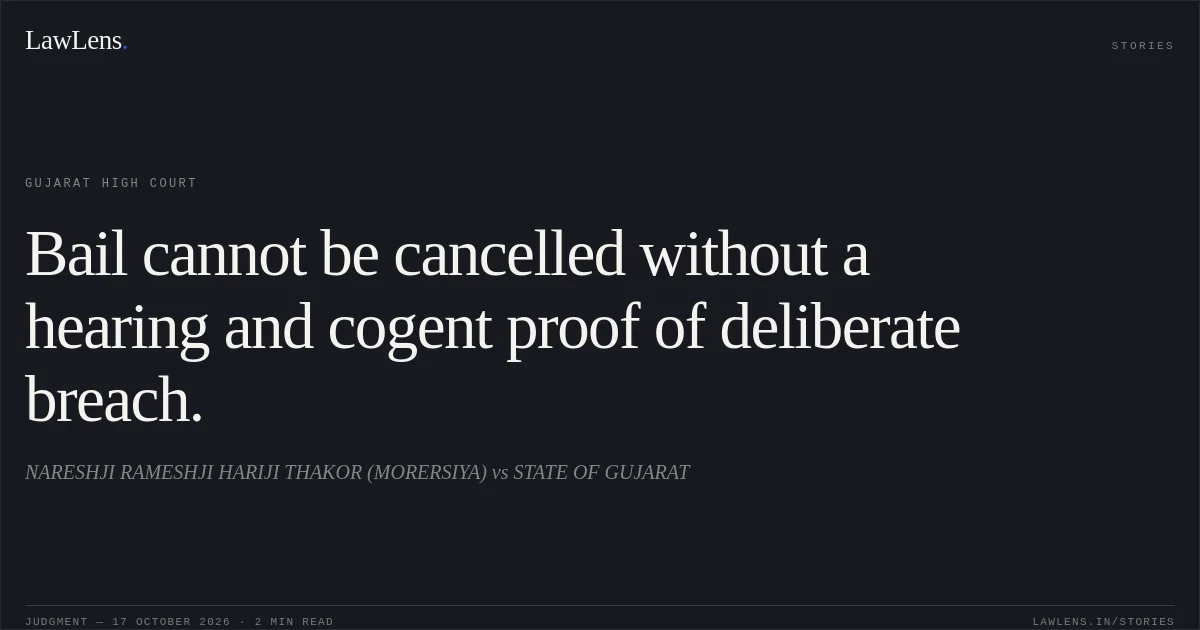
Source reference: p.2The Court applied the principles that cancellation of bail is a serious measure affecting personal liberty; it must be exercised with care and on cogent and sufficient grounds, not mechanically or merely on conjecture. The accused must be afforded an adequate opportunity to answer allegations of breach, consistently with natural justice and due process.
Source reference: pp.7–9Reasoning
The cancellation order rested on the trial judge’s observations that the victim and the advocates were conversing about a settlement, the victim later confirmed that a settlement had been reached, and CCTV footage supported the court’s conclusion.
Source reference: pp.7–9However, the petitioner was not shown to have been present during the conversation, and neither the victim nor the complainant alleged that he had breached his bail conditions or attempted to influence or contact the victim.
Source reference: pp.7–9No application alleging such a breach had been filed by the State or the prosecutrix. The High Court therefore found that the inference of breach, without a hearing or adequate procedure, did not provide a sufficient basis for cancelling bail.
Source reference: pp.7–9It also observed that the trial judge’s personal intervention in directing the victim to attend the courtroom ought to have been avoided, while emphasizing judicial detachment and procedural care.
Source reference: p.9Holding
The High Court held that the bail cancellation could not stand because the petitioner was not heard and the record did not establish a sufficient basis for cancellation.
It quashed and set aside the impugned order and directed the petitioner’s release on bail, unless his custody was required in another case or for another lawful purpose.
Source reference: p.10The Court further directed that the trial court exercise due care and follow the prescribed procedure when considering bail cancellation, and made the Rule absolute.
Source reference: p.11Acts & Sections Cited
6 provisions across 4 statutes referred to in this judgment. Each provision opens on LawLens.
Bharatiya Nagarik Suraksha Sanhita, 20231
Indian Penal Code, 18601
Bharatiya Nyaya Sanhita, 20232
Original Court PDF
NARESHJI RAMESHJI HARIJI THAKOR (MORERSIYA)vsSTATE OF GUJARAT
Click to open original judgment
Original judgment, available to read, download and summarize on LawLens.in