Facts
The Decree Holder sought enforcement under Section 36 of the Arbitration and Conciliation Act, 1996 of an arbitral award dated 13 April 2023, as corrected on 15 April 2023.
Source reference: pp. 1–3The award was signed at Ahmedabad, Gujarat, and stamped under the Gujarat Stamp Act, 1958.
Source reference: pp. 1–3The Judgment Debtor objected that the award attracted differential stamp duty under the Indian Stamp Act, 1899, as applicable in Delhi, and that payment of the differential amount was late.
Source reference: pp. 1–3The Decree Holder had deposited an amount calculated at Delhi rates, although it disputed any obligation to do so.
Source reference: p. 22The award’s interest component had been set aside in Section 34 proceedings, and an appeal under Section 37 was pending; the remaining amount payable was Rs. 3,78,22,968.
Source reference: pp. 23–24Issues
1. Whether an arbitral award executed and stamped in Gujarat attracts additional or differential stamp duty merely because enforcement is sought in Delhi.
Source reference: pp. 9–11, 18–222. Whether the alleged late payment of differential stamp duty rendered the award insufficiently stamped or prevented its enforcement.
Source reference: pp. 2, 6–93. Whether the Decree Holder could withdraw the amount remaining payable under the award while the Section 37 appeal was pending.
Source reference: pp. 23–24Law Applied
Under Sections 2(12) and 17 of the Indian Stamp Act, 1899, “execution” of an instrument means signing it, and an instrument executed in India must be stamped before or at the time of execution.
Source reference: pp. 4–5, 10Sections 33, 35 and 38 require a court to address an insufficiently stamped instrument in accordance with the Act when the issue arises at enforcement; the sufficiency of stamping is relevant at that stage, but enforcement is not itself a chargeable event.
Source reference: pp. 6–10Under New Central Jute Mills Co. Ltd. v. State of W.B., a second State may impose differential duty where its applicable legislation creates a further charge upon receipt of an instrument with the required territorial or transactional nexus.
Source reference: pp. 11–18Genus Power and Infrastructures Ltd. v. Supreme Advertising Pvt. Ltd. clarified that statutory “execution” is not synonymous with enforcement, while M/s URC Construction (P) Ltd. v. Airports Authority of India addressed the enforcement-stage duty to examine stamping and the statutory procedure for insufficiently stamped instruments.
Source reference: pp. 3–9The award was assessed under Article 13 of Schedule I to the Gujarat Stamp Act, 1958.
Source reference: p. 22Reasoning
The Court distinguished the event that makes an instrument chargeable—here, signing the award in Gujarat—from the later stage at which a court may examine whether it is sufficiently stamped. Although stamp sufficiency may be considered during enforcement, that does not create a fresh liability when enforcement is brought in another State.
Source reference: pp. 9–11New Central Jute Mills did not support the Judgment Debtor absent a Delhi statutory provision imposing additional duty upon receipt or enforcement of an out-of-State instrument. No such provision under the Indian Stamp Act as applicable in Delhi was identified; the Court therefore declined to imply a fiscal liability.
Source reference: pp. 11–22Since no differential duty was legally payable, the objection based on the alleged delay in paying it did not defeat enforcement. The Court found the award sufficiently stamped under Gujarat law.
Source reference: p. 22As to disbursement, it made withdrawal conditional on an undertaking and indemnity bond because the Section 37 appeal remained pending.
Source reference: pp. 23–24Holding
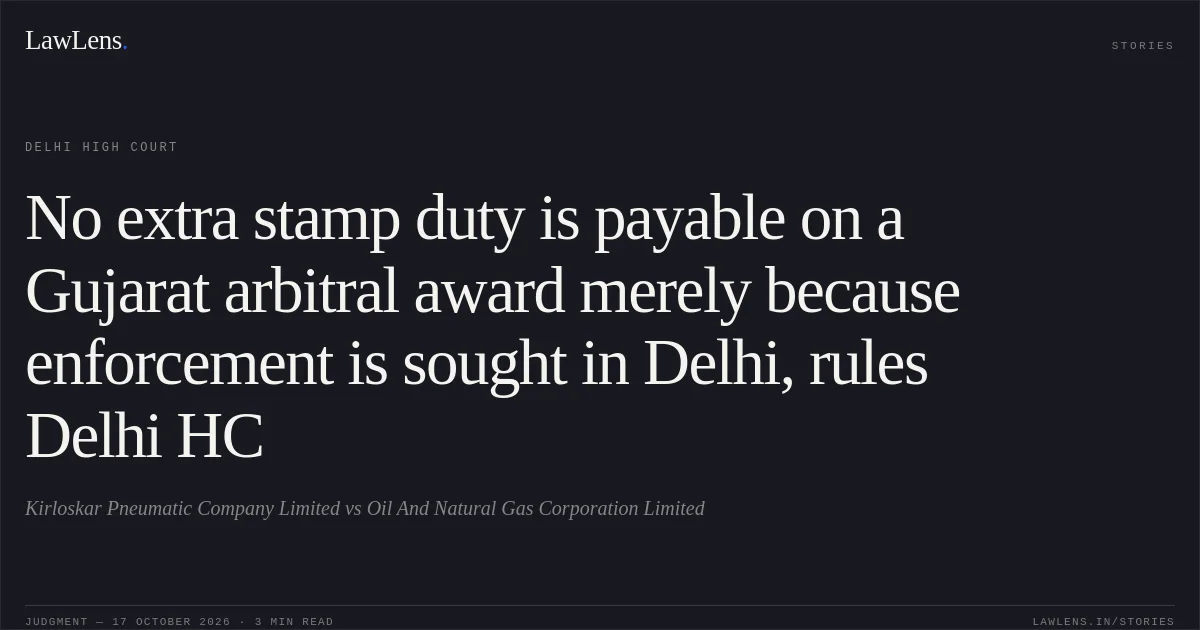
The Court held that enforcement in Delhi did not create an additional liability to pay differential stamp duty and rejected the Judgment Debtor’s insufficiency-of-stamp-duty objection.
It disposed of the enforcement petition, permitting the Decree Holder to withdraw Rs. 3,78,22,968 upon furnishing the required undertaking and indemnity bond to the satisfaction of the Registrar General; the parties retained liberty to seek revival after the Section 37 appeal was decided.
Source reference: pp. 23–24The Judgment Debtor’s application for refund of the excess amount deposited was allowed, with the Registry directed to refund it in accordance with applicable rules and procedure.
Source reference: p. 24Acts & Sections Cited
21 provisions across 5 statutes referred to in this judgment. Each provision opens on LawLens.
Arbitration and Conciliation Act, 19967
Indian Stamp Act, 1899
Bombay Stamp Act, 19581
Maharashtra Stamp Act2
KARNATAKA STAMP ACT, 19571
Original Court PDF
Kirloskar Pneumatic Company LimitedvsOil And Natural Gas Corporation Limited
Click to open original judgment
Original judgment, available to read, download and summarize on LawLens.in