Facts
The State appealed under Section 378(1)(3) of the Code of Criminal Procedure, 1973, against the trial court’s acquittal of the accused of offences under Sections 333, 332, 506(2), 294(b), 323 and 114 of the Indian Penal Code.
Source reference: para. 1The prosecution alleged that, while on police duty during Navratri, the complainant intervened when the accused were teasing women at a garba ground and was then assaulted and threatened.
Source reference: paras. 2, 10The High Court noted that accused no. 1 had sustained a bleeding injury that the prosecution witnesses did not explain; the medical evidence and police witnesses also disclosed inconsistencies, and the prosecution produced no records establishing that the complainant and other police personnel were on duty.
Source reference: paras. 11–13Respondent no. 4 died during the appeal, which abated as against him.
Source reference: para. 1Issues
1. Whether the prosecution proved beyond reasonable doubt that the respondents committed the charged offences.
Source reference: paras. 19–202. Whether the trial court’s acquittal disclosed an error of fact or law warranting interference in the State’s appeal.
Source reference: paras. 14–20Law Applied
Sections 333, 332, 506(2), 294(b), 323 and 114 of the Indian Penal Code defined the offences charged.
Source reference: para. 1Section 378(1)(3) of the Code of Criminal Procedure, 1973, provided the basis for the State’s appeal against acquittal.
Source reference: para. 1Under Chandrappa v. State of Karnataka, as reaffirmed in Rajesh Prasad v. State of Bihar, Babu Sahebagouda Rudragoudar v. State of Karnataka and Ramesh v. State of Karnataka, an appellate court may review and reappreciate the evidence in an acquittal appeal, but must account for the double presumption of innocence; where two reasonable conclusions are possible, it should not disturb the acquittal.
Source reference: paras. 15–18Reasoning
The High Court considered the unexplained injury to accused no. 1 significant because the complainant and other police witnesses did not account for it, supporting the trial court’s concern that the prosecution had suppressed the genesis of the incident.
Source reference: paras. 11–14The medical evidence did not consistently support the complainant’s account, and the prosecution’s witnesses differed on material matters.
Source reference: paras. 11–12The absence of records corroborating the police personnel’s claimed duty further weakened the prosecution case.
Source reference: para. 13On that evidence, the Court found no credible basis to prove the charges beyond reasonable doubt and no ground to displace the acquittal under the applicable appellate principles.
Source reference: paras. 19–20Holding
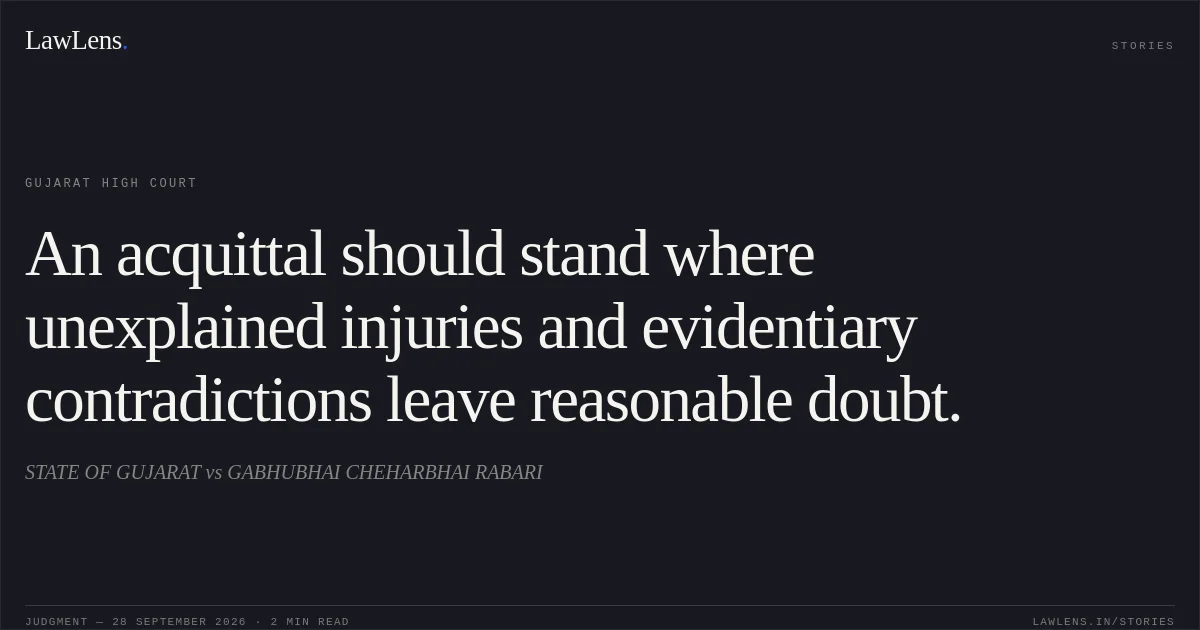
The Court held that the prosecution had failed to prove the charges beyond reasonable doubt and that the trial court committed no error of fact or law in acquitting the accused.
The State’s appeal was dismissed and the acquittal confirmed; the appeal had abated as against respondent no. 4, who died during its pendency.
Source reference: paras. 1, 21The bail bond was cancelled, and the record and proceedings were ordered returned to the trial court.
Source reference: para. 21Acts & Sections Cited
8 provisions across 2 statutes referred to in this judgment. Each provision opens on LawLens.
Code of Criminal Procedure, 19732
Indian Penal Code, 18606
Original Court PDF
STATE OF GUJARATvsGABHUBHAI CHEHARBHAI RABARI
Click to open original judgment
Original judgment, available to read, download and summarize on LawLens.in