Facts
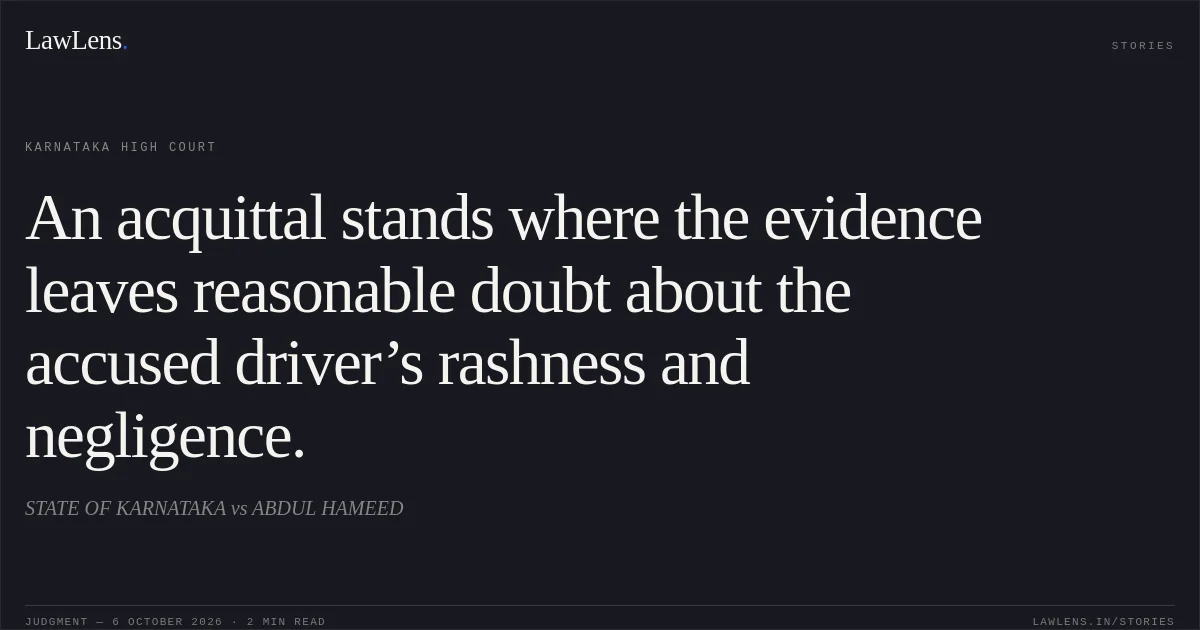
The State appealed the JMFC, Karkala’s judgment acquitting Abdul Hameed of offences under Sections 279, 338 and 304A of the Indian Penal Code.
Source reference: para. 1The prosecution alleged that, on 16 July 2013, the respondent drove an Eicher lorry rashly and negligently, colliding with an oncoming motorcycle; the rider died and the pillion rider, PW1, was injured.
Source reference: para. 1PW1 was the sole eyewitness.
Source reference: para. 1The trial court found that the accident occurred in the middle of the road and that the evidence left open the possibility that the deceased had negligently attempted to overtake another vehicle.
Source reference: paras. 2–3, 6–8It therefore acquitted the respondent on reasonable doubt.
Source reference: paras. 2–3, 6–8Issues
1. Whether the trial court’s acquittal was vitiated by legal or factual error warranting appellate interference.
Source reference: paras. 4–5, 92. Whether the prosecution proved beyond reasonable doubt that the respondent’s rash or negligent driving caused the accident and resulting death and injuries.
Source reference: paras. 6–9Law Applied
The prosecution charged the respondent under Sections 279, 338 and 304A IPC, concerning rash or negligent driving on a public way, causing grievous hurt by such conduct, and causing death by a rash or negligent act, respectively.
Source reference: no citationThe judgment applied the criminal standard of proof beyond reasonable doubt and the principle that, where the evidence leaves a reasonable doubt, the accused receives its benefit.
Source reference: no citationIt identified no precedent or separate statutory test governing appellate review of an acquittal.
Source reference: no citationReasoning
The High Court considered PW1’s account alongside the cross-examination and the sketch, Ex. P11.
Source reference: para. 7PW1 could not state the distance between the vehicles and acknowledged that the deceased had struck the front of the lorry; the sketch placed the accident in the middle of the road.
Source reference: paras. 7–9The defence that the deceased had attempted an unsafe overtake therefore remained a possible explanation, and the evidence did not establish the respondent’s rash or negligent driving beyond reasonable doubt.
Source reference: paras. 7–9On reviewing the record, the High Court found no legal or factual error in the trial court’s assessment.
Source reference: paras. 7–9Holding
The High Court answered the appeal against the State: it found no basis to disturb the acquittal and dismissed the appeal.
The respondent’s acquittal of the offences under Sections 279, 338 and 304A IPC accordingly stood.
Source reference: paras. 1, 9Acts & Sections Cited
4 provisions across 2 statutes referred to in this judgment. Each provision opens on LawLens.
Code of Criminal Procedure, 19732
Indian Penal Code, 18602
Original Court PDF
STATE OF KARNATAKAvsABDUL HAMEED
Click to open original judgment
Original judgment, available to read, download and summarize on LawLens.in