Facts
The petitioner alleged that she married respondent No. 1, Vinod Kumar Kushwaha, in 2010 according to Hindu rites and customs.
Source reference: para. 2She claimed that, despite dowry being given at the time of marriage, the respondents subjected her to cruelty and harassment for an additional demand of ₹50,000, a television, cooler and motorcycle, and further alleged that she was assaulted and driven out of the matrimonial home.
Source reference: para. 2After approaching the police and the Parivar Paramarsh Kendra without effective result, she instituted a complaint under Section 200 Cr.P.C.
Source reference: para. 2Statements were recorded under Section 202 Cr.P.C., following which charges under Section 498-A IPC and Sections 3 and 4 of the Dowry Prohibition Act were framed on 28.11.2014.
Source reference: para. 2The matter was thereafter fixed for the complainant’s evidence.
Source reference: para. 2The complainant asserted that she could not adduce evidence because of illness and treatment for stomach-related ailments between 01.08.2016 and 30.01.2017.
Source reference: para. 2The trial Court recorded that repeated opportunities had been granted from 05.08.2016, but the complainant failed to produce evidence, resulting in closure of her opportunity on 18.01.2017.
Source reference: para. 2As no evidence was led in support of the allegations, the Judicial Magistrate First Class, Deosar, acquitted the respondents by judgment dated 20.07.2017 in Criminal Case No. 1922/2014.
Source reference: paras. 1–2The petitioner challenged the acquittal under Section 378(4) Cr.P.C.
Source reference: para. 1Issues
Whether the trial Court acted illegally or perversely in closing the complainant’s evidence after granting repeated opportunities and thereafter acquitting the respondents for want of evidence?
Source reference: paras. 2–6Whether the medical documents relied upon by the petitioner warranted interference with the acquittal or required that a further opportunity to lead evidence be granted?
Source reference: paras. 3–6Whether the acquittal judgment suffered from perversity, manifest illegality or miscarriage of justice so as to justify appellate interference under Section 378(4) Cr.P.C.?
Source reference: para. 7Law Applied
The Court applied Section 378(4) Cr.P.C., governing an appeal against acquittal by a complainant, and Sections 498-A IPC and 3 and 4 of the Dowry Prohibition Act, which constituted the offences charged in the trial.
Source reference: para. 1It reiterated that the framing of charges establishes only a prima facie case and does not dispense with the complainant’s obligation to prove the allegations through admissible evidence at trial.
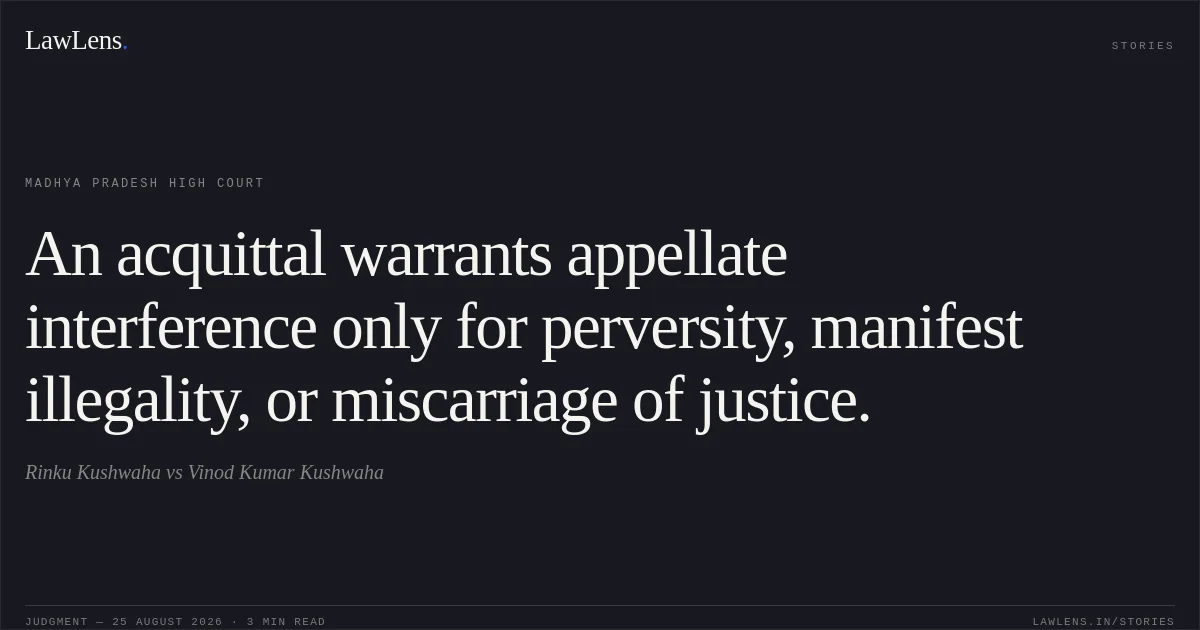
Source reference: para. 5The Court further applied the settled appellate principle that an acquittal should not be interfered with merely because another view is possible; interference is warranted only where the findings are perverse, manifestly illegal, or result in miscarriage of justice, particularly because an acquittal strengthens the presumption of innocence.
Source reference: para. 7Reasoning
The Court found that the trial Court had granted the complainant repeated opportunities to produce evidence, but she failed to avail herself of them, leading to closure of her evidence.
Source reference: paras. 2, 5Since no evidence was adduced, the allegations under Section 498-A IPC and the Dowry Prohibition Act remained unsubstantiated, notwithstanding the earlier framing of charges.
Source reference: para. 5The medical documents did not establish that the petitioner was permanently or continuously unable to prosecute the complaint despite the opportunities granted, nor did they demonstrate that the trial Court had acted arbitrarily or illegally in closing the evidence.
Source reference: para. 6Consequently, the trial Court’s exercise of discretion was not perverse, and the heightened threshold for interference with an acquittal was not met.
Source reference: paras. 6–7Holding
The Court answered the issues against the petitioner.
It held that the trial Court was justified in closing the complainant’s evidence after repeated opportunities and in acquitting the respondents in the absence of supporting evidence.
Source reference: paras. 5–6Finding no perversity, manifest illegality or miscarriage of justice, the High Court dismissed the petition under Section 378(4) Cr.P.C. and affirmed the judgment dated 20.07.2017 passed by the Judicial Magistrate First Class, Deosar, District Singrauli, in Criminal Case No. 1922/2014.
Source reference: paras. 7–8Acts & Sections Cited
6 provisions across 3 statutes referred to in this judgment. Linked provisions open on LawLens.
Code of Criminal Procedure, 19733
Indian Penal Code, 18601
Dowry Prohibition Act, 19612
Original Court PDF
Rinku KushwahavsVinod Kumar Kushwaha
Click to open original judgment
Original judgment, available to read, download and summarize on LawLens.in
![Courts will not interfere with transfers absent mala fides or violation of statutory rules.. M Ramya vs EMPLOYEES STATE INSURANCE CORPORATION (ESIC). CAT - ['Chennai']. LawLens](/stories/thumbnails/courts-will-not-interfere-with-transfers-absent-mala-fides-or-violation-of-statutory-rules-a6845e9ca6f548fca284c51c8351957f.webp)
![Courts cannot direct one-time recruitment age relaxation absent authority in the governing rules or advertisement.. UT OF PUDUCHERRY vs M ANDAL. CAT - ['Chennai']. LawLens](/stories/thumbnails/courts-cannot-direct-one-time-recruitment-age-relaxation-absent-authority-in-the-governing-895d78fde47143e2a8ed0207c4b6a44f.webp)
![A review cannot correct an allegedly erroneous decision absent an error apparent on the record.. Ajit Kumar Jha vs RAILWAY BOARD. CAT - ['Delhi']. LawLens](/stories/thumbnails/a-review-cannot-correct-an-allegedly-erroneous-decision-absent-an-error-apparent-on-the-re-8ac952fd4eba470c92f7da20af72a220.webp)