Facts
The petitioner, a registered GST dealer engaged in works contracts, was alleged to have claimed excess input tax credit (ITC) for July 2019.
Source reference: paras. 3–11; pp. 2–4After an earlier adjudication under Section 74 of the CGST Act was set aside by the High Court, which held that the show-cause notice and orders did not make out a case under that provision, the matter was remanded for fresh decision in accordance with law.
Source reference: paras. 3–11; pp. 2–4On remand, the Assistant Commissioner issued a personal-hearing notice described as relating to de novo adjudication of the earlier, quashed order, and subsequently confirmed the demand, interest and penalty under Section 74.
Source reference: paras. 12–15; pp. 4–5A corrigendum was also issued more than six months after the order.
Source reference: paras. 12–15; pp. 4–5Issues
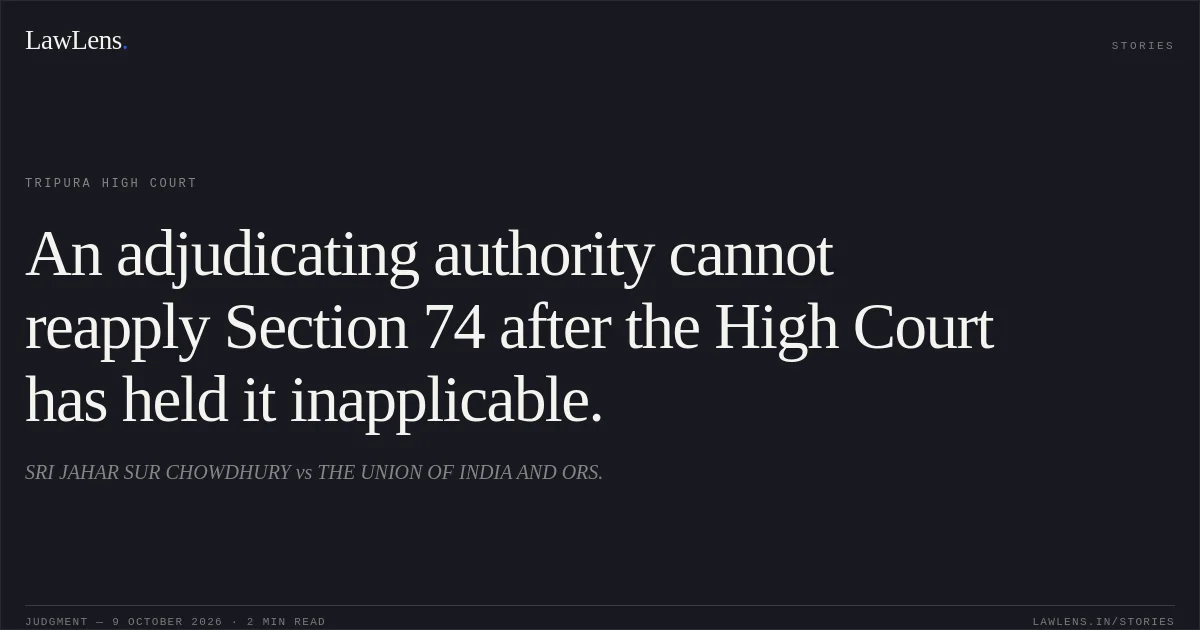
1. Whether the Assistant Commissioner could again adjudicate the matter under Section 74 after the High Court had held that the provision did not apply on the basis of the show-cause notice and had set aside the earlier order.
Source reference: paras. 16–18; pp. 5–62. Whether the corrigendum issued more than six months after the adjudication order was permitted under Section 161 of the CGST Act.
Source reference: para. 20; p. 63. Whether the respondents could be granted liberty to commence fresh proceedings under Section 73, given the limitation in Section 73(10).
Source reference: paras. 22–23; pp. 6–7Law Applied
Section 74 of the CGST Act provides for recovery where ITC is wrongly availed or utilised by reason of fraud, wilful misstatement or suppression; an authority cannot proceed under that provision contrary to a prior binding judicial determination that the notice and orders do not make out a case under it.
Source reference: paras. 11, 18; pp. 4, 6The first proviso to Section 161 bars rectification of a decision or order after six months from its issue.
Source reference: para. 20; p. 6Section 73(10) requires an order under that section to be issued within three years from the due date for furnishing the annual return for the relevant financial year.
Source reference: para. 22; p. 6The Court also treated action contrary to its earlier order, and the impugned orders made without jurisdiction, as arbitrary and violative of Article 14 of the Constitution.
Source reference: paras. 18, 21; p. 6Reasoning
The earlier judgment had already held that the case presented in the show-cause notice did not attract Section 74.
Source reference: paras. 16–18; pp. 5–6The fresh proceeding was expressly framed as de novo adjudication of the earlier order that had been quashed; the respondents did not explain how they could nevertheless proceed again under Section 74.
Source reference: paras. 16–18; pp. 5–6The Court therefore found the fresh order contrary to its prior ruling and without jurisdiction.
Source reference: paras. 16–18; pp. 5–6Separately, the corrigendum was issued beyond Section 161’s six-month period.
Source reference: para. 20; p. 6The Court declined to permit fresh proceedings under Section 73 because, in its view, the three-year period under Section 73(10) had elapsed.
Source reference: paras. 22–23; pp. 6–7These jurisdictional defects also defeated the respondents’ objection that the petitioner should pursue an appellate remedy under Section 107.
Source reference: para. 19; p. 6Holding
The Court allowed the writ petition and set aside both the adjudication order dated 10 June 2024 and the corrigendum dated 18 December 2024 as illegal, arbitrary, without jurisdiction and violative of Article 14.
It granted no liberty to initiate fresh proceedings under Section 73 and made no order as to costs.
Source reference: paras. 21–25; pp. 6–7Acts & Sections Cited
4 provisions across 1 statute referred to in this judgment. Each provision opens on LawLens.
Central Goods and Services Tax Act, 20174
Original Court PDF
SRI JAHAR SUR CHOWDHURYvsTHE UNION OF INDIA AND ORS.
Click to open original judgment
Original judgment, available to read, download and summarize on LawLens.in
![Authorities must consider employees’ claims under cited precedents, subject to similarity and applicable rules.. Anwar Ul Hassan Chesti vs D/o Health And Medical Education Ut Of Jammu & Kashmir. CAT - ['Srinagar']. LawLens](/stories/thumbnails/authorities-must-consider-employees-claims-under-cited-precedents-subject-to-similarity-an-ea3a30d13510422ca1f750e161753fd2.webp)