Facts
The petitioner, Maniram, sought correction of the revenue records under Section 32 of the Chhattisgarh Land Revenue Code, 1959, concerning Khasra No. 618, measuring 1.20 acres, situated at Village Khargahna, on the basis of an alleged family partition.
Source reference: para. 2; p. 3Respondent No. 6, Chaitram, stated in his reply before the Tahsildar that a partition had taken place and that the petitioner’s name had consequently been recorded in the revenue records.
Source reference: para. 2; p. 3The Patwari’s inquiry and panchnama also indicated the petitioner’s possession over the land.
Source reference: para. 2; p. 3The Tahsildar allowed the petitioner’s application on 21 August 2014 and directed deletion of respondent No. 6’s name and recording of the petitioner’s name.
Source reference: para. 2; pp. 3–5The Sub-Divisional Officer reversed that order on 27 May 2015.
Source reference: para. 2; pp. 3–5The Additional Commissioner, in second appeal, restored the Tahsildar’s order on 21 December 2016.
Source reference: para. 2; pp. 3–5However, the Board of Revenue, by order dated 20 January 2021, allowed respondent No. 6’s revision, set aside the Additional Commissioner’s order, and restored the Sub-Divisional Officer’s decision.
Source reference: para. 2; pp. 3–5The petitioner challenged the Board of Revenue’s order under Article 226 of the Constitution.
Source reference: paras. 1–2Issues
Whether the Board of Revenue erred in holding that there was no sufficient material to establish the partition, despite respondent No. 6’s admission and the supporting revenue record and inquiry materials?
Source reference: paras. 7–8Whether the alleged partition, mutation, and entitlement to compensation could be conclusively adjudicated in revenue proceedings or required determination by a competent civil court?
Source reference: paras. 9, 11Law Applied
The Court considered Section 32 of the Chhattisgarh Land Revenue Code, 1959, which enables correction or updating of revenue records.
Source reference: para. 2It applied the principle that an admission made by a party in pleadings or a reply is material evidence and cannot be disregarded without adequate justification.
Source reference: paras. 7–8The Court further recognized that mutation and revenue entries do not finally adjudicate civil title or substantive rights in immovable property; disputed questions concerning the validity of partition, title, and apportionment of compensation must be decided by the competent civil court.
Source reference: paras. 9, 11The writ jurisdiction under Article 226 was therefore exercised to correct the revenue authority’s failure to consider material evidence, without adjudicating the parties’ ultimate civil rights.
Source reference: paras. 10–11Reasoning
The Court found that respondent No. 6 had expressly admitted the factum of partition and had stated that the petitioner’s name was recorded pursuant to that partition.
Source reference: para. 7This admission was supported by the Patwari’s inquiry, panchnama, and material indicating the petitioner’s possession.
Source reference: para. 7Accordingly, the Board of Revenue’s conclusion that there was no material establishing partition was unsustainable.
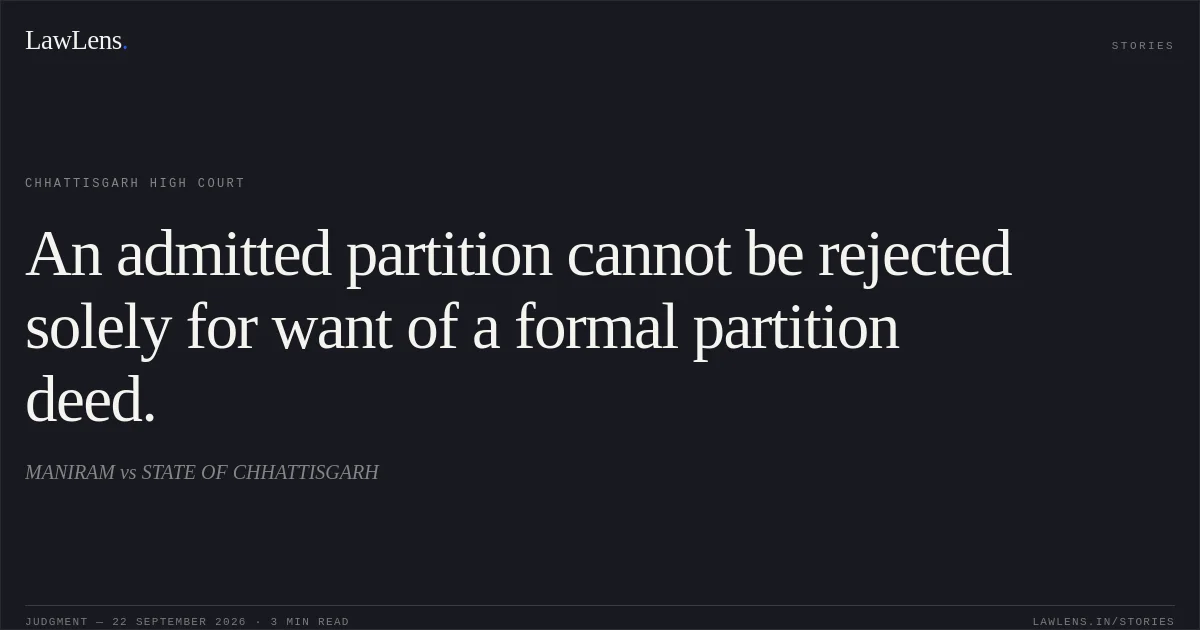
Source reference: para. 8The absence of a formal partition deed, by itself, could not justify ignoring the admission in the revenue proceedings.
Source reference: para. 8However, because the validity of the partition, the parties’ civil rights, and their respective entitlement to compensation involved disputed questions of fact and title, the Court left those matters open for adjudication before the competent civil court.
Source reference: paras. 9, 11Holding
The High Court allowed the writ petition and set aside the Board of Revenue’s order dated 20 January 2021.
It affirmed the Additional Commissioner’s order dated 21 December 2016 and the Tahsildar’s order directing correction of the revenue records.
Source reference: para. 10The Court clarified that it had not finally determined the parties’ civil rights.
Source reference: para. 11Respondent No. 6 was permitted to approach the competent civil court to challenge the alleged partition and mutation and to seek determination of entitlement and apportionment of compensation.
Source reference: para. 11The petition was disposed of without any order as to costs.
Source reference: paras. 12–13Acts & Sections Cited
1 provisions across 1 statute referred to in this judgment. Linked provisions open on LawLens.
Chhattisgarh Land Revenue Code, 19591
Original Court PDF
MANIRAMvsSTATE OF CHHATTISGARH
Click to open original judgment
Original judgment, available to read, download and summarize on LawLens.in