Facts
The petitioner sought a writ of habeas corpus under Article 226, alleging that his 21-year-old wife, Ankita, was being unlawfully confined by her parents, respondents 4 and 5.
Source reference: pp. 3, 5–6He stated that they had married on 14 August 2026 and that, after discussions at the police station, Ankita had gone with her parents.
Source reference: pp. 4–5The police produced Ankita before the Court, which recorded her statement in an in-camera proceeding.
Source reference: p. 6Issues
1. Whether Ankita was being unlawfully confined by respondents 4 and 5 so as to warrant habeas corpus relief
Source reference: pp. 5–62. Whether Ankita, having attained majority, should be permitted to go with the petitioner in accordance with her expressed wish
Source reference: p. 6Law Applied
The Court exercised its habeas corpus jurisdiction under Article 226 of the Constitution of India.
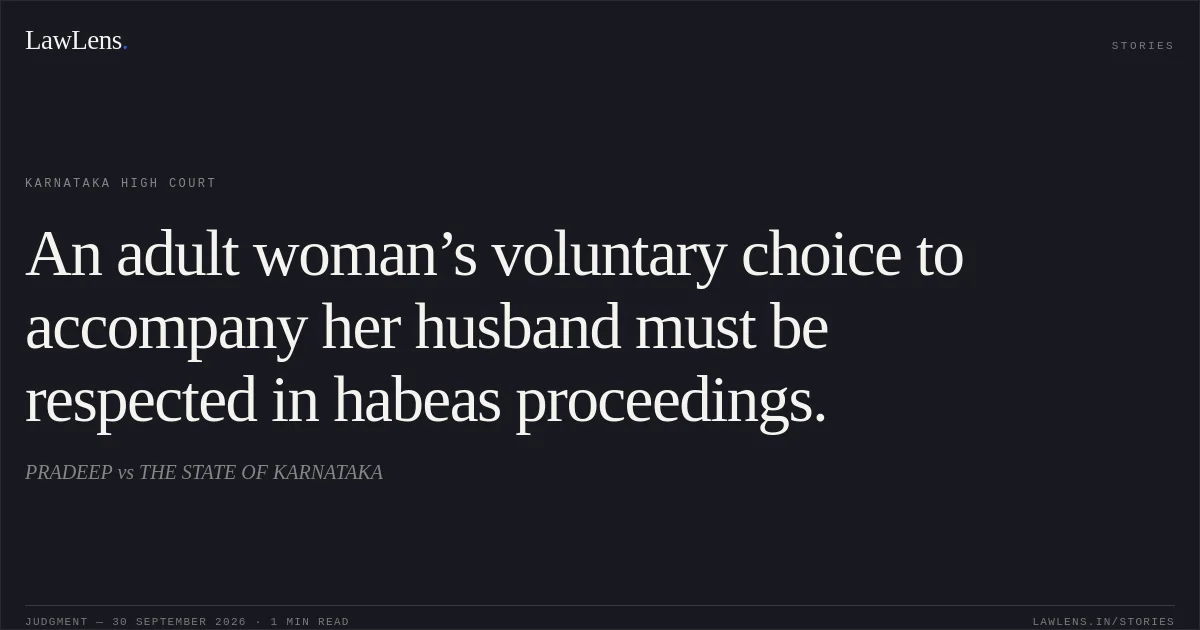
Source reference: no citationThe order reflects the principle that, where an adult’s wishes are ascertained by the Court and she expresses a voluntary choice about whom to accompany, that choice should be respected.
Source reference: p. 6Reasoning
The Court had Ankita produced and questioned her in camera. She stated that she was 21 years old, was the petitioner’s wife, and wished to accompany him and go to his house.
Source reference: p. 6On the basis of her recorded wishes, the Court permitted her to return with the petitioner; it did not separately set out findings on the alleged circumstances of her confinement.
Source reference: pp. 6–7Holding
The Court permitted Ankita to go with the petitioner and directed that she be set free to accompany him.
The writ petition was disposed of, with any pending applications also disposed of.
Source reference: p. 7Original Court PDF
PRADEEPvsTHE STATE OF KARNATAKA
Click to open original judgment
Original judgment, available to read, download and summarize on LawLens.in