Facts
The respondent-landlord obtained an eviction order under Section 14(1)(e) of the Delhi Rent Control Act, 1958, concerning Shop No. 104, Gaffar Market, on the basis of a bona fide requirement for his son to start a mobile-accessories business.
Source reference: p. 2, para. 2The petitioners’ application for leave to defend was rejected by the Rent Controller.
Source reference: no citationIn revision under Section 25-B(8), the petitioners argued that the son was already carrying on a business selling ladies’ purses from Shop No. 152 in the same market, making the pleaded requirement not bona fide; they contended that the Rent Controller had failed to properly consider that defence.
Source reference: pp. 2–3, paras. 4–9The High Court confined its review to that challenge.
Source reference: p. 2, para. 3Issues
Whether the Rent Controller’s treatment of the petitioners’ objection concerning the son’s alleged business at Shop No. 152 disclosed a material error warranting interference under Section 25-B(8).
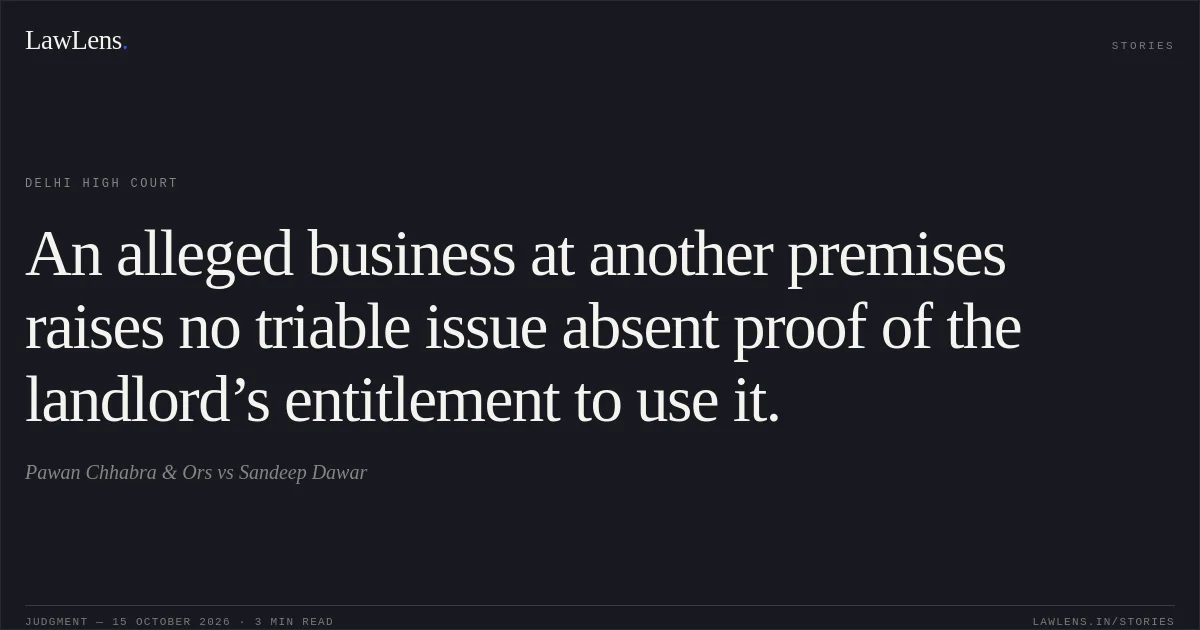
Source reference: pp. 6–7, paras. 18–21Whether the allegation that the son was already conducting business from Shop No. 152 raised a triable issue concerning the bona fide requirement or the availability of suitable alternative accommodation.
Source reference: pp. 7–9, paras. 21–24Law Applied
Section 25-B(8) of the Delhi Rent Control Act confers limited revisional—not appellate—jurisdiction: the High Court reviews the legality and propriety of the Rent Controller’s decision-making process and does not reappraise the evidence or substitute its own view merely because another view is possible.
Source reference: pp. 4–6, paras. 13–19Interference may be warranted for jurisdictional error, manifest illegality, material irregularity, perversity, an unreasonable conclusion, or failure to consider a material plea.
Source reference: pp. 4–6, paras. 13–19The Court relied on Sarla Ahuja v. United India Insurance Co. Ltd., (1998) 8 SCC 119; Hindustan Petroleum Corporation Ltd. v. Dilbahar Singh, (2014) 9 SCC 78; and Abid-Ul-Islam v. Inder Sain Dua, (2022) 6 SCC 30, as well as Pankaj Pahwa v. Prem Wati & Ors., 2024:DHC:9322, and Sanjeev Hiranandani v. Sunny Grover, 2025:DHC:11285.
Source reference: pp. 4–6, paras. 14–17Under Section 14(1)(e), the relevant alternative-accommodation question is whether the landlord has reasonably suitable alternative accommodation; an unsupported allegation does not, by itself, establish a triable issue.
Source reference: pp. 7–9, paras. 20–24At the leave-to-defend stage, a tenant need not conclusively prove the defence, but the pleaded facts and supporting material must disclose a triable issue of substance.
Source reference: pp. 7–9, paras. 20–24Reasoning
The High Court considered the alleged business at Shop No. 152 together with the petitioners’ claim that the shop was suitable alternative accommodation.
Source reference: pp. 7–9, paras. 21–23It held that the petitioners had not substantiated the respondent’s ownership of, or entitlement to use, the shop, nor shown the nature and extent of the son’s alleged business or how the premises were available to meet the pleaded need.
Source reference: pp. 7–9, paras. 21–23Without that material, the alleged business activity did not establish that the requirement was fictitious or that suitable alternative accommodation was available.
Source reference: pp. 7–9, paras. 21–23The Rent Controller had addressed the objection, and the petitioners had not shown that material had been overlooked or that the decision rested on a legally untenable premise.
Source reference: pp. 8–9, paras. 23–24Their challenge therefore sought a fresh assessment of the assertions, which was outside the limited revisional scope.
Source reference: pp. 8–9, paras. 23–24Holding
The Court held that the petitioners had not established a triable issue or any jurisdictional error, material irregularity, or perversity warranting revision.
It dismissed the revision petition and disposed of the pending applications; it also directed the Registry to release to the respondent, within four weeks, the amount deposited by the petitioners towards user and occupation charges, together with any accrued interest.
Source reference: p. 10, paras. 25–28Acts & Sections Cited
1 provisions across 1 statute referred to in this judgment. Each provision opens on LawLens.
delhi rent control act, 19581
Original Court PDF
Pawan Chhabra & OrsvsSandeep Dawar
Click to open original judgment
Original judgment, available to read, download and summarize on LawLens.in