Facts
On 13 January 2015 at approximately 8:00 p.m., accused No. 1 allegedly called the complainant, Bharatbhai Ukabhai Gohil, a member of the Scheduled Caste community, and requested transportation in the complainant’s Alto car from Dhusia to Umrethi.
Source reference: p.2, para. 2Near Umrethi Dam, accused No. 1 allegedly asked the complainant to stop the car, whereupon accused Nos. 2 and 3 allegedly arrived on a motorcycle, threw stones at the car, and broke its window.
Source reference: p.2, para. 2Accused No. 1 allegedly assaulted the complainant, inflicted a knife injury, and used caste-based abusive words against him.
Source reference: p.2, para. 2A complaint was lodged at Talala Police Station alleging offences under Sections 324, 323, 504, 427 and 114 of the Indian Penal Code, Section 135 of the Gujarat Police Act, and Section 3(1)(x) of the Scheduled Castes and the Scheduled Tribes (Prevention of Atrocities) Act, 1989 (“Atrocities Act”).
Source reference: p.2, para. 2After investigation, a charge-sheet was filed and charges were framed.
Source reference: pp.2–3, paras. 2.1–5The accused denied the allegations in their statements under Section 313 of the Code of Criminal Procedure, 1973.
Source reference: pp.2–3, paras. 2.1–5The Third Additional Sessions Judge, Veraval, acquitted all accused in Atrocity Sessions Case No. 8 of 2015 by judgment dated 24 August 2016.
Source reference: pp.2–3, paras. 2.1–5The original complainant thereafter preferred the present appeal against acquittal under Section 374(2) of the Code of Criminal Procedure.
Source reference: p.1, para. 1Issues
Whether the trial Court was justified in acquitting the accused of the offences alleged against them?
Source reference: p.7, para. 11Whether the trial Court properly appreciated the oral and documentary evidence led by the prosecution?
Source reference: p.7, para. 11Whether the judgment of acquittal suffered from illegality, irregularity, perversity, or manifest error warranting appellate interference?
Source reference: p.7, para. 11Whether the prosecution proved the essential ingredients of the offence under Section 3(1)(x) of the Atrocities Act, including intentional caste-based insult in a public place or within public view?
Source reference: pp.9–10, para. 14Law Applied
The Court considered the offences alleged under Sections 324, 323, 504, 427 and 114 of the Indian Penal Code, Section 135 of the Gujarat Police Act, and Section 3(1)(x) of the Atrocities Act.
Source reference: p.1, para. 1For Section 3(1)(x) of the Atrocities Act, the prosecution was required to prove intentional insult or intimidation of a person belonging to a Scheduled Caste or Scheduled Tribe by caste-based words in a public place or within public view.
Source reference: p.9, para. 14The Court relied on Hitesh Verma v. State of Uttarakhand, (2020) 10 SCC 710, and other decisions, including Shajan Skaria v. State of Kerala, AIR 2024 SC 4557.
Source reference: pp.10–12, paras. 15–18These authorities establish that an appellate court may fully reappreciate evidence in an appeal against acquittal, but must account for the strengthened or “double” presumption of innocence; where two reasonable views are possible, the acquittal should not ordinarily be disturbed.
Source reference: pp.10–12, paras. 15–18The Court also referred to Ramesh v. State of Karnataka, (2024) 9 SCC 169, which requires firm and weighty grounds before reversing a well-reasoned acquittal.
Source reference: pp.12–13, para. 18Reasoning
The complainant knew accused No. 1 but did not know accused Nos. 2 and 3, and no test-identification parade was conducted in respect of them.
Source reference: p.7, para. 12The complainant’s account in deposition was found to be inconsistent with the FIR, and his testimony was also considered in light of pending criminal and civil proceedings disclosed in cross-examination.
Source reference: p.7, para. 12The medical evidence did not corroborate the alleged knife assault: the doctor found only multiple abrasions on both hands and no visible injury on the left knee; the abrasions could have resulted from a fall on an asphalt road or contact with bushes, and no knife injury was found.
Source reference: pp.8–9, paras. 13–14Further, when the complainant reached the hospital, he reportedly described the assailants as three unknown persons and did not name the accused.
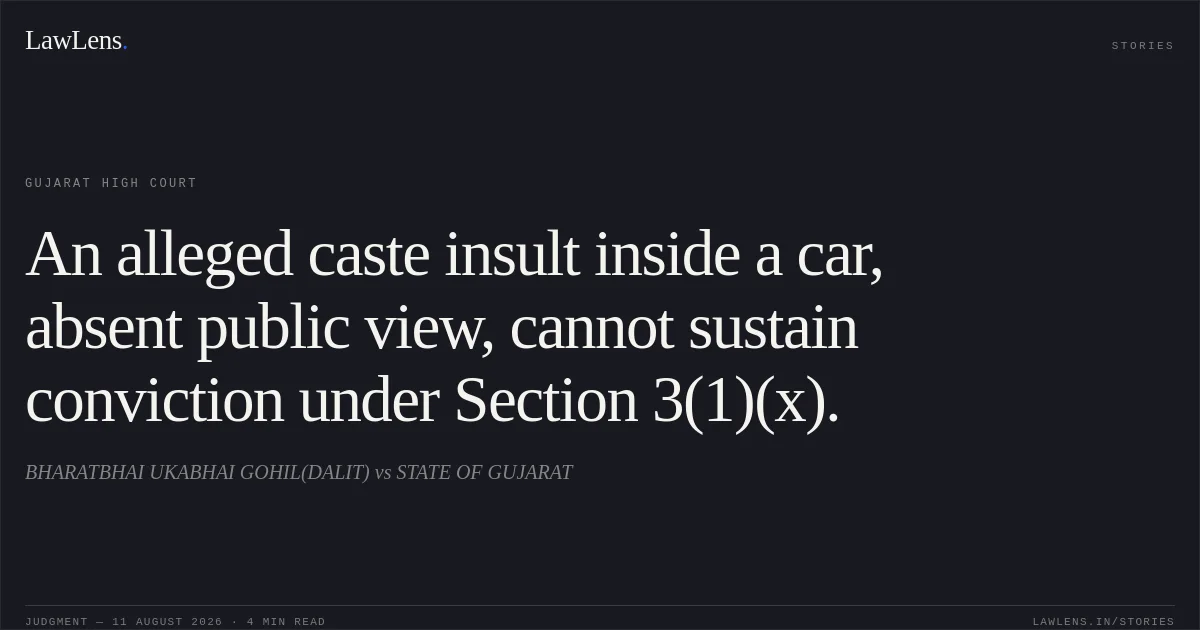
Source reference: p.9, para. 14The Court also held that the alleged incident occurred inside the Alto car and that the prosecution failed to establish the requisite public-place or public-view element for Section 3(1)(x) of the Atrocities Act.
Source reference: p.9, para. 14In view of these contradictions, lack of identification, medical inconsistency, and failure to prove the statutory ingredients, the trial Court’s view was held to be a reasonable one and not perverse or manifestly illegal.
Source reference: pp.9–11, paras. 14–17Holding
The High Court answered the issues in favour of the accused.
It held that the prosecution failed to prove the charges beyond reasonable doubt and that the trial Court had properly appreciated the evidence.
Source reference: pp.13–14, paras. 19–20No illegality, perversity, or manifest error warranting interference in an appeal against acquittal was established.
Source reference: pp.13–14, paras. 19–20The appeal was accordingly dismissed, the judgment and order of acquittal dated 24 August 2016 were confirmed, the bail bonds were cancelled, and the record and proceedings were directed to be returned to the trial Court.
Source reference: p.14, para. 21Acts & Sections Cited
11 provisions across 4 statutes referred to in this judgment. Each provision opens on LawLens.
Code of Criminal Procedure, 19732
Indian Penal Code, 18607
Gujarat Police Act, 1951.1
Scheduled Castes and the Scheduled Tribes (Prevention of Atrocities) Act, 19891
Original Court PDF
BHARATBHAI UKABHAI GOHIL(DALIT)vsSTATE OF GUJARAT
Click to open original judgment
Original judgment, available to read, download and summarize on LawLens.in