Facts
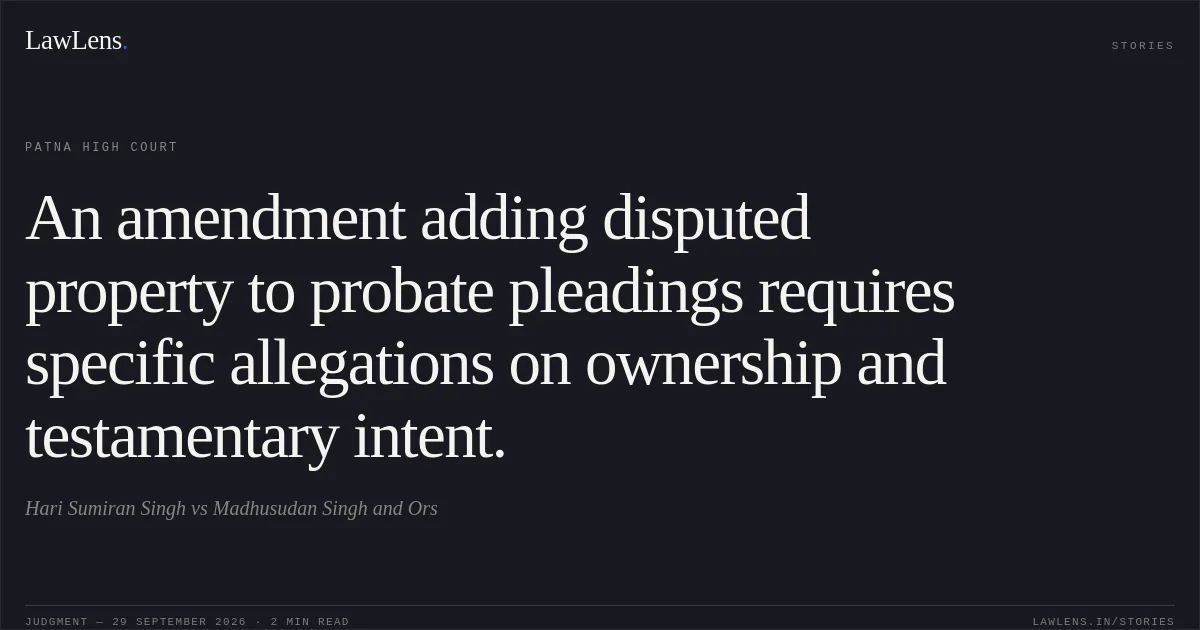
Respondents 1 and 2 sought letters of administration concerning a 1993 Will allegedly executed by Shanti Devi. After objections were filed, the proceeding was converted into a testamentary suit.
Source reference: pp. 2–6, paras. 3–7During the original proceeding, respondents 1 and 2 sought to amend their case to include an additional property, which they claimed was covered by the Will. The Additional District Judge allowed the amendment on 20 September 2016; the petitioners’ review application was dismissed.
Source reference: pp. 2–6, paras. 3–7, 8The petitioners then challenged the amendment order, arguing that the property was not identified in the Will’s schedule and that its ownership and the testator’s intention to bequeath it remained disputed.
Source reference: pp. 2–6, paras. 3–7, 8Issues
1. Whether the trial court was justified in allowing an amendment to the letters-of-administration case to include property not specifically described in the Will’s schedule.
Source reference: pp. 5–6, para. 8; pp. 9–11, paras. 13–172. Whether the disputed questions of ownership and the testator’s intention to bequeath the additional property could be addressed without specific pleadings.
Source reference: p. 11, para. 16Law Applied
Order VI Rule 17 of the Code of Civil Procedure governs amendments of pleadings, while Section 151 preserves the court’s inherent powers; the judgment identifies these provisions as the basis of the amendment application.
Source reference: p. 4, para. 5Sections 74 and 75 of the Indian Succession Act, 1925, provide that a Will need not use technical language, but its intention must be ascertainable from its wording, and that a court may examine material facts concerning the persons, property, testator, and family to determine the meaning of the Will.
Source reference: p. 7, para. 10Reasoning
The court observed that the Will’s schedule specifically described the bequeathed property but did not mention the property added by amendment; the respondents relied instead on a provision of the Will that the court considered vague.
Source reference: pp. 9–10, paras. 13–14It also noted that litigation concerning the additional property had resulted in findings that Shanti Devi and her heirs were entitled to it, but those findings did not resolve whether the property was Shanti Devi’s self-acquired property or had been purchased with joint-family funds, nor whether she intended to bequeath it to the legatees.
Source reference: pp. 10–11, paras. 14–16Because those material questions required specific pleadings and remained undecided, the court held that the amendment order was not proper or justified.
Source reference: p. 11, paras. 16–17Holding
The High Court set aside the order dated 20 September 2016 allowing the amendment and allowed the civil miscellaneous petition.
It requested the trial court to expedite the testamentary suit and directed both parties to cooperate in its prompt disposal.
Source reference: p. 11, para. 18Acts & Sections Cited
4 provisions across 2 statutes referred to in this judgment. Each provision opens on LawLens.
Code of Civil Procedure, 19081
Indian Succession Act, 19253
Original Court PDF
Hari Sumiran SinghvsMadhusudan Singh and Ors
Click to open original judgment
Original judgment, available to read, download and summarize on LawLens.in