Facts
The plaintiff, Manju, instituted Civil Suit No. 302 of 2016 seeking permanent prohibitory injunction to restrain Hem Singh from raising construction on joint land comprised in Khasra No. 3546, Khata-Khatauni No. 2/2, situated at Phati Railla Kothi, Bhallan, District Kullu.
Source reference: para. 4The defendant contested the suit, asserting that he was in possession of a separate parcel purchased from the plaintiff through a registered sale deed dated 10 March 2017, together with a three-storeyed building, and that the relevant mutation had been entered in his favour.
Source reference: para. 7Issues were framed on 16 April 2022 and the matter proceeded to the stage of plaintiff’s evidence.
Source reference: para. 8During the pendency of the proceedings, the plaintiff filed an application under Order VI Rule 17 of the Code of Civil Procedure, 1908, seeking to amend the plaint by introducing claims for declaration, possession of the alleged unsold portion of the house, and mesne profits of ₹20,000 per month.
Source reference: paras. 9–10The trial Court allowed the amendment application on 2 December 2025.
Source reference: para. 13The defendant challenged that order under Article 227 of the Constitution, contending that the amendment introduced an entirely new case, changed the nature of the suit, and was moved after commencement of trial without satisfying the proviso to Order VI Rule 17 CPC.
Source reference: para. 14–15Issues
Whether the plaintiff’s proposed amendment, filed after commencement of trial, satisfied the due-diligence requirement under the proviso to Order VI Rule 17 CPC?
Source reference: paras. 15, 18, 22Whether the proposed amendment, which introduced claims for declaration, possession, and mesne profits, materially changed the nature and cause of action of the original suit for permanent injunction?
Source reference: paras. 18, 20–22Whether the trial Court exceeded its jurisdiction in allowing the amendment application under Order VI Rule 17 CPC?
Source reference: paras. 20–23Law Applied
The Court applied Order VI Rule 17 CPC, under which amendments necessary for determining the real questions in controversy may ordinarily be permitted; however, after commencement of trial, an amendment cannot be allowed unless the Court is satisfied that, despite due diligence, the matter could not have been raised earlier.
Source reference: para. 18The Court relied on Life Insurance Corporation of India v. Sanjeev Builders Pvt. Ltd., (2022) 16 SCC 1, particularly the principles that amendments should generally be allowed when necessary for effective adjudication and avoidance of multiplicity of proceedings, but should be refused where they change the nature of the suit, introduce a time-barred claim, are mala fide, withdraw a clear admission, or deprive the opposite party of a valid defence.
Source reference: para. 19The Court further applied the principle that an amendment introducing an entirely new case or cause of action, foreign to the original pleadings, is impermissible, particularly where the trial has already commenced.
Source reference: para. 19Reasoning
The original suit was confined to a claim for permanent prohibitory injunction against alleged unlawful construction on joint land.
Source reference: paras. 4–5The proposed amendment sought to introduce materially different reliefs—declaration of the extent of the sale, recovery of possession of an allegedly unsold portion of the house, and mesne profits—thereby changing both the nature of the suit and the factual basis of the dispute.
Source reference: paras. 9–10, 20–21Since issues had already been framed and the case was pending for plaintiff’s evidence, the trial had commenced.
Source reference: para. 18The plaintiff’s application did not explain why these matters could not have been pleaded before commencement of trial, and therefore failed to satisfy the statutory due-diligence requirement in the proviso to Order VI Rule 17 CPC.
Source reference: paras. 18, 22The Court consequently held that allowing the amendment would effectively require a de novo trial and prejudice the defendant, who had already filed his written statement on the basis of the original case.
Source reference: para. 21Holding
The High Court allowed the petition under Article 227 and set aside the trial Court’s order dated 2 December 2025.
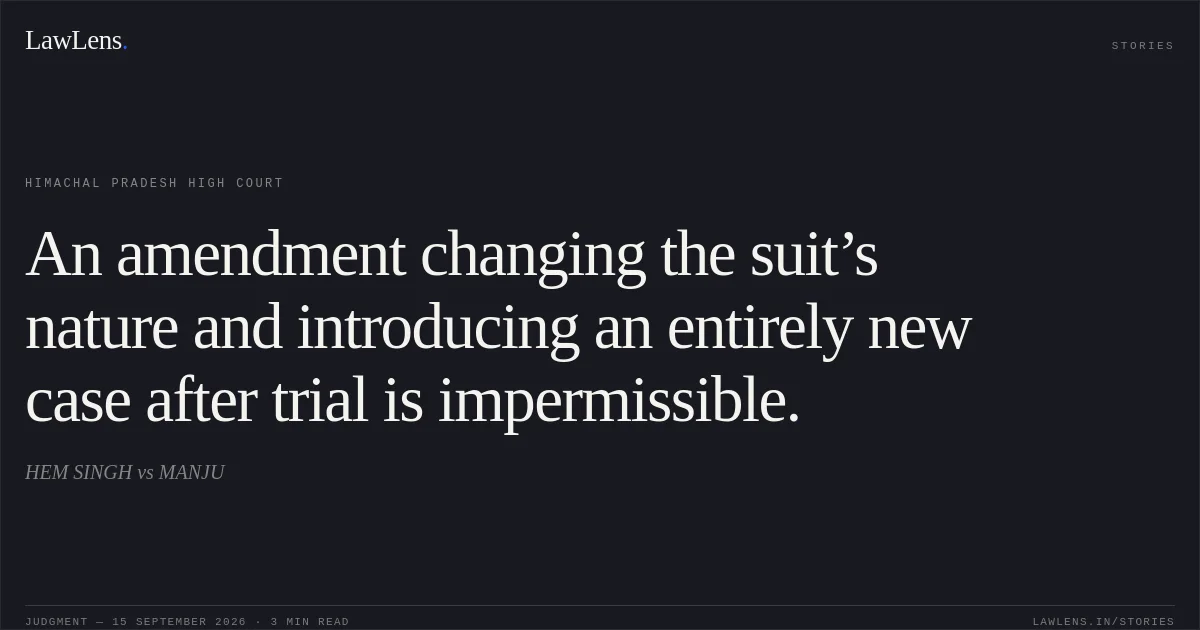
It dismissed the plaintiff’s application under Order VI Rule 17 CPC, holding that the proposed amendment impermissibly changed the nature of the suit and was unsupported by any explanation satisfying the due-diligence requirement after commencement of trial.
Source reference: paras. 20–23The parties were directed to appear before the trial Court on 30 September 2026, and the record was ordered to be returned forthwith.
Source reference: paras. 24–26Original Court PDF
HEM SINGHvsMANJU
Click to open original judgment
Original judgment, available to read, download and summarize on LawLens.in