Facts
The petitioner-plaintiff brought a suit seeking declaration of title and permanent injunction over three parcels of land, alleging that a sale deed executed in favour of respondent Nos. 1 and 2 was nominal and that he remained in possession.
Source reference: para. 2After issues had been framed and the matter was set for the plaintiff’s evidence, he applied under Order VI Rule 17 CPC to amend the plaint to seek possession if the trial court found that he was not in possession.
Source reference: paras. 4–5The trial court rejected the application as inconsistent with the original pleading; the plaintiff challenged that order under Article 227 of the Constitution.
Source reference: paras. 1, 6Issues
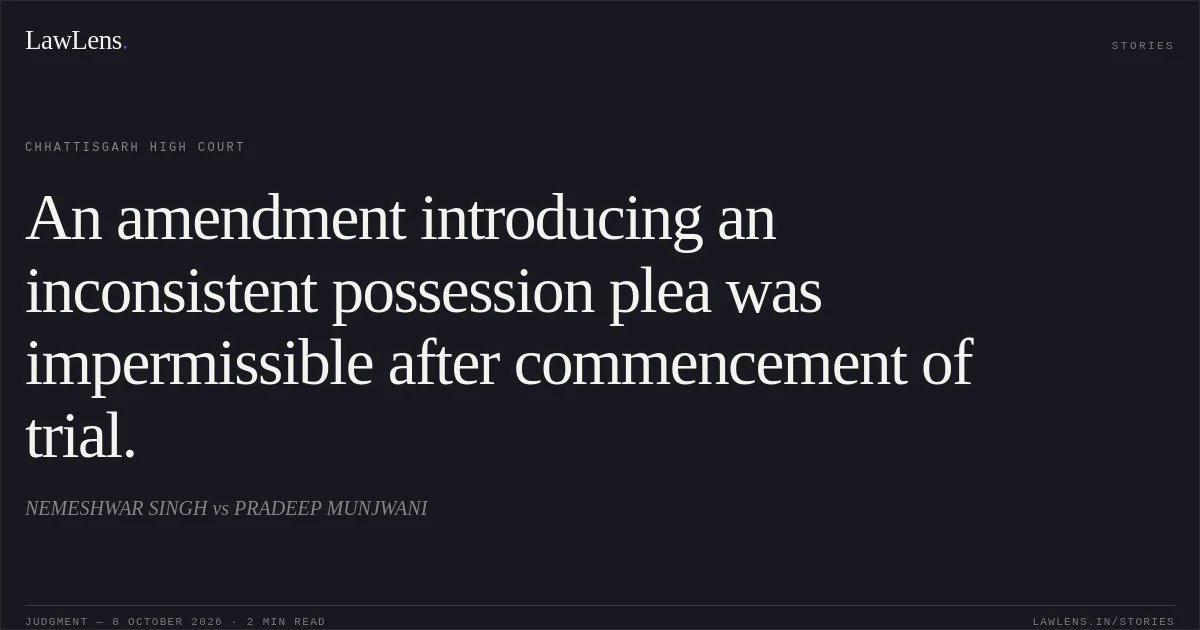
1. Whether the proposed amendment seeking possession, conditional on a finding that the plaintiff was not in possession, was inconsistent with his original pleading that he remained in possession.
Source reference: paras. 4–62. Whether the amendment could be allowed after issues had been framed and the case fixed for the plaintiff’s evidence.
Source reference: para. 5Law Applied
Order VI Rule 17 CPC governs amendment of pleadings; the court considered the provision alongside Section 151 CPC, under which the plaintiff had made his application.
Source reference: para. 4The court treated a proposed amendment that contradicted the plaintiff’s existing assertion of possession as mutually inconsistent in the circumstances of the case.
Source reference: para. 5It also relied on Vidyabai & Ors. v. Padmalatha & Anr., (2009) 2 SCC 409, in addressing the restriction on entertaining an amendment application after trial has commenced.
Source reference: para. 5Article 227 provides the supervisory jurisdiction invoked to challenge the trial court’s order.
Source reference: para. 1Reasoning
The plaint expressly asserted that the plaintiff was in possession and that possession had never been delivered to the defendants; the proposed amendment, by contrast, sought recovery of possession if the trial court found the defendants to be in possession.
Source reference: paras. 4–5The High Court held that this was a mutually inconsistent plea in light of the transaction pleaded.
Source reference: para. 5It further noted that issues had been framed and the suit was fixed for the plaintiff’s evidence, and concluded that the amendment could not be entertained at that stage, referring to Vidyabai.
Source reference: para. 5It found no jurisdictional error or illegality in the trial court’s refusal.
Source reference: para. 6Holding
The High Court dismissed the petition under Article 227, leaving in place the trial court’s order rejecting the application to amend the plaint.
Acts & Sections Cited
1 provisions across 1 statute referred to in this judgment. Each provision opens on LawLens.
Code of Civil Procedure, 19081
Original Court PDF
NEMESHWAR SINGHvsPRADEEP MUNJWANI
Click to open original judgment
Original judgment, available to read, download and summarize on LawLens.in