Facts
The complainant alleged that the petitioner owed Rs. 8,30,885 for garments supplied on credit and issued a cheque for that amount, which was dishonoured for insufficient funds. The trial court convicted the petitioner under Section 138 of the Negotiable Instruments Act, 1881 (NI Act), and imposed a fine of Rs. 9,00,000, with default imprisonment.
Source reference: para. 1–2, 4The petitioner’s defence was that he operated a travel agency, had given a signed blank cheque to a loan broker, and had no garment-trading relationship with the complainant. He also relied on the complainant’s other proceedings against his brother concerning the same aggregate liability.
Source reference: para. 3The petitioner’s appeal was dismissed on merits in his and his counsel’s absence. He then sought relief under Section 482 of the Code of Criminal Procedure, 1973 (Code), challenging the ex parte appellate decision and raising concerns about the trial record, the complainant’s proof of debt, and the parallel complaints.
Source reference: para. 5–6Issues
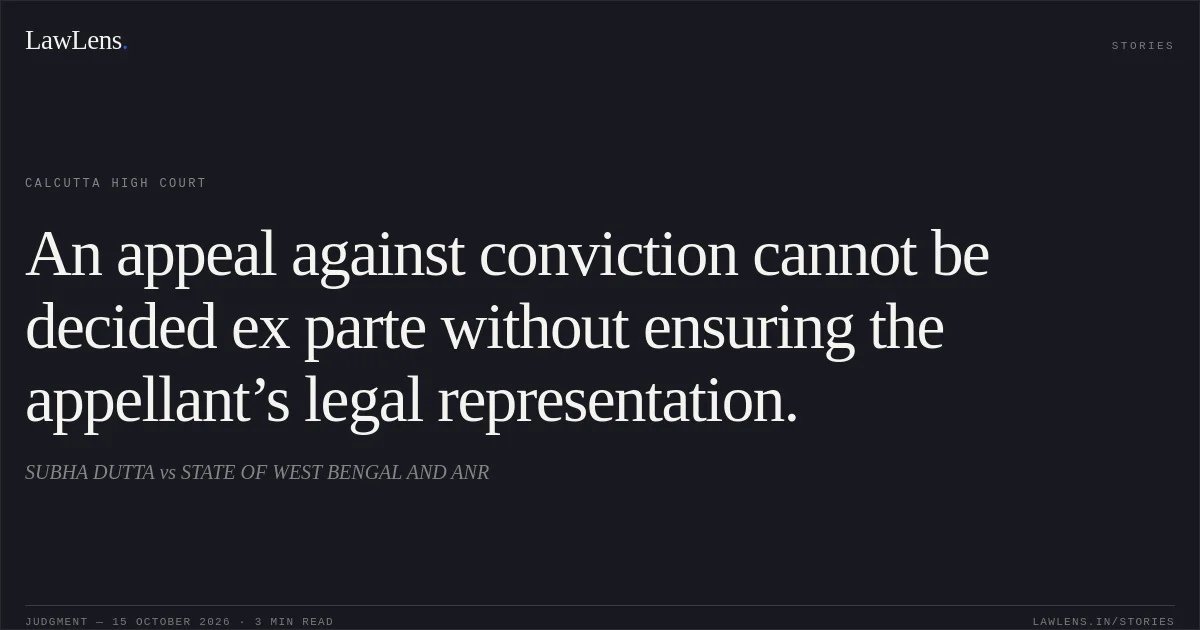
Whether the appellate court could decide the appeal against conviction in the appellant’s absence without providing notice or legal representation.
Source reference: para. 10(A), 11–13Whether the illegible trial-court order entry and the disputed opportunity to cross-examine the complainant on recalled evidence rendered the conviction procedurally irregular.
Source reference: para. 10(B), 14–15Whether the complainant established a legally enforceable debt without primary business records and authenticated vouchers.
Source reference: para. 10(C), 16–17Whether the petitioner rebutted the presumption under Section 139 of the NI Act on a balance of probabilities.
Source reference: para. 10(D), 18–19What effect the complainant’s parallel proceedings concerning the same alleged liability had on the case.
Source reference: para. 10(E), 20–21What relief was appropriate in the circumstances.
Source reference: para. 10(F), 22–23Law Applied
Section 386 of the Code requires an appellate court to consider the record and hear the appellant or counsel if appearing; an appeal against conviction cannot be dismissed for non-appearance, and the court must ensure meaningful representation before deciding it.
Source reference: para. 12–13Article 21 protects the right to a fair hearing.
Source reference: para. 13Under Sections 118 and 139 of the NI Act, the statutory presumptions may be rebutted by the accused on a preponderance of probabilities.
Source reference: para. 18Section 138 requires a cheque to relate to a legally enforceable debt or liability.
Source reference: para. 16The judgment also treated cross-examination as an essential fair-trial safeguard under Section 138 of the Indian Evidence Act, 1872.
Source reference: para. 15Reasoning
The Court held that the appellate court’s decision to proceed on the merits without administrative notice or appointing legal representation deprived the petitioner of a fair hearing and violated the procedure required for an appeal against conviction.
Source reference: para. 11–13It also found material uncertainty in the trial record: the entry said to close cross-examination was illegible, and the record did not establish that the complainant had been cross-examined on the documents produced after recall.
Source reference: para. 14–15On the debt and presumption issues, the Court considered the unacknowledged vouchers, absence of primary accounting records, the petitioner’s travel-agency defence, and the parallel complaints as supporting a probable defence and undermining the complainant’s case.
Source reference: para. 16–21These merits-related findings informed the directions on remand; the Court’s operative order set aside the appellate judgment and returned the appeal for fresh consideration.
Source reference: para. 22–29Holding
The High Court allowed the revision and set aside the appellate judgment dated 19 May 2022.
It remanded the appeal for a fresh hearing on the merits, directing the appellate court to address the illegible order entry and cross-examination, the absence of primary business records, and the parallel complaints.
Source reference: para. 24–28The parties were directed to appear on 25 November 2026, and the appellate court was instructed to appoint legal-aid counsel or an amicus curiae if the petitioner or counsel failed to appear.
Source reference: para. 27–30Execution of the trial-court sentence was stayed pending disposal of the appeal on remand.
Source reference: para. 27–30Acts & Sections Cited
6 provisions across 2 statutes referred to in this judgment. Each provision opens on LawLens.
Code of Criminal Procedure, 19733
Negotiable Instruments Act, 18813
Original Court PDF
SUBHA DUTTAvsSTATE OF WEST BENGAL AND ANR
Click to open original judgment
Original judgment, available to read, download and summarize on LawLens.in
![The competent authority must decide the appeal by a reasoned, speaking order within four weeks.. DR NISHANT GOYAL vs HEALTH. CAT - ['Delhi']. LawLens](/stories/thumbnails/the-competent-authority-must-decide-the-appeal-by-a-reasoned-speaking-order-within-four-we-51ef3c532385466483f4156703e7e0bc.webp)
![Competent authority must decide the pending representation by a reasoned order within four weeks.. AJAY YADAV vs MUNICIPAL CORPORATION OF DELHI (GNCTD). CAT - ['Delhi']. LawLens](/stories/thumbnails/competent-authority-must-decide-the-pending-representation-by-a-reasoned-order-within-four-1bec6310839148709c127f0a0c64e2b5.webp)
