Facts
The plaintiff and defendant (real brothers) disputed the ownership of a bungalow on Sub-plot No. 6B
Source reference: p. 2The plot was registered in the defendant's name in 1964
Source reference: p. 2The plaintiff filed a suit for partition and injunction based on their late father’s registered Will (1969), which stated the property was purchased with HUF funds
Source reference: p. 2-3The defendant contended he was the sole owner, having built it with his own funds, and that the plaintiff was a permissive occupier
Source reference: p. 5The Trial Court dismissed the suit twice—initially in 1987 and again after a remand in 2000
Source reference: p. 6Although the suit was dismissed in his favor, the defendant filed this appeal to challenge specific adverse findings of the Trial Court regarding the validity of the Will and the status of the property as HUF
Source reference: p. 1-2, 7The plaintiff, without filing a separate appeal, filed Cross-Objections seeking a decree for partition
Source reference: p. 6Issues
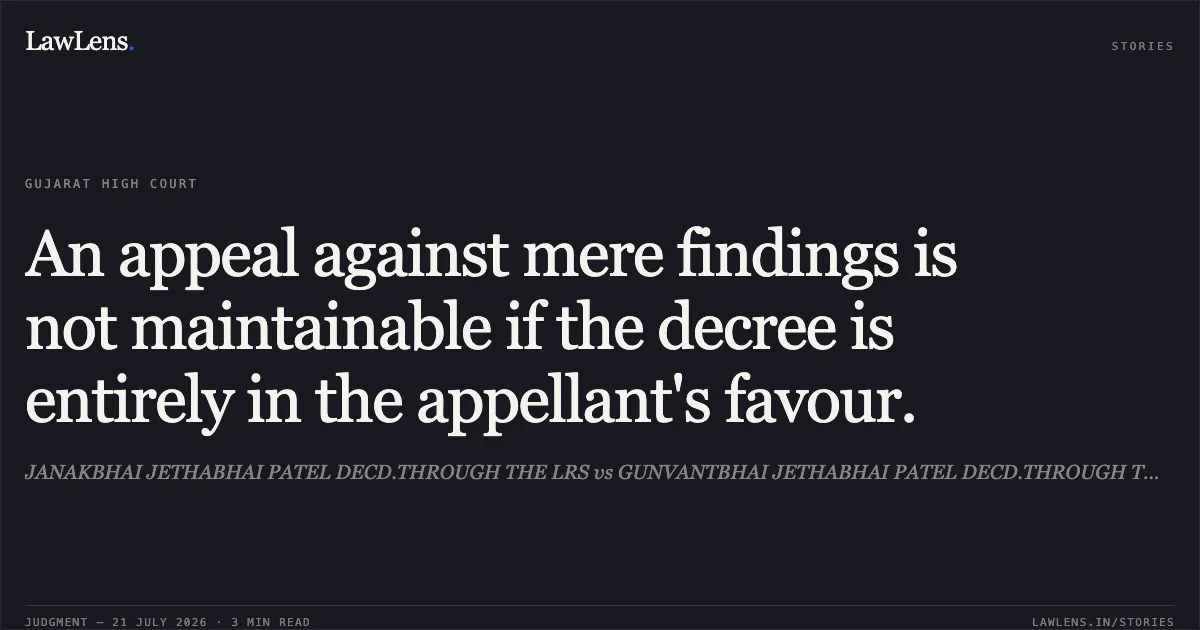
Whether a defendant who successfully secured a dismissal of the suit can maintain an appeal under Section 96 of the CPC solely to challenge adverse findings on specific issues
Source reference: para. 7Whether a plaintiff, whose suit was dismissed in entirety and who did not file an independent appeal, can seek a full reversal and a decree in their favor through Cross-Objections under Order XLI Rule 22
Source reference: para. 7, 20Law Applied
The court applied Section 2(2) of the CPC, which defines a "decree" as a formal expression conclusively determining the rights of parties
Source reference: para. 11Under Section 96, an appeal lies only against a "decree," not mere findings
Source reference: para. 13-14The court relied on Ganga Bai v. Vijay Kumar and Devaram v. Ishwarchand [(1995) 6 SCC 733], establishing that a successful party cannot appeal against adverse findings unless they constitute res judicata
Source reference: para. 18Regarding Cross-Objections, the court applied Order XLI Rule 22 and the principles from Banarsi v. Ram Phal [(2003) 9 SCC 606], which stipulate that while a respondent can challenge findings to support a decree, they cannot seek a substantive reversal of a decree (like a total dismissal of their suit) without filing an independent appeal
Source reference: para. 21-23Reasoning
The court reasoned that the defendant-appellant was not a "person aggrieved" because the final decree (dismissal of the suit) was entirely in his favor; thus, under Section 96, he cannot appeal against the Trial Court’s observations regarding the Will or HUF funds as they do not constitute a decree
Source reference: para. 19, 27Regarding the plaintiff-respondent, the court held that since the suit was dismissed in toto, the plaintiff’s only remedy was a substantive appeal under Section 96. Cross-Objections under Order XLI Rule 22 are intended to allow a respondent to either support the decree reached or challenge specific findings while the decree stands; they cannot be used as a "camouflage" or alternative platform to seek a decree that was completely denied by the lower court
Source reference: para. 24, 28Holding
The High Court held that neither the First Appeal nor the Cross-Objection was maintainable. The defendant’s First Appeal was dismissed because an appeal does not lie against mere findings when the suit is dismissed
The plaintiff’s Cross-Objection was dismissed because a party who failed to obtain any relief cannot seek a substantive decree through Cross-Objections without filing an independent appeal. Both the First Appeal and Cross-Objections were dismissed as not maintainable
Source reference: para. 28, 29Acts & Sections Cited
6 provisions across 3 statutes referred to in this judgment. Each provision opens on LawLens.
Code of Civil Procedure, 19084
Indian Succession Act, 19251
Limitation Act, 19631
Original Court PDF
JANAKBHAI JETHABHAI PATEL DECD.THROUGH THE LRSvsGUNVANTBHAI JETHABHAI PATEL DECD.THROUGH THE LRS
Click to open original judgment
Original judgment, available to read, download and summarize on LawLens.in