Facts
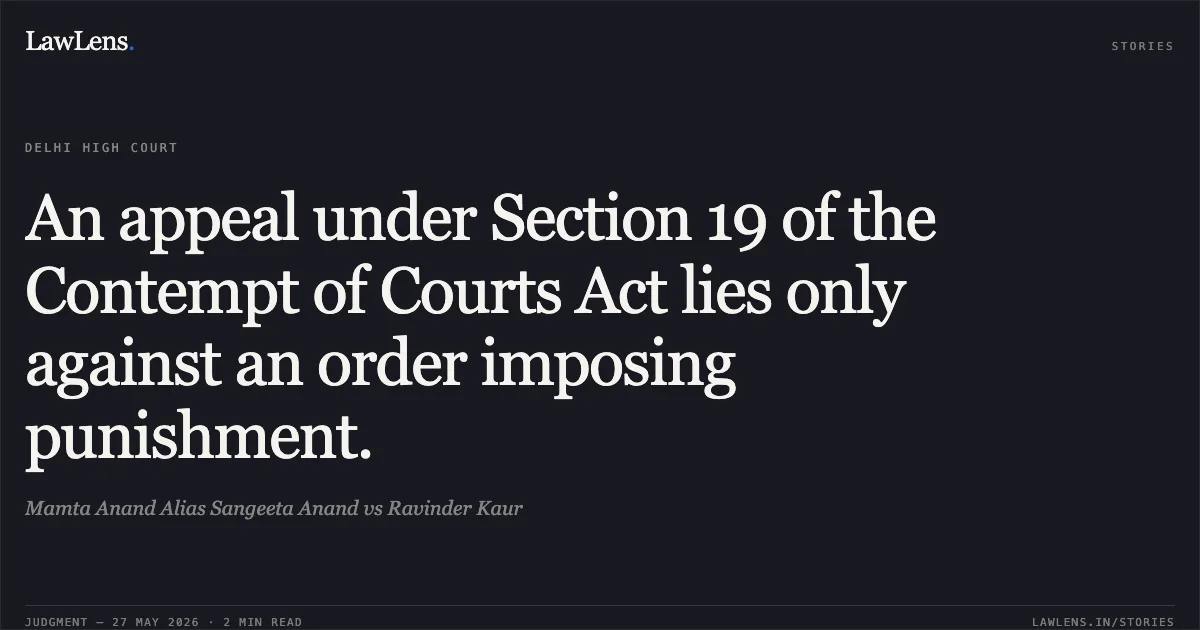
The Appellant was held guilty of contempt by a Single Judge of the Delhi High Court via orders dated 6th September 2022 and 10th February 2026.
Source reference: para. 4While the finding of guilt was recorded, the Single Judge had not yet awarded a sentence or determined the quantum of punishment.
Source reference: para. 4, 10On 27th March 2026, the Division Bench of the High Court dismissed the Appellant's appeal as premature and non-maintainable at that stage.
Source reference: para. 4The Appellant filed the present application (CM APPL. 36653/2026) seeking modification of the dismissal order, contending that an appeal is maintainable under Section 19 of the Contempt of Courts Act, 1971, once a finding of guilt is recorded, regardless of whether a sentence has been passed.
Source reference: para. 3, 5Issues
1. Whether an appeal under Section 19 of the Contempt of Courts Act, 1971, is maintainable against an order that finds a party guilty of contempt but has not yet imposed a punishment or sentence.
Source reference: para. 5, 10Law Applied
Section 19 of the Contempt of Courts Act, 1971, which provides a right of appeal from any "order or decision" of the High Court in the exercise of its jurisdiction to punish for contempt.
Source reference: para. 7The Supreme Court precedent in Midnapore Peoples’ Coop. Bank Ltd. v. Chunilal Nanda (2006), which established that an appeal under Section 19 is maintainable only against an order imposing punishment, and not against mere findings of guilt or interlocutory orders.
Source reference: para. 7, 15Principles from Ajay Kumar Bhalla v. State (2022) and D.N. Taneja v. Bhajan Lal (1988), which clarify that the jurisdiction to "punish" is only exercised when a penalty is actually imposed.
Source reference: para. 7, 16Reasoning
The Court rejected the modification application by strictly interpreting the statutory language of Section 19 and binding precedents. The Bench reasoned that "exercise of jurisdiction to punish" implies the actual imposition of a sentence.
Source reference: no citationThe Single Judge had only reached a finding of "guilt" but had not yet determined the quantum of punishment.
Source reference: para. 9Following the rule in Midnapore, the Court observed that unless a punishment is awarded, the appeal is premature.
Source reference: para. 10The Bench remained consistent with its own recent rulings in Dalbir Singh Yadav and Raghunath Singh, emphasizing that the right of appeal under Section 19 is a limited statutory right triggered by the act of punishment.
Source reference: para. 7-8The Appellant is not left without a remedy, as she may challenge both the finding of guilt and the eventual sentence once the Single Judge passes a final order on the quantum.
Source reference: para. 13Holding
The Court held that the appeal remains non-maintainable and premature because no punishment has been pronounced by the Single Judge.
The application for modification of the order dated 27th March 2026 was dismissed.
Source reference: para. 15The Court clarified that the Appellant would be entitled to challenge the merits of the contempt finding and the sentence simultaneously if and when a sentence is awarded.
Source reference: para. 13Acts & Sections Cited
1 provisions across 1 statute referred to in this judgment. Each provision opens on LawLens.
Code of Civil Procedure, 19081
Original Court PDF
Mamta Anand Alias Sangeeta AnandvsRavinder Kaur
Click to open original judgment
Original judgment, available to read, download and summarize on LawLens.in