Facts
The petitioner, a Scale-I Officer appointed in 1984, was subsequently promoted as a Scale-II Officer and posted at the Head Office of Sri Satavahana Grameena Bank.
Source reference: no citationHe was suspended on 8 November 1998 and, thereafter, issued a charge memo dated 8 May 2000 alleging failures in maintaining accounts, supervising reconciliation work, monitoring inter-bank transactions, and detecting or preventing fraudulent transactions at the Karimnagar Branch.
Source reference: para. 3Following a departmental enquiry, the Disciplinary Authority imposed the penalty of reduction by one stage for three years without cumulative effect and treated the suspension period as “off duty” by order dated 8 June 2005.
Source reference: para. 3.1The petitioner preferred an appeal.
Source reference: no citationDuring consideration of the appeal, the Appellate Authority issued a show-cause notice proposing enhancement of the punishment, including permanent reduction of five increments, denial of future promotions, adverse treatment of the suspension period, and recovery of approximately Rs.1.93 lakhs allegedly representing the Bank’s loss arising from the fraud.
Source reference: para. 3.2After considering the petitioner’s explanation, the Appellate Authority passed an order dated 28 February 2006 enhancing the punishment and directing recovery from the petitioner’s salary.
Source reference: paras. 3.2–3.5The petitioner challenged the disciplinary and appellate orders under Article 226 of the Constitution.
Source reference: no citationIssues
Whether the Appellate Authority could enhance the punishment imposed by the Disciplinary Authority in an appeal filed by the delinquent employee, in the absence of a specific enabling statutory or regulatory provision?
Source reference: paras. 9–12Whether the Appellate Authority’s order enhancing the punishment and directing recovery was valid when it did not independently consider the petitioner’s explanation or record cogent reasons for finding the original punishment inadequate?
Source reference: paras. 12–14Whether the findings and penalty imposed by the Disciplinary Authority warranted interference under Article 226 of the Constitution?
Source reference: para. 8Law Applied
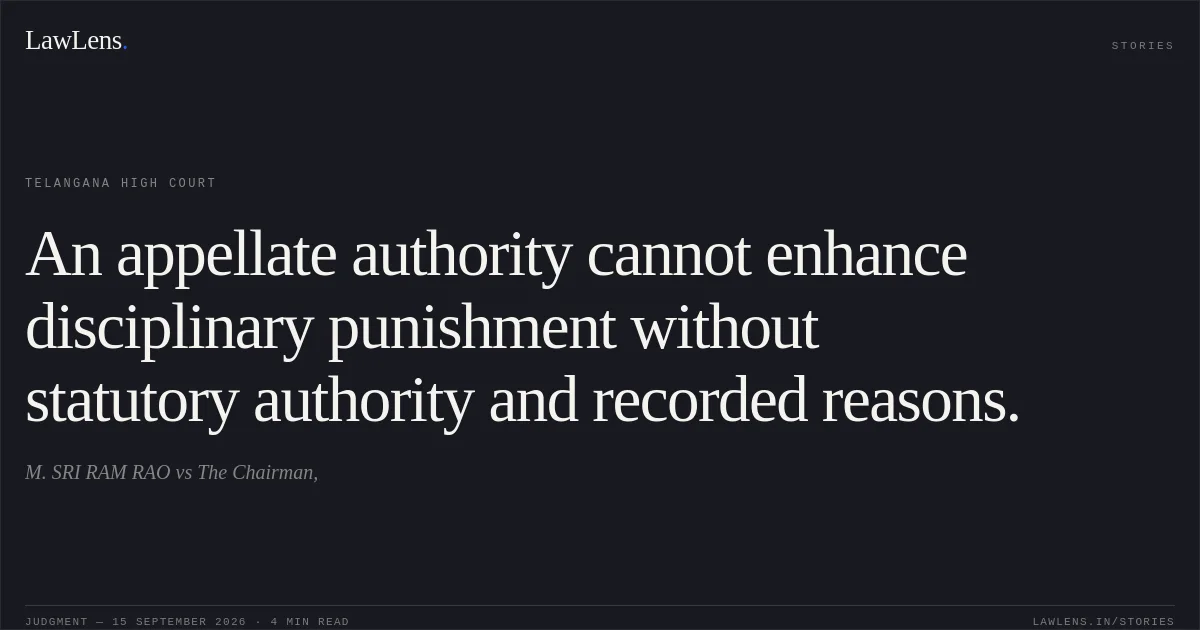
The Court applied the principle that an appellate authority hearing an appeal filed by an aggrieved employee cannot, in the absence of an enabling statutory or regulatory provision, impose a punishment more severe than that imposed by the Disciplinary Authority, thereby placing the appellant in a worse position for having exercised the right of appeal.
Source reference: paras. 9–11The Court relied on D. Subhash Chandra Bose Babu v. Andhra Pradesh State Electricity Board, 1995 SCC OnLine AP 738, which held that an appellate authority cannot exercise review powers in an employee’s appeal to impose a higher punishment, and Makeshwar Nath Srivastava v. State of Bihar, 1971 (1) SCC 662, which recognised that, absent an enabling provision, an appellate authority may uphold, set aside, or modify the impugned order but cannot impose a higher penalty.
Source reference: paras. 9–11The Court further applied the administrative-law requirement that an authority exercising disciplinary or appellate powers must independently consider the delinquent employee’s explanation and record reasons, particularly when enhancing an existing penalty or directing recovery.
Source reference: paras. 12–14Judicial review under Article 226 does not ordinarily permit reappreciation of departmental findings unless perversity, violation of natural justice, or other jurisdictional error is demonstrated.
Source reference: para. 8Reasoning
The Court upheld the Disciplinary Authority’s order because the petitioner had participated in a departmental enquiry, the charges were found proved, and he failed to establish perversity in the findings or violation of natural justice.
Source reference: para. 8However, the Appellate Authority’s action stood on a different footing.
Source reference: no citationThe respondents did not produce any statutory or regulatory provision specifically empowering the Appellate Authority to enhance the punishment in the petitioner’s appeal.
Source reference: para. 12Even assuming such power existed, the Appellate Authority was required to explain why the original penalty was inadequate and why the additional punishment and recovery were justified.
Source reference: paras. 12–13Instead, it merely observed that the petitioner had raised no new facts and that his submissions had already been dealt with by the Disciplinary Authority.
Source reference: paras. 12–13The Court held that this did not demonstrate independent consideration of the petitioner’s explanation or furnish cogent reasons for enhancement.
Source reference: paras. 12–13The mere issuance of a show-cause notice did not cure the defect because a meaningful opportunity requires consideration of the employee’s response and a reasoned decision.
Source reference: para. 14Holding
Accordingly, the enhanced punishment and salary recovery could not be sustained.
The writ petition was partly allowed.
Source reference: para. 16The Disciplinary Authority’s order dated 8 June 2005 imposing reduction by one stage for three years without cumulative effect was upheld.
Source reference: para. 16The Appellate Authority’s order dated 28 February 2006, insofar as it enhanced the punishment and directed recovery from the petitioner’s salary, was quashed for want of demonstrated authority, independent consideration, and adequate reasons.
Source reference: paras. 15–16Any amount recovered pursuant to the impugned appellate order was directed to be refunded to the petitioner.
Source reference: para. 16Pending miscellaneous petitions, if any, were closed, with no order as to costs.
Source reference: para. 17Original Court PDF
M. SRI RAM RAOvsThe Chairman,
Click to open original judgment
Original judgment, available to read, download and summarize on LawLens.in