Facts
The petitioner/complainant reported that her son, Jai Namdev, had been missing since 28 September 2023.
Source reference: paras. 1–3During investigation, his dead body was recovered and the respondent child was alleged to have committed the offences under Sections 363, 302 and 201 of the IPC.
Source reference: paras. 1–3Since the respondent was aged 16 years, 7 months and 10 days on the date of the alleged offence, the charge-sheet was filed before the Juvenile Justice Board (“JJB”).
Source reference: paras. 1–3After considering the respondent’s school records, psychological report and social investigation report, the JJB conducted a preliminary assessment under Section 15 of the Juvenile Justice (Care and Protection of Children) Act, 2015 (“JJ Act”).
Source reference: para. 3It concluded that the respondent could understand the consequences of the alleged offence and transferred the matter to the Children’s Court for trial as an adult.
Source reference: para. 3On appeal under Section 101 of the JJ Act, the Fourth Additional Sessions Judge set aside the JJB’s order, holding that the psychological and social investigation reports did not specifically establish the respondent’s ability to understand the far-reaching consequences of the offence, its social stigma, or his emotional competence to control his actions.
Source reference: para. 4The complainant challenged that order under Section 102 of the JJ Act.
Source reference: para. 1Issues
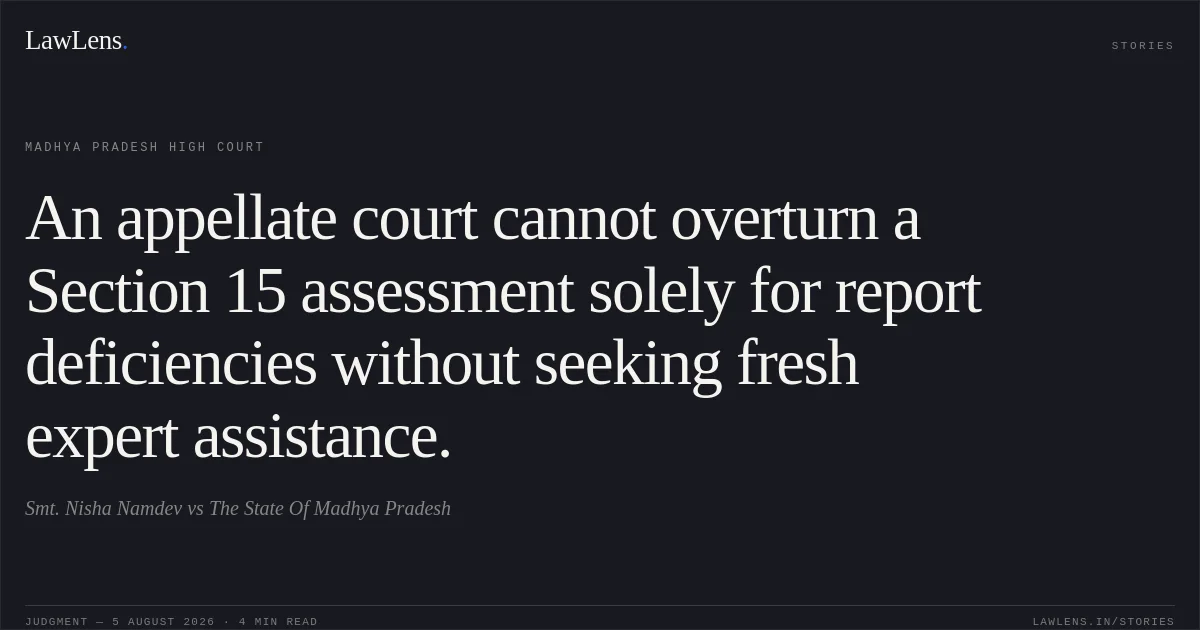
Whether the appellate court was justified in setting aside the JJB’s preliminary assessment under Section 15 of the JJ Act solely because the existing psychological and social investigation reports did not expressly address every relevant factor concerning the respondent’s maturity and understanding of consequences?
Source reference: paras. 8–11Whether, upon finding deficiencies in the expert material relied upon by the JJB, the appellate court ought to have independently sought assistance from another experienced psychologist or medical specialist before deciding the appeal?
Source reference: paras. 9–11Whether the matter required reconsideration on the basis of a holistic assessment of the respondent’s psychological condition, maturity, background and the circumstances of the alleged heinous offence?
Source reference: paras. 11–12Law Applied
The Court applied Sections 15, 101 and 102 of the JJ Act.
Source reference: paras. 1, 3, 4, 9Section 15 requires the JJB to conduct a preliminary assessment, in cases involving children aged between 16 and 18 years alleged to have committed heinous offences, regarding the child’s mental and physical capacity to commit the offence, ability to understand its consequences, and the circumstances in which the offence was allegedly committed.
Source reference: paras. 1, 3, 9Section 101 permits an appeal against the JJB’s order, while Section 102 confers revisional jurisdiction on the High Court.
Source reference: paras. 1, 4The Court relied on X v. State of Bihar and Another, 2026 INSC 728, and the principles extracted from Child in Conflict with Law v. State of Gujarat, 2023 SCC OnLine Guj 3119, holding that an appellate court is not bound by the reports placed before the JJB and may independently obtain assistance from experienced psychologists or medical specialists.
Source reference: para. 10The Court further held that preliminary assessment must be holistic and should consider the circumstances of the alleged offence, mental and emotional maturity, intellectual capacity, social and family background, behavioural pattern, psychological conditions, physical and educational maturity, prior conduct, and likely consequences of the offence; no single report or circumstance is conclusive.
Source reference: paras. 10–12Reasoning
The JJB had considered the psychological and social investigation reports along with the alleged conduct of the respondent—namely, strangulation of the deceased and subsequent attempts to disfigure the body and conceal the identity of the deceased—and concluded that he could understand the consequences of the offence.
Source reference: para. 8The appellate court, however, merely observed that the reports did not expressly refer to far-reaching consequences, social stigma, intelligence, or emotional competence and consequently set aside the JJB’s order.
Source reference: paras. 8–9The High Court held that, once the appellate court found the expert report deficient, it should have exercised its power to obtain an independent assessment from another experienced psychologist or medical specialist rather than rejecting the JJB’s determination outright.
Source reference: paras. 9–11The Court also emphasised that the seriousness or heinous nature of the alleged offence alone cannot determine the outcome; the Board or appellate court must independently and holistically evaluate all relevant circumstances, while balancing the child’s rehabilitative interests against societal concerns.
Source reference: paras. 11–12Holding
The High Court allowed the criminal revision and set aside the Fourth Additional Sessions Judge’s order dated 26 April 2024.
The matter was remanded to the Fourth Additional Sessions Judge for fresh consideration in accordance with the applicable legal principles, including the power to obtain a fresh report or assistance from an experienced psychologist or medical specialist, without being influenced by the High Court’s observations.
Source reference: paras. 9, 11, 13The Court therefore did not finally determine whether the respondent should be tried as an adult; that question was left open for fresh adjudication by the appellate court.
Source reference: para. 13The child’s identity was directed to remain concealed in conformity with Section 74 of the JJ Act.
Source reference: para. 15Acts & Sections Cited
8 provisions across 2 statutes referred to in this judgment. Each provision opens on LawLens.
Juvenile Justice (Care and Protection of Children) Act, 2015.5
Indian Penal Code, 18603
Original Court PDF
Smt. Nisha NamdevvsThe State Of Madhya Pradesh
Click to open original judgment
Original judgment, available to read, download and summarize on LawLens.in