Facts
The appellant, Bibi Shavrin (PW-2), alleged that respondent no. 2, Pawan Kumar Sah, had previously harassed her husband, Umar Khayam @amp; Tunna (PW-3), and had demanded money from him.
Source reference: paras. 3–4She alleged that on 5 February 2016, Pawan and his associate called her husband to court; when he did not return, she contacted Pawan, who allegedly stated that he had killed and thrown away her husband, a conversation which she claimed to have recorded.
Source reference: paras. 3–4On this basis, Mojahidpur P.S. Case No. 24 of 2016 was registered under Sections 364 and 365 IPC on 6 February 2016.
Source reference: paras. 3–4The prosecution examined five witnesses, including the victim, his wife, the victim’s brother, and two Investigating Officers; the accused examined himself as a defence witness.
Source reference: para. 6The trial court acquitted Pawan Kumar Sah of offences under Sections 364A and 365 IPC, finding material gaps in the investigation and insufficient corroboration of the testimony of the related prosecution witnesses.
Source reference: paras. 8–13The appellant challenged the acquittal before the High Court.
Source reference: no citationIssues
Whether the prosecution proved beyond reasonable doubt that respondent no. 2 abducted or wrongfully confined PW-3, thereby committing offences under Sections 364A and 365 IPC.
Source reference: paras. 32–42Whether the testimony of PW-1, PW-2, and PW-3, in the absence of independent or corroborative evidence, was sufficient to sustain a conviction.
Source reference: paras. 35–42Whether the trial court’s order of acquittal disclosed such an erroneous or impermissible view as to warrant appellate interference.
Source reference: para. 43Law Applied
The Court applied Sections 364A and 365 IPC, concerning kidnapping/abduction for ransom or other specified purposes and wrongful confinement following kidnapping or abduction.
Source reference: no citationIt applied the general principle that the prosecution must establish guilt beyond reasonable doubt, particularly where the case rests substantially on circumstantial evidence.
Source reference: no citationThe Court considered the “last seen” principle relied upon by the appellant from Pohalya Motya Valvi v. State of Maharashtra, AIR 1979 SC 1949, but noted that the prosecution first had to establish that the accused and victim were actually seen together.
Source reference: para. 15It also referred to Muluwa Son of Binda v. State of Madhya Pradesh, AIR 1976 SC 989, for the principle that infirm evidence does not become reliable merely because it is corroborated by witnesses of the same category.
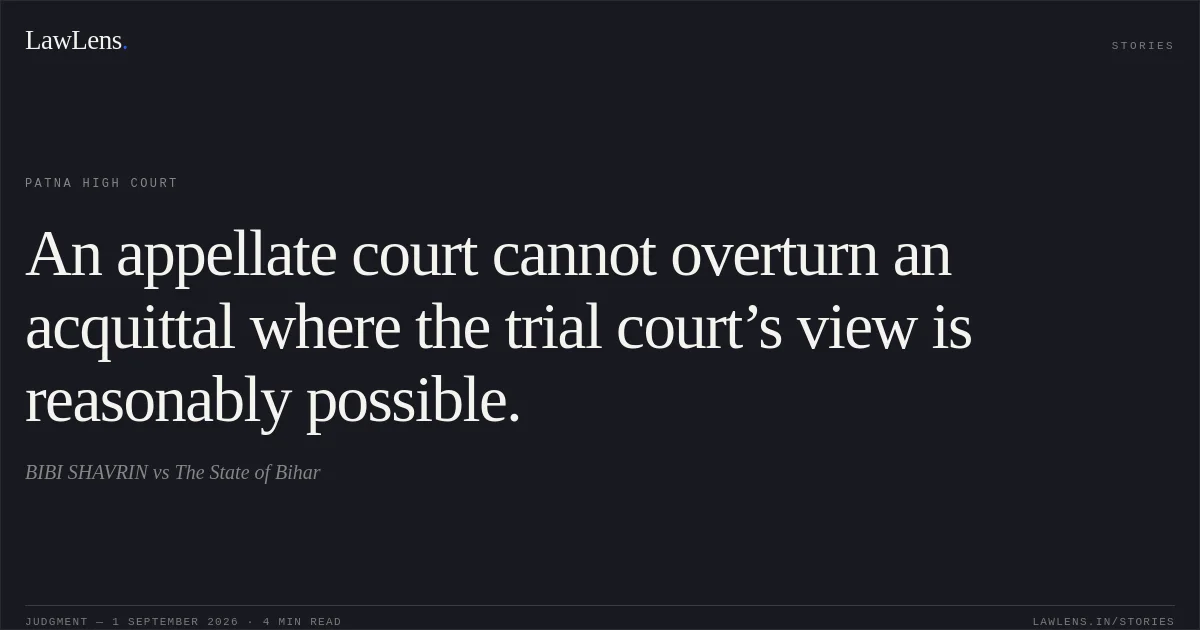
Source reference: para. 29On appeals against acquittal, the Court relied on H.D. Sundara v. State of Karnataka, (2023) 9 SCC 581: acquittal strengthens the presumption of innocence; although the appellate court may reappreciate the evidence, it cannot interfere where the trial court’s view is a possible view; interference is justified only where the evidence permits the sole conclusion that guilt was proved beyond reasonable doubt.
Source reference: para. 43Reasoning
The High Court held that the prosecution failed to establish the essential links in the alleged abduction.
Source reference: no citationAlthough PW-3 claimed that Pawan and another person called him, offered him tea, and that he later regained consciousness in confinement, the Investigating Officer did not collect the relevant call-detail records, tower locations, or the alleged recording of the conversation; the phones were also not seized.
Source reference: para. 35No tea vendor or independent witness was examined to prove that PW-3 was last seen with Pawan near the court, and there was no reliable evidence regarding the alleged abandoned motorcycle.
Source reference: paras. 36, 42The prosecution also failed to examine any witness from Kahalgaon Police Station or produce station records to prove that PW-3 had reached there and was thereafter handed over to the investigating agency.
Source reference: para. 26The victim did not claim that Pawan personally confined or threatened him; according to him, an unidentified associate did so, and Pawan was not seen in the room.
Source reference: paras. 37–38The Court further noted inconsistencies and the admitted hostility between the parties, as well as the absence of proof of any prior demand for “rangdari”.
Source reference: paras. 37–42The delay in lodging the FIR and PW-2’s conduct, including her failure to produce the alleged recording or immediately search for her husband after being told that he had been killed, also weakened the prosecution case.
Source reference: paras. 32–34In these circumstances, the trial court’s assessment that the related and inimical witnesses required corroboration was a possible and legally sustainable view.
Source reference: paras. 42–44Holding
The Court answered the issues against the appellant.
It held that the prosecution had not proved beyond reasonable doubt that respondent no. 2 committed the offences under Sections 364A and 365 IPC, and that the uncorroborated testimony of the interested witnesses was insufficient to overturn the acquittal.
Source reference: paras. 42–44Applying the restrictive principles governing appeals against acquittal, the High Court found no compelling error in the trial court’s judgment and dismissed the criminal appeal.
Source reference: paras. 44–46A copy of the judgment and the trial court records was directed to be transmitted to the learned trial court.
Source reference: paras. 44–46Acts & Sections Cited
5 provisions across 3 statutes referred to in this judgment. Each provision opens on LawLens.
Indian Penal Code, 18602
Hindu Marriage Act, 19551
Code of Criminal Procedure, 19732
Original Court PDF
BIBI SHAVRINvsThe State of Bihar
Click to open original judgment
Original judgment, available to read, download and summarize on LawLens.in