Facts
The complainant alleged that, on 20 September 1992, respondent Sricharan Patra slapped and pushed him, causing him to fall on the staircase and sustain a bleeding gum injury; the other respondents allegedly abused, assaulted, or threatened him with a farsa.
Source reference: pp. 3–4The complainant claimed that the police refused to receive his written FIR, following which he instituted I.C.C. Case No. 149 of 1992. He examined himself and two alleged independent eyewitnesses, while the defence examined one witness and relied on documentary exhibits.
Source reference: p. 5The learned S.D.J.M., Bhubaneswar, disbelieved the prosecution case on account of contradictions, non-production of the blood-stained shirt, absence of medical evidence, and non-examination of neighbours, and acquitted the respondents on 26 March 1994.
Source reference: pp. 5–6The complainant obtained leave to appeal under Section 378(4) of the Code of Criminal Procedure, 1973, on 27 October 1994.
Source reference: p. 2After the appeal remained pending for over three decades, the High Court appointed learned counsel as amicus curiae for the appellant.
Source reference: p. 2Issues
Whether the trial court’s appreciation of the prosecution evidence and consequent acquittal of the respondents were perverse, wholly unreasonable, or based on misreading or omission of material evidence.
Source reference: pp. 8–10, 16Whether, in an appeal against acquittal under Section 378(4) Cr.P.C., the High Court could reverse the acquittal merely because another view of the evidence was possible.
Source reference: pp. 8–10, 13–16Whether the passage of more than thirty years after the acquittal constituted an additional reason not to interfere in the absence of compelling and substantial grounds.
Source reference: p. 17Law Applied
The Court applied Section 378(4) of the Code of Criminal Procedure, 1973, governing an appeal against acquittal by a complainant.
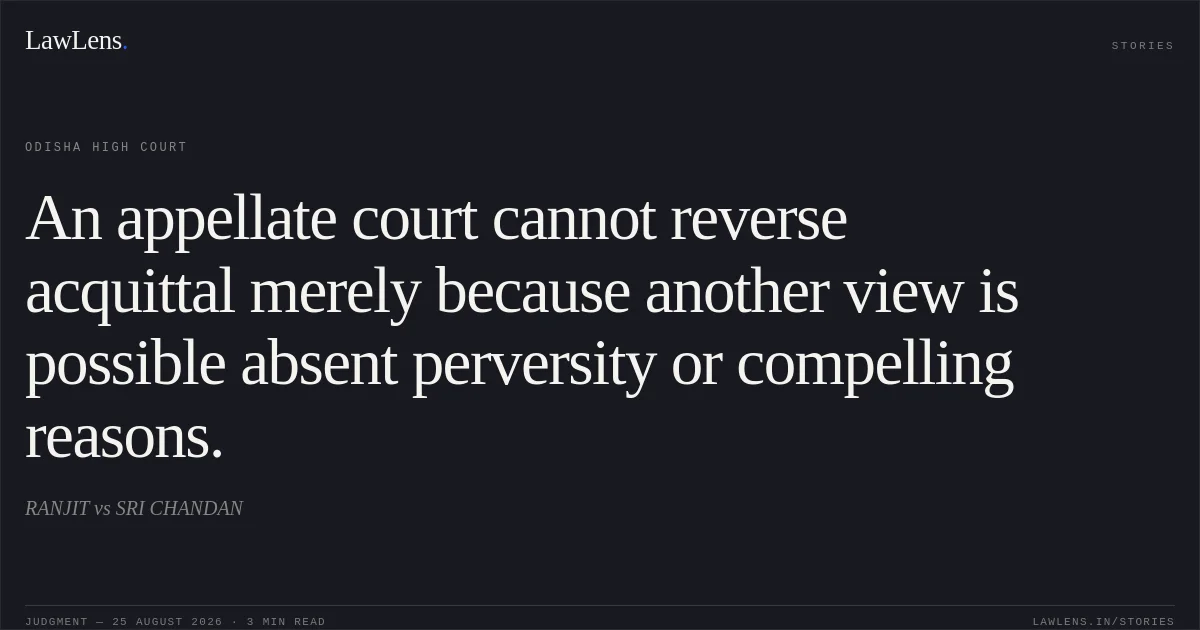
Source reference: p. 1It relied on the settled principle that an appellate court may reappreciate the evidence in an appeal against acquittal, but must respect the strengthened presumption of innocence arising from acquittal and should not interfere where the trial court has taken a possible or plausible view.
Source reference: pp. 8–10Interference is justified only where the acquittal is perverse, impossible, clearly unreasonable, founded on misreading or omission of material evidence, or where compelling and substantial reasons demonstrate that guilt was proved beyond reasonable doubt and no other conclusion was possible, as reiterated in Tulasareddi @ Mudakappa v. State of Karnataka, 2026 INSC 67, Ballu v. State of Madhya Pradesh, (2024) 12 SCC 202, H.R. Sundara v. State of Karnataka, 2023 INSC 858, and Mallappa v. State of Karnataka, 2024 INSC 104.
Source reference: pp. 8–15Suspicion, however strong, cannot substitute proof beyond reasonable doubt.
Source reference: pp. 10–13Reasoning
The High Court found that the trial court had reasonably relied on material weaknesses in the prosecution case, including the complainant’s repeated visits to the respondents’ quarters despite the alleged earlier hostility, the improbability of the alleged participation of all the accused except Deepak, the non-production of the blood-stained shirt, absence of proved medical treatment, non-examination of neighbours, and contradictions in the evidence of P.Ws. 2 and 3.
Source reference: pp. 5–8Although the appellant argued that the evidence, viewed cumulatively, supported conviction and that the absence of medical evidence was not decisive, the High Court held that these submissions at most suggested an alternative view of the evidence.
Source reference: p. 7Since the trial court’s view was possible, plausible, and not perverse or wholly unreasonable, the heightened standard governing appellate interference with acquittal was not satisfied.
Source reference: pp. 8–10, 16The Court further considered that the acquittal had remained undisturbed for more than thirty years and that no compelling circumstance justified unsettling the respondents’ reinforced presumption of innocence at such a late stage.
Source reference: p. 17Holding
The High Court answered the issues against the appellant, holding that the trial court’s acquittal was a possible and legally sustainable view of the evidence and that no compelling or substantial ground existed for appellate interference.
The criminal appeal was accordingly dismissed, and the judgment of acquittal dated 26 March 1994 was affirmed.
Source reference: p. 17The Court also directed that the learned amicus curiae be paid an honorarium of ₹5,000 for his assistance.
Source reference: p. 17Acts & Sections Cited
3 provisions across 1 statute referred to in this judgment. Linked provisions open on LawLens.
Code of Criminal Procedure, 19733
Original Court PDF
RANJITvsSRI CHANDAN
Click to open original judgment
Original judgment, available to read, download and summarize on LawLens.in
![Courts will not interfere with transfers absent mala fides or violation of statutory rules.. M Ramya vs EMPLOYEES STATE INSURANCE CORPORATION (ESIC). CAT - ['Chennai']. LawLens](/stories/thumbnails/courts-will-not-interfere-with-transfers-absent-mala-fides-or-violation-of-statutory-rules-a6845e9ca6f548fca284c51c8351957f.webp)
![Courts cannot direct one-time recruitment age relaxation absent authority in the governing rules or advertisement.. UT OF PUDUCHERRY vs M ANDAL. CAT - ['Chennai']. LawLens](/stories/thumbnails/courts-cannot-direct-one-time-recruitment-age-relaxation-absent-authority-in-the-governing-895d78fde47143e2a8ed0207c4b6a44f.webp)
![A review cannot correct an allegedly erroneous decision absent an error apparent on the record.. Ajit Kumar Jha vs RAILWAY BOARD. CAT - ['Delhi']. LawLens](/stories/thumbnails/a-review-cannot-correct-an-allegedly-erroneous-decision-absent-an-error-apparent-on-the-re-8ac952fd4eba470c92f7da20af72a220.webp)