Facts
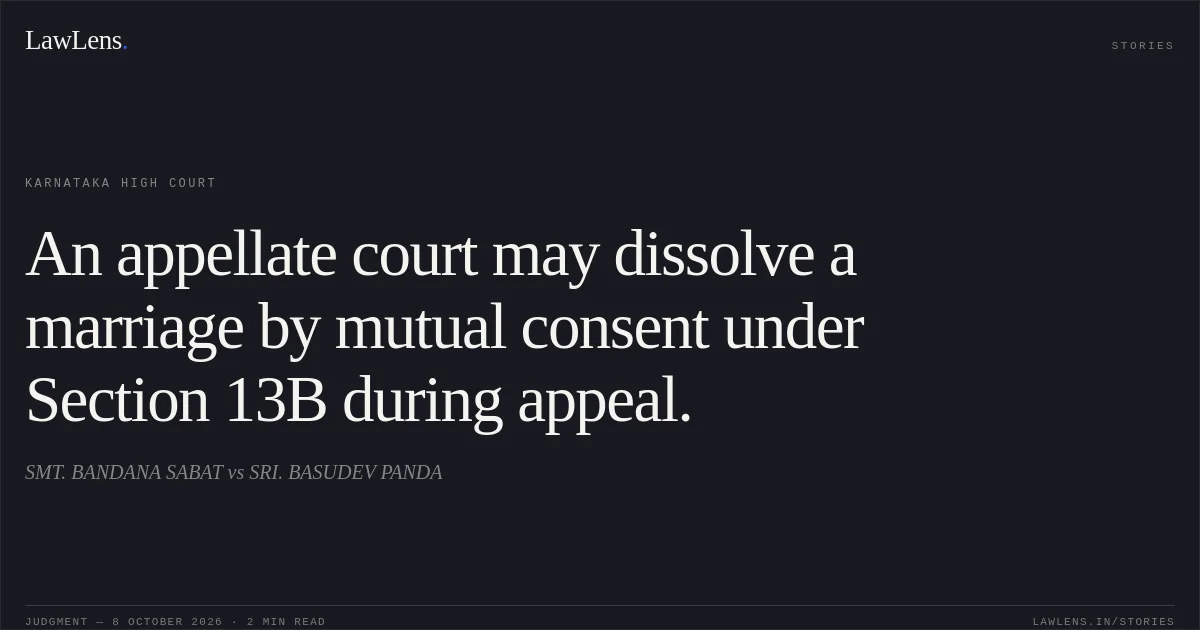
The wife appealed under Section 19(1) of the Family Courts Act, 1984, against the Family Court’s decree allowing the husband’s petition under Section 13(1)(ia) of the Hindu Marriage Act, 1955, and dissolving their marriage.
Source reference: p. 1; p. 2During the appeal, the parties settled their disputes and jointly applied under Section 13B of the Hindu Marriage Act, filing a memorandum of settlement under Section 89 of the Code of Civil Procedure read with Rules 24 and 25 of the Karnataka Civil Procedure (Mediation) Rules, 2005.
Source reference: p. 2The settlement addressed dissolution of the marriage, parenting arrangements, property and financial terms, and closure or withdrawal of pending proceedings.
Source reference: p. 2; p. 3; p. 4; p. 5; p. 6Both parties appeared before the Court and stated that they would abide by the settlement.
Source reference: p. 2; p. 3; p. 4; p. 5; p. 6Issues
1. Whether the parties’ joint application and settlement warranted dissolution of their marriage by mutual consent under Section 13B of the Hindu Marriage Act.
Source reference: p. 2; p. 3; p. 62. Whether the appeal should be disposed of in accordance with the parties’ settlement.
Source reference: p. 6Law Applied
Section 19(1) of the Family Courts Act, 1984, provides for an appeal from a Family Court decree.
Source reference: p. 1Section 13B of the Hindu Marriage Act, 1955, provides for dissolution of marriage by mutual consent.
Source reference: p. 6The Court also recorded that the settlement was presented under Section 89 of the Code of Civil Procedure read with Rules 24 and 25 of the Karnataka Civil Procedure (Mediation) Rules, 2005.
Source reference: p. 2Reasoning
The parties had resolved their matrimonial disputes, jointly sought dissolution by mutual consent, and appeared before the Court to confirm that they would comply with the settlement terms.
Source reference: p. 2; p. 3; p. 4; p. 5; p. 6The Court accepted the settlement and allowed the Section 13B application; it did not separately analyse the individual settlement terms in its reasons.
Source reference: p. 6Holding
The Court allowed I.A. No. 1/2026 under Section 13B and dissolved the marriage solemnized on 14 February 2009 by mutual consent.
It disposed of the appeal in light of the compromise, directed the Registry to draw the decree, and disposed of any pending interlocutory applications.
Source reference: p. 7Acts & Sections Cited
4 provisions across 4 statutes referred to in this judgment. Each provision opens on LawLens.
Family Courts Act, 19841
Hindu Marriage Act, 19551
Code of Civil Procedure, 19081
Code of Criminal Procedure, 19731
Original Court PDF
SMT. BANDANA SABATvsSRI. BASUDEV PANDA
Click to open original judgment
Original judgment, available to read, download and summarize on LawLens.in