Facts
The appellants challenged the judgment dated 7 June 2023 by which the Additional Sessions Judge-III, Madhubani acquitted Runa Devi, Chhedi Sah, Bina Devi and Sanjay Sah of offences under Sections 302 and 120B/34 of the IPC, Section 27 of the Arms Act, and Sections 3 and 4 of the Explosive Substances Act.
Source reference: p. 2, para. 2The appellants’ parents, Renu Kumari and Rajeev Sah, were allegedly shot dead inside their house during the intervening night of 3–4 December 2020 at approximately 2:30 a.m., allegedly in the background of a land dispute involving the accused persons.
Source reference: p. 2, para. 3; pp. 3–4, paras. 4–6The prosecution examined five witnesses, including the doctor and the investigating officer, but the surviving child of the deceased couple, Varsha Kumari, was not examined during the trial despite her statement having been recorded under Section 164 of the CrPC.
Source reference: p. 4, paras. 7–15In an earlier appellate order dated 2 April 2024, the High Court exercised its power under Section 391 CrPC and directed the trial court to record Varsha’s evidence as a vulnerable witness, in the presence of the accused and with an opportunity for cross-examination.
Source reference: pp. 5–7, paras. 17–29Varsha was subsequently examined as Court Witness No. 1 on 10 May 2024, and the accused persons’ statements under Section 313 CrPC were recorded on 10 June 2024.
Source reference: p. 7, para. 5; p. 9, para. 7Issues
1. Whether the High Court could exercise its appellate powers under Sections 386 and 391 CrPC after the acquittal, in view of the material evidence of the surviving child not having been recorded during the original trial.
Source reference: pp. 5–7, paras. 17–212. Whether, after recording the additional evidence of Varsha Kumari, the matter ought to be finally decided by the High Court or remitted to the trial court for a fresh determination after giving the parties adequate opportunity to examine, cross-examine and re-examine witnesses and to be heard.
Source reference: pp. 10–11, paras. 9–113. Whether the acquittal should be set aside without expressing any opinion on the merits of the prosecution evidence.
Source reference: pp. 11–13, paras. 11–17Law Applied
The Court applied Section 386 CrPC, which empowers an appellate court hearing an appeal against acquittal to reverse the acquittal and order a retrial or otherwise pass an appropriate order, and Section 391 CrPC, which permits an appellate court to take additional evidence or direct it to be taken when necessary for a proper decision of the appeal or to prevent failure of justice.
Source reference: pp. 5–7, paras. 18–21The Court emphasised that a fair trial requires fairness not only to the accused but also to the victim, and that the trial judge possesses powers under the CrPC to elicit the truth.
Source reference: p. 6, paras. 16–20It also relied upon Ajitsinh Chehuji Rathod v. State of Gujarat & Anr., 2024 SCC OnLine SC 77, concerning the controlled exercise of the power to receive additional evidence under Section 391 CrPC to secure the ends of justice.
Source reference: pp. 5–6, para. 17The charges themselves arose under Sections 302 and 120B/34 IPC, Section 27 of the Arms Act, and Sections 3 and 4 of the Explosive Substances Act.
Source reference: p. 2, para. 2Reasoning
The High Court found that Varsha Kumari was a material eyewitness because she was present in the room when her parents were allegedly killed, yet the prosecution had not examined her at trial despite the investigating officer having recorded her statement under Section 164 CrPC.
Source reference: pp. 4–5, paras. 12–15To avoid prejudice to the accused, the Court directed that her evidence be recorded under Section 391 CrPC in accordance with vulnerable-witness safeguards and with a full opportunity for cross-examination.
Source reference: pp. 6–7, paras. 21–26After her evidence was recorded, the Court noted that the defence might require further opportunity to confront the investigating officer regarding alleged omissions and contradictions, and that the defence had also not been afforded a proper opportunity to lead evidence after the Section 313 examination.
Source reference: pp. 8–11, paras. 6–10Since the evidentiary record was incomplete and the trial court had not assessed the additional evidence, the High Court considered a fresh trial-court determination more appropriate than either recording an immediate conviction or affirming the acquittal.
Source reference: p. 11, para. 11; p. 13, para. 16It therefore declined to express any view on the credibility or ultimate evidentiary value of the witnesses.
Source reference: p. 11, para. 11; p. 13, para. 16Holding
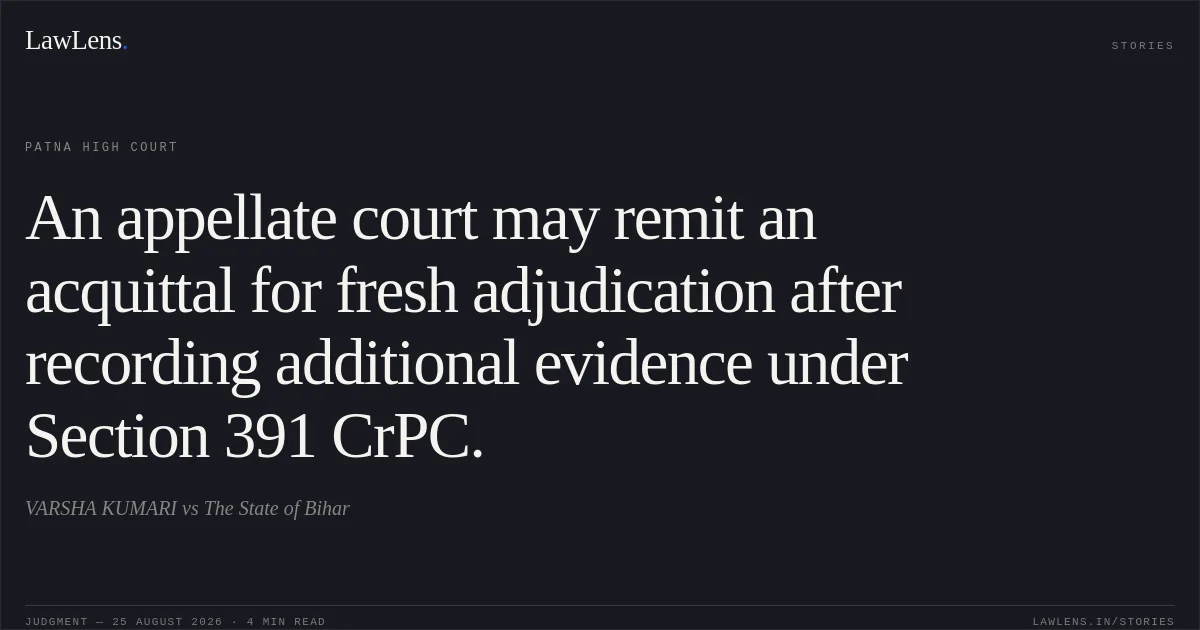
The appeal was allowed to the extent that the judgment of acquittal dated 7 June 2023 was set aside and the matter was remitted to the Additional Sessions Judge-III, Madhubani for fresh consideration.
The trial court was directed to provide the prosecution and defence adequate opportunities to examine, cross-examine and re-examine witnesses, as necessary, and thereafter to hear both sides and pass a fresh judgment or order within four months of receiving the records.
Source reference: p. 12, paras. 12–13Runa Devi, Chhedi Sah and Bina Devi were permitted to remain on bail on their existing bail bonds, while Sanjay Sah, who had been in custody when the acquittal was delivered, was directed to surrender before the trial court within two weeks.
Source reference: pp. 12–13, paras. 14–15The High Court expressly clarified that it had made no finding on the merits of the prosecution case or the evidentiary value of the witnesses.
Source reference: p. 13, para. 16Acts & Sections Cited
5 provisions across 3 statutes referred to in this judgment. Each provision opens on LawLens.
Indian Penal Code, 18602
Arms Act, 19591
Original Court PDF
VARSHA KUMARIvsThe State of Bihar
Click to open original judgment
Original judgment, available to read, download and summarize on LawLens.in
![Courts will not interfere with transfers absent mala fides or violation of statutory rules.. M Ramya vs EMPLOYEES STATE INSURANCE CORPORATION (ESIC). CAT - ['Chennai']. LawLens](/stories/thumbnails/courts-will-not-interfere-with-transfers-absent-mala-fides-or-violation-of-statutory-rules-a6845e9ca6f548fca284c51c8351957f.webp)
![Courts cannot direct one-time recruitment age relaxation absent authority in the governing rules or advertisement.. UT OF PUDUCHERRY vs M ANDAL. CAT - ['Chennai']. LawLens](/stories/thumbnails/courts-cannot-direct-one-time-recruitment-age-relaxation-absent-authority-in-the-governing-895d78fde47143e2a8ed0207c4b6a44f.webp)
![A review cannot correct an allegedly erroneous decision absent an error apparent on the record.. Ajit Kumar Jha vs RAILWAY BOARD. CAT - ['Delhi']. LawLens](/stories/thumbnails/a-review-cannot-correct-an-allegedly-erroneous-decision-absent-an-error-apparent-on-the-re-8ac952fd4eba470c92f7da20af72a220.webp)