Facts
The applicant was convicted under Section 138 of the Negotiable Instruments Act, 1881, and sentenced to three months’ imprisonment.
Source reference: para. 1–6On appeal, the First Additional Sessions Judge suspended the conviction and sentence but directed him to deposit 20% of the compensation within 60 days.
Source reference: para. 1–6The applicant challenged that condition under Section 528 of the Bharatiya Nagarik Suraksha Sanhita, 2023, contending that the direction was non-speaking and that the appellate court had not considered his financial circumstances or whether the case warranted dispensing with the deposit
Source reference: para. 1–6Issues
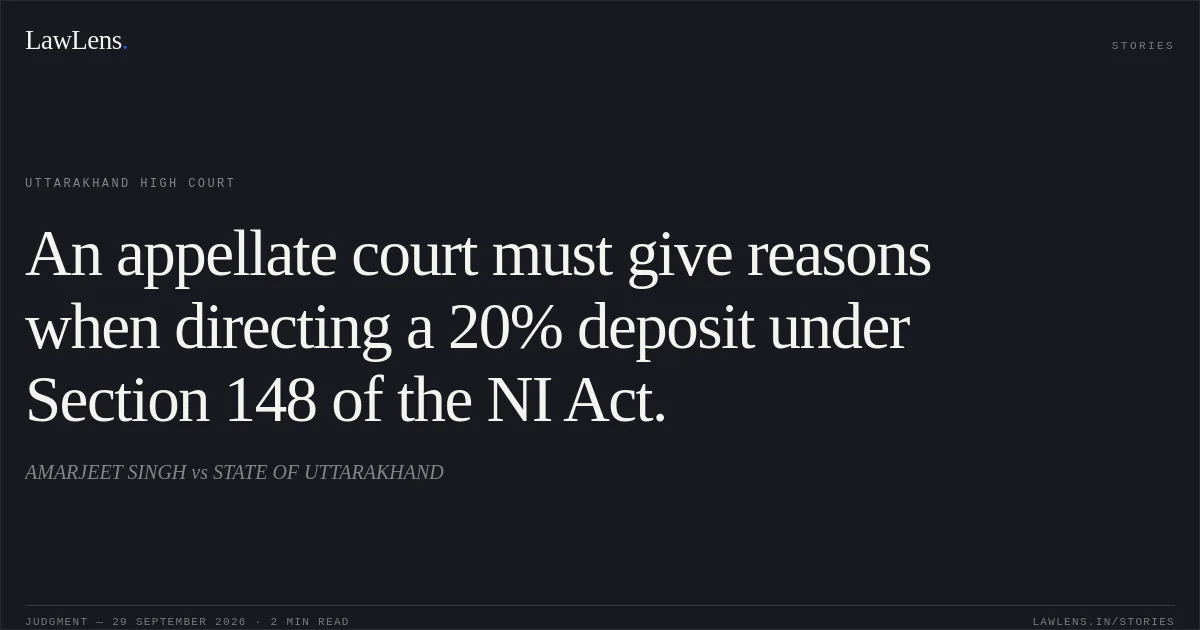
1. Whether the appellate court’s direction to deposit 20% of the compensation under Section 148 of the Negotiable Instruments Act could stand when it gave no reasons for imposing that condition
Source reference: para. 8–102. Whether the applicant should be permitted to seek waiver of the deposit condition by establishing his financial circumstances
Source reference: para. 10Law Applied
Section 148 of the Negotiable Instruments Act governs an appellate court’s power to direct a deposit when suspending a sentence in an appeal arising from a conviction under Section 138.
Source reference: para. 6–7, 10Relying on Jamboo Bhandari v. M.P. State Industrial Development Corporation Ltd., (2023) 10 SCC 446, and Muskan Enterprises v. State of Punjab, (2024) 20 SCC 85, the court treated the deposit direction as one requiring judicial consideration: the appellate court must consider whether sufficient grounds exist to dispense with deposit and exercise its discretion on the circumstances of the case
Source reference: para. 6–7, 10Reasoning
The appellate court directed the deposit without recording reasons or addressing whether the circumstances justified dispensing with it.
Source reference: para. 8–10The High Court therefore found the order non-speaking and insufficient to show that the appellate court had considered the relevant issue under Section 148.
Source reference: para. 8–10Rather than determine whether the applicant was entitled to waiver, the High Court allowed him to renew his request and directed the appellate court to decide it with reasons, taking account of the cited Supreme Court decisions and proof of the applicant’s financial status
Source reference: para. 8–10Holding
The High Court set aside the impugned order and permitted the applicant to apply afresh for waiver of the 20% deposit, with supporting proof of his financial status, within 15 days of receiving the order.
If such an application is filed, the appellate court must decide it by a reasoned order in light of the cited Supreme Court decisions.
Source reference: para. 10–11The application under Section 528 BNSS was disposed of, without the High Court deciding whether the deposit should ultimately be waived
Source reference: para. 10–11Acts & Sections Cited
4 provisions across 3 statutes referred to in this judgment. Each provision opens on LawLens.
Bharatiya Nagarik Suraksha Sanhita, 20231
Negotiable Instruments Act, 18812
Code of Criminal Procedure, 19731
Original Court PDF
AMARJEET SINGHvsSTATE OF UTTARAKHAND
Click to open original judgment
Original judgment, available to read, download and summarize on LawLens.in