Facts
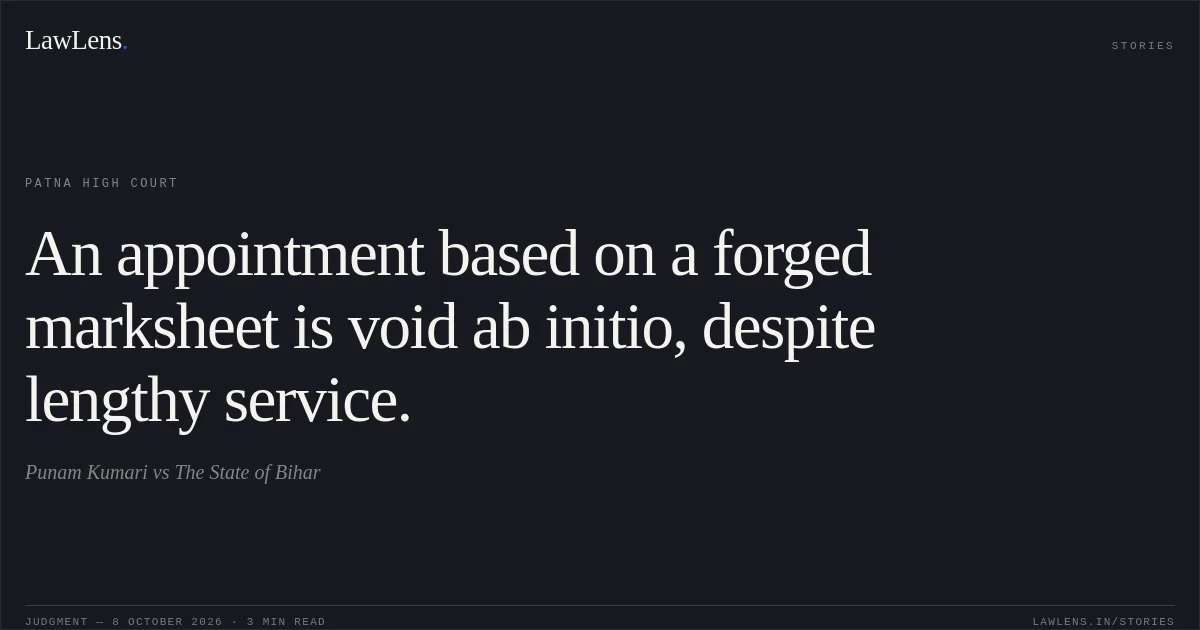
Punam Kumari appealed against the judgment setting aside her appointment as a Panchayat Teacher in Gram Panchayat Raj Dumariya.
Source reference: para. 13–18, 30–37Her selection was based on marks attributed to her in the Intermediate examination.
Source reference: para. 13–18, 30–37Sunita Kumari, the writ petitioner, alleged that Punam had actually obtained 384 out of 900 marks (42.66%), rather than the 72.77% reflected in the selection record.
Source reference: para. 13–18, 30–37Punam admitted before the District Appellate Authority that she had obtained 384 marks.
Source reference: para. 13–18, 30–37The District and State Appellate Authorities rejected Sunita’s challenge, principally on delay; the Single Judge later set aside those orders and Punam’s appointment, but declined to direct Sunita’s appointment because she lacked the requisite teachers’ training.
Source reference: para. 13–18, 30–37Punam’s Letters Patent Appeal challenged that decision, including on grounds of delay and the finding concerning the marks-sheet.
Source reference: para. 3–6Issues
1. Whether the Single Judge was justified in setting aside Punam’s appointment upon finding that it had been secured on the basis of a forged and fabricated marks-sheet
Source reference: para. 122. Whether delay in challenging the appointment, or Punam’s period of service, warranted sustaining the appointment
Source reference: para. 29–333. Whether the Single Judge improperly directed Sunita’s appointment in Punam’s place
Source reference: para. 34–37Law Applied
The Court applied the principle fraus omnia corrumpit—fraud vitiates the proceeding—and held that an appointment obtained through forged documents or misrepresentation is void ab initio and does not create an equity in the appointee’s favour.
Source reference: para. 21–26It relied on Jainendra Singh v. State of Uttar Pradesh, (2012) 8 SCC 748, concerning appointments procured through forged documents; Vijay Kishanrao Kurundkar v. State of Maharashtra, 2020 SCC OnLine SC 834, on appointments based on fraudulent certificates being void ab initio; and Chairman and Managing Director, Food Corporation of India v. Jagdish Balram Bahira, (2017) 8 SCC 670.
Source reference: para. 21–26The Court also applied the principle that passage of time or length of service does not validate an appointment founded on fraud.
Source reference: para. 25, 33It noted that Section 23(2) of the Right of Children to Free and Compulsory Education Act, 2009, and the notification dated 9 August 2017 were relevant to the writ petitioner’s training qualification.
Source reference: para. 36Reasoning
The Court found that Punam’s merit position depended on the marks attributed to her in the Intermediate examination, but the record showed that she had obtained 384 out of 900 marks, and she had admitted those marks before the District Appellate Authority.
Source reference: para. 17–20, 27, 39The discrepancy undermined the foundation of her selection and supported the Single Judge’s finding that the appointment rested on a forged or fabricated marks-sheet.
Source reference: para. 17–20, 27, 39The Court rejected the delay argument because Sunita had approached the High Court in 2012 and thereafter pursued the remedies identified by the Court and the appellate authorities; Punam’s length of service could not cure an appointment founded on fraud.
Source reference: para. 30–33Nor had the Single Judge substituted Sunita for Punam: the Court had declined to order Sunita’s appointment because she lacked the requisite training.
Source reference: para. 35–37Holding
The Court answered the principal issue in the affirmative and held that the Single Judge was justified in setting aside Punam’s appointment.
Finding no error, perversity, or material misappreciation warranting interference in the intra-court appeal, it dismissed the Letters Patent Appeal and made no order as to costs; any interlocutory applications were also disposed of.
Source reference: para. 28, 38–44Acts & Sections Cited
1 provisions across 1 statute referred to in this judgment. Each provision opens on LawLens.
Right of Children to Free and Compulsory Education Act, 20091
Original Court PDF
Punam KumarivsThe State of Bihar
Click to open original judgment
Original judgment, available to read, download and summarize on LawLens.in