Facts
The respondent-contractor was awarded a Railway contract for constructing 24 houses at Jabalpur, originally scheduled for completion within 11 months.
Source reference: para. 2, p. 1The work was completed after approximately 27 months, with delay attributable to both parties.
Source reference: para. 2, p. 1The contractor raised several claims, including claims relating to penalty, waterproofing, doors and windows, material-price differences, pipes, and idling charges for labour, machinery, a graduate engineer, a supervisor, and a watchman.
Source reference: para. 2, p. 1A three-member arbitral tribunal, comprising senior Railway officers, passed an award dated 28 August 2014 allowing various claims, including Claims Nos. 11, 12 and 13 concerning idling of the graduate engineer, supervisor and watchman.
Source reference: para. 1, p. 1; para. 11, p. 4The Union of India challenged the award under Section 34 of the Arbitration and Conciliation Act, 1996. The Additional District Judge, Jabalpur, rejected the challenge on 14 December 2016 and upheld the award, leading to the present appeal under Section 37.
Source reference: para. 1, p. 1Issues
Whether the arbitral award was liable to be set aside under Section 34(2)(b) of the Arbitration and Conciliation Act, 1996, on the ground that it conflicted with the public policy of India.
Source reference: paras. 5, 7–10, pp. 2–3Whether the alleged absence of detailed reasons for allowing the claims relating to idling of the graduate engineer, supervisor and watchman justified interference with the award under Section 37.
Source reference: paras. 3–4, pp. 1–2Whether the matter ought to be remanded to the arbitral tribunal for passing a fresh award.
Source reference: para. 5, p. 2Law Applied
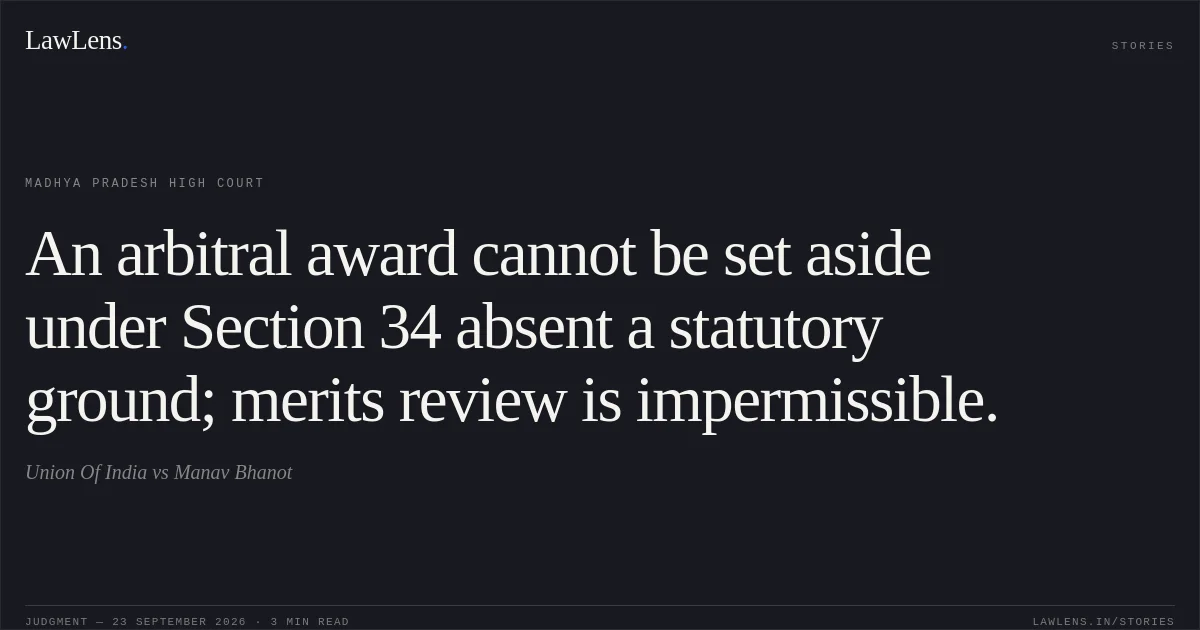
The Court applied Section 34(2)(b) of the Arbitration and Conciliation Act, 1996, under which an arbitral award may be set aside where the subject matter is not arbitrable or where the award conflicts with the public policy of India.
Source reference: para. 7, p. 2Explanation 1 limits conflict with public policy to cases involving fraud or corruption, violation of Sections 75 or 81, contravention of the fundamental policy of Indian law, or conflict with the most basic notions of morality or justice.
Source reference: para. 7, pp. 2–3Explanation 2 provides that determining whether there is a contravention of the fundamental policy of Indian law does not permit a review of the merits of the dispute.
Source reference: para. 7, p. 3The Court also considered the appellant’s reliance on Indian Oil Corporation v. M/s Metro Builders (Orissa) Pvt. Ltd., where absence of discernible reasoning was treated as a fundamental infirmity, but held that the statutory grounds for interference were not established in the present case.
Source reference: para. 4, p. 2Reasoning
The Union of India contended that the tribunal had given no adequate reasoning for allowing the three idling-related claims and relied on the Delhi High Court decision concerning absence of discernible reasoning.
Source reference: paras. 3–4, pp. 1–2The High Court, however, held that the appellant had neither pleaded nor established fraud, corruption, violation of Sections 75 or 81, contravention of the fundamental policy of Indian law, or conflict with the basic notions of morality or justice.
Source reference: paras. 8–9, p. 3It further emphasized that Explanation 2 barred a merits review of the dispute under the guise of examining public policy.
Source reference: para. 10, p. 3The award recorded that the contractor had produced documentary evidence supporting Claims Nos. 11, 12 and 13, and the appellant could not demonstrate any basis for taking a different view.
Source reference: para. 11, p. 4The Court also observed that the Union of India’s failure to properly contest the claims before the arbitral tribunal did not justify a subsequent appeal on what it considered frivolous grounds.
Source reference: para. 11, p. 4Holding
The Court answered the issues against the Union of India.
It held that none of the grounds under Section 34(2)(b)(i) or (ii), including conflict with the public policy of India, had been made out, and that the alleged lack of reasoning concerning the idling claims did not warrant interference.
Source reference: paras. 10–11, pp. 3–4The arbitration appeal under Section 37 was accordingly dismissed, and the order dated 14 December 2016 upholding the arbitral award was affirmed.
Source reference: para. 12, p. 5Acts & Sections Cited
4 provisions across 1 statute referred to in this judgment. Each provision opens on LawLens.
Arbitration and Conciliation Act, 19964
Original Court PDF
Union Of IndiavsManav Bhanot
Click to open original judgment
Original judgment, available to read, download and summarize on LawLens.in