Facts
The Petitioner had obtained a housing loan of ₹7,70,000 from the Respondent-Bank in 2006 under Loan Account No. SCHLN/44, secured by deposit of title deeds relating to Flat No. 102, Sunrise Tower, Thane. The Petitioner claimed that this loan was repaid in March 2023 but that the Bank failed to return the original title deeds.
Source reference: paras. 2(i)–(ii); pp. 2–3The Bank subsequently initiated proceedings under Section 84 of the Multi-State Co-operative Societies Act, 2002 (“MCS Act”) concerning a separate cash-credit facility availed by Respondent No. 2 under Loan Account No. CC/111. The Petitioner was shown as a co-borrower/surety, and his flat was described as collateral security for that facility. The Petitioner denied executing any such documents and alleged that his signatures and the seal of his proprietary concern had been forged.
Source reference: para. 2(iii), (viii); pp. 3–5The Arbitrator proceeded ex parte against the opponents and, by award dated 6 March 2024, directed them jointly and severally to pay ₹18,16,562.64 with interest at 14% per annum, arbitration fees and administrative costs. The award also declared the Petitioner’s flat to be mortgage property and restrained the opponents from creating third-party rights in the secured assets.
Source reference: paras. 1, 18; pp. 1–2, 16–18The Petitioner challenged the award under Section 34 of the Arbitration and Conciliation Act, 1996, contending that he had not been given a meaningful opportunity to present his case, was not a co-borrower or surety for the cash-credit facility, had not mortgaged his flat for that facility, and was not a member of the Respondent-Bank. The Bank argued that notices had been served, that the Petitioner was liable as a co-borrower, and that the award did not suffer from patent illegality.
Source reference: paras. 4–12; pp. 5–12Issues
Whether the arbitral award was liable to be set aside under Section 34 of the Arbitration and Conciliation Act, 1996 for breach of natural justice and denial of a meaningful opportunity to present the Petitioner’s case?
Source reference: paras. 13–16, 18; pp. 12–16, 24–25Whether the award suffered from patent illegality, perversity and absence of reasons by failing to determine whether the Petitioner was a co-borrower or surety for Loan Account No. CC/111 and whether his flat was validly mortgaged as security for that facility?
Source reference: paras. 14–18, 22; pp. 13–16, 25Whether the award was legally sustainable without findings on the Petitioner’s alleged membership of the Bank, the applicability of Section 84 of the MCS Act, and the authenticity of the documents and signatures relied upon by the Bank?
Source reference: paras. 5, 17–18, 22; pp. 6–8, 15–16, 25Law Applied
The Court applied Section 34 of the Arbitration and Conciliation Act, 1996, particularly the grounds of breach of natural justice and patent illegality under Section 34(2A), while recognising that reappreciation of evidence is generally impermissible.
Source reference: paras. 13, 19–20; pp. 12, 18–24Under the principles stated in Associate Builders v. DDA, Ssangyong Engineering & Construction Co. Ltd. v. NHAI, and DMRC Ltd. v. Delhi Airport Metro Express (P) Ltd., an award may be set aside where it is perverse, based on no evidence, ignores vital evidence, adopts a view that no reasonable person could take, or violates fundamental principles of natural justice.
Source reference: paras. 13, 19–20; pp. 12, 18–24The Court also relied on I-Pay Clearing Services (P) Ltd. v. ICICI Bank Ltd., which holds that failure to record findings on contentious issues constitutes patent illegality and that an award cannot ordinarily be remanded merely to fill gaps in reasoning where material issues have not been decided.
Source reference: para. 21; pp. 24–25The proceedings were purportedly conducted under Section 84 of the MCS Act, whose applicability depended upon the nature of the dispute and the Petitioner’s relationship with the Bank.
Source reference: paras. 5, 9, 22; pp. 6–10, 25Reasoning
The Court found that the award merely recorded that notices had been served and that the opponents had been proceeded against ex parte; it did not demonstrate that the Petitioner had been afforded a meaningful opportunity to answer the Bank’s claim or contest the documents relied upon.
Source reference: para. 14; pp. 12–13The Arbitrator also failed to address material contradictions: the housing loan secured by the Petitioner’s flat originated in 2006, whereas the cash-credit facility commenced in 2011; the Petitioner disputed becoming a co-borrower only in 2014; and the relevant documents allegedly bore forged signatures and an unauthorised seal.
Source reference: paras. 15–17; pp. 13–16The award did not determine whether the housing loan had been repaid, whether the mortgage extended to the cash-credit facility, how an agreement concerning hypothecation of movable property could secure the Petitioner’s immovable flat, or whether the Petitioner was a Bank member bound by the MCS Act.
Source reference: paras. 15–17; pp. 13–16These omissions concerned the root of liability and security enforcement, were not matters of mere evidentiary reappreciation, and rendered the award non-speaking, perverse and patently illegal under Section 34.
Source reference: paras. 18–22; pp. 16, 24–25Holding
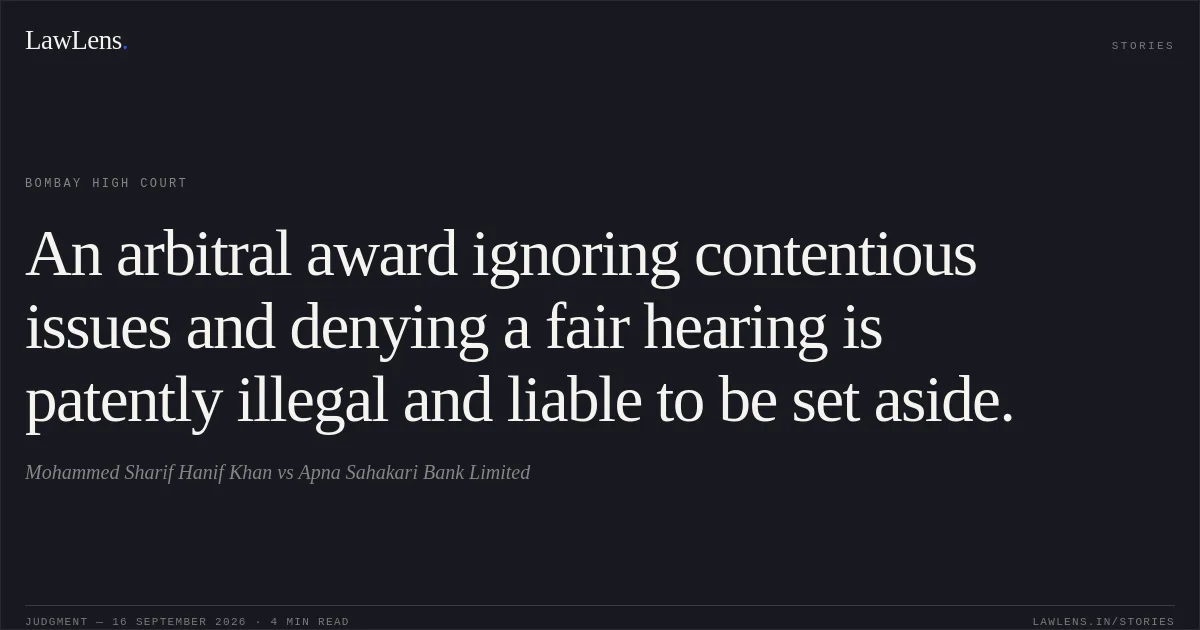
The Court held that the arbitral award was vitiated by breach of natural justice, failure to decide material contentious issues, perversity and patent illegality.
It therefore set aside the arbitral award dated 6 March 2024 under Section 34 of the Arbitration and Conciliation Act, 1996.
Source reference: paras. 22–23; pp. 25–26Any amount deposited in Court was directed to be released within one month of uploading the judgment. The petition was allowed, the interim application was disposed of as infructuous, no costs were awarded, and the parties were left at liberty to commence fresh arbitration proceedings in accordance with law.
Source reference: para. 23; p. 26Acts & Sections Cited
7 provisions across 2 statutes referred to in this judgment. Each provision opens on LawLens.
Arbitration and Conciliation Act, 19965
Multi-State Co-operative Societies Act, 20022
Original Court PDF
Mohammed Sharif Hanif KhanvsApna Sahakari Bank Limited
Click to open original judgment
Original judgment, available to read, download and summarize on LawLens.in