Facts
The landowner and developers entered into a Joint Development Agreement (JDA) and General Power of Attorney on 28 February 2014 for development of one acre in Sy. No. 157, Bidaluru Village.
Source reference: pp. 14–16The project was to be completed within two years, but the developers took no effective steps to develop the property for approximately seven years.
Source reference: pp. 14–16, 19On reference to arbitration, the sole arbitrator cancelled the JDA and GPA and directed that the developers’ advance be forfeited to the landowner.
Source reference: pp. 14–16, 19The Commercial Court, acting under Section 34 of the Arbitration and Conciliation Act, 1996, set aside the forfeiture and gave the developers liberty to pursue recovery of the advance.
Source reference: p. 16The developers challenged that order, while the landowner appealed against the setting aside of the forfeiture.
Source reference: pp. 16–18Issues
1. Whether the Commercial Court was justified under Section 34 in setting aside the arbitral award’s forfeiture of the developers’ advance
Source reference: pp. 16, 202. Whether the developers were entitled to recovery of the advance, including interest, in light of the Commercial Court’s order
Source reference: p. 16Law Applied
Sections 34 and 37 of the Arbitration and Conciliation Act, 1996 governed the challenges to the arbitral award and the Commercial Court’s decision, respectively.
Source reference: pp. 13, 20Section 34 permits only limited judicial interference with an arbitral award on the statutory grounds, including conflict with the public policy of India and patent illegality; courts should not interfere merely because they might have reached a different conclusion.
Source reference: pp. 18–20The Court also relied on party autonomy in arbitration as a reason for exercising restraint.
Source reference: p. 19Reasoning
Although the JDA contained no express provision for forfeiture of the advance, the Court considered the developers’ failure to take effective steps to implement the agreement over seven years.
Source reference: p. 19It held that, in the circumstances, the arbitrator’s direction forfeiting the advance did not conflict with public policy, fundamental policy of Indian law, or basic notions of morality and justice, and was not vitiated by patent illegality.
Source reference: pp. 19–20Accordingly, the Commercial Court had exceeded the permissible limits of Section 34 by setting that part of the award aside.
Source reference: p. 20The Court did not separately grant the developers’ request for interest on the advance.
Source reference: p. 16Holding
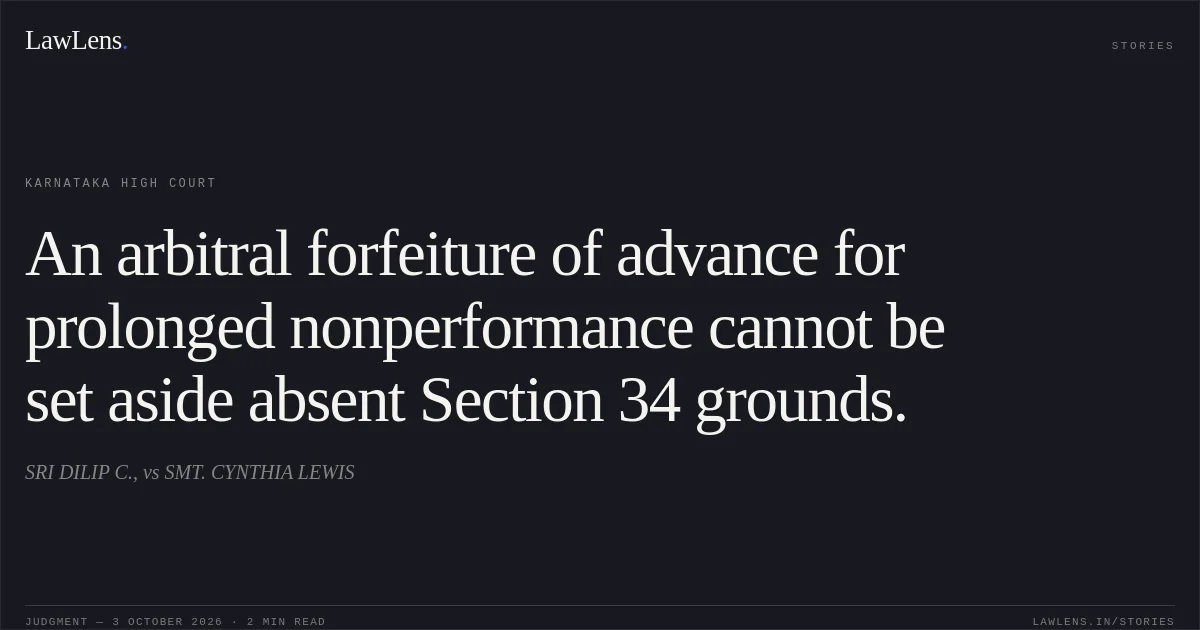
The developers’ appeal was dismissed and the landowner’s appeal was allowed.
The Commercial Court’s decision was affirmed except insofar as it had set aside the arbitrator’s forfeiture of the advance; that interference was set aside, leaving the arbitral forfeiture in effect.
Source reference: p. 21Acts & Sections Cited
3 provisions across 2 statutes referred to in this judgment. Each provision opens on LawLens.
Commercial Courts Act, 20151
Arbitration and Conciliation Act, 19962
Original Court PDF
SRI DILIP C.,vsSMT. CYNTHIA LEWIS
Click to open original judgment
Original judgment, available to read, download and summarize on LawLens.in