Facts
In January 2011, Chennai Metro Rail Corporation Limited awarded the Petitioner a contract for the design and construction of underground stations and associated panels in Chennai.
Source reference: pp. 2–3The Petitioner obtained a Contractor All Risk Insurance Policy No. 112200/44/2011/154 (“Policy No. 154”) from the Respondent on payment of a premium of approximately ₹7.8 crores.
Source reference: pp. 2–3The policy prescribed deductibles of 5% of the claim amount, subject to minimum amounts of ₹20 lakhs for normal claims, ₹50 lakhs for AOG/major perils/maintenance, and ₹1 crore for tunnel collapse/design defect claims.
Source reference: p. 3Following severe flooding and heavy rainfall in December 2015, damage was caused to the project sites. An interim payment of ₹3 crores was made, and the final survey report assessed the gross liability at ₹7,38,19,499, applying the AOG deductible of 5% subject to a minimum of ₹50 lakhs.
Source reference: p. 3However, the Respondent subsequently applied the tunnel risk/collapse deductible of ₹1 crore and also adjusted ₹1 crore allegedly paid under a separate policy, offering ₹2,29,64,223 to the Petitioner. The amount was accepted under protest.
Source reference: p. 3The Petitioner invoked arbitration. The Arbitral Tribunal held that the two insurance policies were distinct and that the Respondent could not adjust ₹1 crore paid under Policy No. 153 against Policy No. 154.
Source reference: p. 4However, by a 2:1 majority, it held that the omission of “tunnel risk” from Policy No. 154 was a typographical error and upheld the application of the ₹1 crore tunnel-risk deductible on the basis of pre-contractual cover notes and discussions.
Source reference: pp. 4–5The Petitioner challenged the majority award under Section 34 of the Arbitration and Conciliation Act, 1996, limited to the finding on Issue C.
Source reference: p. 1Issues
1. Whether the Respondent correctly applied the “tunnel risk/collapse (AOG/normal)” deductible of 5% of the claim amount subject to a minimum of ₹1 crore while settling the Petitioner’s claim under Policy No. 154.
Source reference: pp. 1–2, 42. Whether the majority Arbitral Tribunal could rely on pre-contractual cover notes and discussions to treat the omission of “tunnel risk” from the executed policy as a typographical error and effectively rectify or alter the policy terms.
Source reference: pp. 5–73. Whether the majority award suffered from patent illegality, perversity, jurisdictional error, or violation of the fundamental policy of Indian law warranting interference under Section 34 of the Arbitration and Conciliation Act, 1996.
Source reference: p. 6Law Applied
The Court applied Section 34(2)(a) and Section 34(2)(b) of the Arbitration and Conciliation Act, 1996, permitting interference with an arbitral award on grounds including jurisdictional error, patent illegality, and conflict with the fundamental policy of Indian law.
Source reference: p. 6It relied on the insurance-law principle stated in K. Nagendra v. New India Insurance Co. Ltd. & Ors., 2025 INSC 1270, that once a formal insurance policy is issued, the rights and obligations of the parties are governed by the policy’s terms and conditions, and prior negotiations, cover notes, and discussions merge into the final contract.
Source reference: pp. 6–7The Court further applied Section 26 of the Specific Relief Act, 1963, under which rectification of an instrument cannot ordinarily be granted unless specifically claimed by a party through appropriate pleadings.
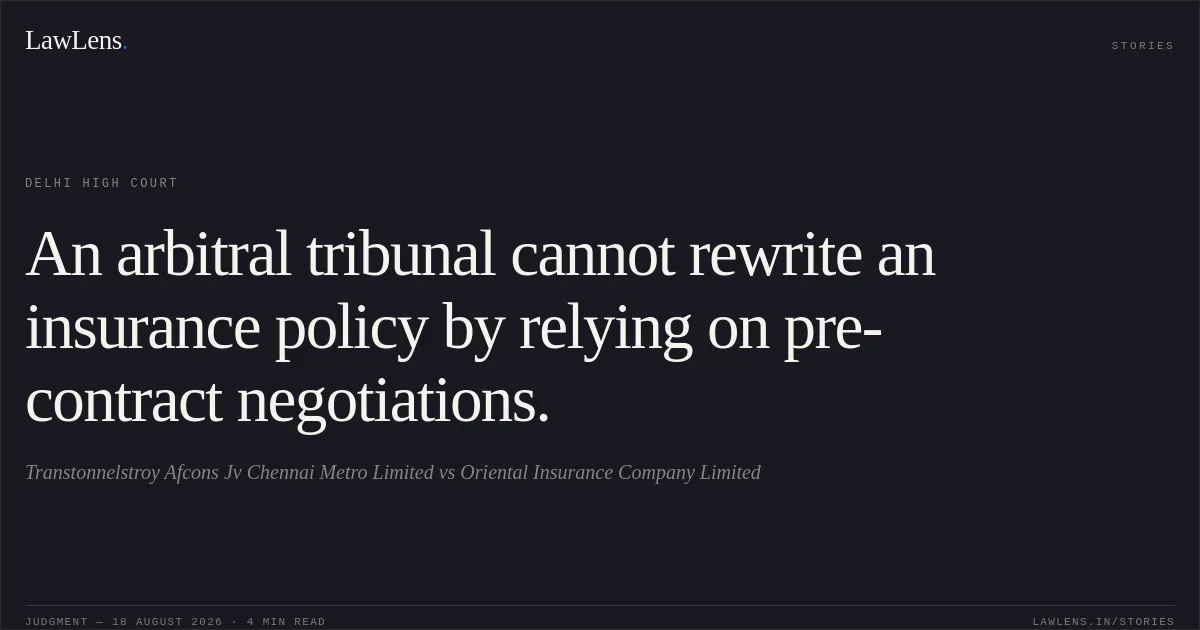
Source reference: p. 7An arbitral tribunal, being a creature of the contract, cannot rewrite or unilaterally correct the parties’ express contractual terms.
Source reference: p. 7Reasoning
The Court held that the majority exceeded its jurisdiction by travelling beyond the executed terms of Policy No. 154 and inserting “tunnel risk” on the basis of pre-contractual material, despite the policy and its deductible schedule not expressly providing for the disputed term in the manner relied upon by the Respondent.
Source reference: pp. 6–7The Court placed particular reliance on the Respondent’s subsequent extension of Policy No. 154 in July 2016, after receipt of an additional premium, where the deductible schedule was reiterated without any correction or reverse tunnel-risk endorsement.
Source reference: p. 7This document was treated as vital evidence that the majority had failed to consider.
Source reference: p. 7The Court also found that the Respondent had neither sought rectification through a counterclaim nor issued a corrective endorsement during the policy’s tenure; therefore, the Tribunal could not unilaterally rectify the insurance contract under the guise of interpretation.
Source reference: p. 7Further, the Tribunal failed to determine the factual question whether the damage occurred in a tunnel or station area, even though that question was material to the application of a tunnel-specific deductible.
Source reference: pp. 7–8Its refusal to adjudicate that foundational issue, coupled with reliance on an unsupported assumption concerning the Respondent’s head-office decision, rendered the majority reasoning perverse and legally unsustainable.
Source reference: pp. 7–8Holding
The Court answered Issue C against the Respondent and held that the ₹1 crore tunnel-risk/collapse deductible could not be applied by relying on pre-contractual documents or by treating the policy as containing an omitted term.
The majority award was found to suffer from patent illegality, jurisdictional error, perversity, and conflict with the fundamental policy of Indian law under Section 34 of the Arbitration and Conciliation Act, 1996.
Source reference: pp. 6–8Accordingly, the petition was allowed and the majority award was set aside to the extent of its findings on Issue C.
Source reference: p. 8Acts & Sections Cited
2 provisions across 2 statutes referred to in this judgment. Each provision opens on LawLens.
Arbitration and Conciliation Act, 19961
Specific Relief Act, 19631
Original Court PDF
Transtonnelstroy Afcons Jv Chennai Metro LimitedvsOriental Insurance Company Limited
Click to open original judgment
Original judgment, available to read, download and summarize on LawLens.in