Facts
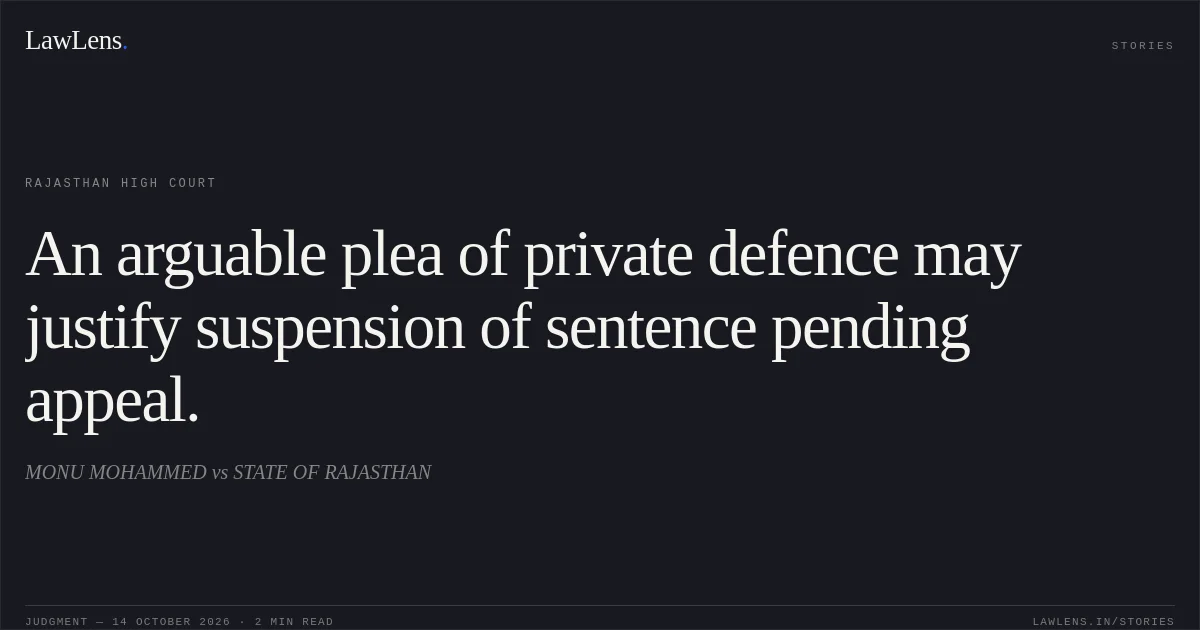
The applicants were convicted by the Additional Sessions Judge, Jayal, for offences under Sections 304 Part II and 323 read with Section 34 IPC and sentenced to five years’ rigorous imprisonment with a fine of Rs. 10,000.
Source reference: para. 1–4, 10They sought suspension of sentence during the pendency of their appeal, relying, among other things, on their conduct while on bail during trial, the expected delay in hearing the appeal, and an arguable plea of private defence.
Source reference: para. 1–4, 10The State opposed the application.
Source reference: para. 1–4, 10Issues
Whether the applicants had raised substantial and arguable grounds warranting suspension of sentence pending appeal.
Source reference: para. 6, 8, 10Whether the applicants’ plea of private defence, including whether the force used exceeded its permissible limits, required reappraisal in the appeal.
Source reference: para. 10Law Applied
Section 430 of the Bharatiya Nagarik Suraksha Sanhita, 2023 (corresponding to Section 389 CrPC) empowers an appellate court to suspend a sentence pending appeal; unlike pre-conviction bail under Section 483 BNSS (corresponding to Section 439 CrPC), its exercise follows conviction and requires prima facie consideration of whether the appeal presents substantial and arguable grounds.
Source reference: para. 5–8The court relied on Muna Bisoi v. State of Odisha and Kashmira Singh v. State of Punjab, (1977) 4 SCC 291, for the relevance of prolonged appeal pendency and continued incarceration.
Source reference: para. 7On private defence, it referred to State of Rajasthan v. Shiv Narayan and Bishna v. State of West Bengal, AIR 2006 SC 302: the assessment of whether defensive force exceeded permissible limits must be contextual, taking account of the apparent danger and circumstances at the time, rather than applying detached, retrospective judgment; private defence is protective, not punitive or retaliatory.
Source reference: para. 10Reasoning
The applicants’ argument that the occurrence involved a right of private defence raised questions requiring reappraisal of the genesis of the incident, the rival accounts of who initiated the assault, the injuries on both sides, and each applicant’s role.
Source reference: para. 9–10The court considered those matters potentially material to whether the applicants acted defensively and whether any force exceeded permissible limits.
Source reference: para. 9–10It therefore found the appeal raised arguable issues that should not be foreclosed at the sentence-suspension stage.
Source reference: para. 9–10The court also took account of the expected delay in disposal of the appeal.
Source reference: para. 9–10Holding
The court allowed the application under Section 430 BNSS and suspended the applicants’ sentences pending disposal of the appeal.
Their release on bail was made subject to execution of a personal bond of Rs. 50,000 with two sureties of Rs. 25,000 each, and conditions including annual appearance before the trial court in January, notification of address changes, and compliance with any further appearance direction.
Source reference: para. 11–12The trial court was directed to maintain a separate attendance file and report any failure to appear to the High Court for consideration of cancellation of bail.
Source reference: para. 11–12Acts & Sections Cited
7 provisions across 3 statutes referred to in this judgment. Each provision opens on LawLens.
Bharatiya Nagarik Suraksha Sanhita, 20232
Code of Criminal Procedure, 19732
Indian Penal Code, 18603
Original Court PDF
MONU MOHAMMEDvsSTATE OF RAJASTHAN
Click to open original judgment
Original judgment, available to read, download and summarize on LawLens.in