01Facts
Petitioner No. 1 obtained an overdraft facility of ₹75 crore from Axis Bank Ltd. and issued three post-dated cheques of ₹25 crore each as security; Petitioners Nos. 2–4 were its directors.
¶ 2–3The cheques were dishonoured for “Funds Insufficient”. Axis Bank issued a statutory notice under Section 138 of the Negotiable Instruments Act, 1881 (NI Act), and thereafter instituted a complaint under Sections 138, 141 and 142 before the Metropolitan Magistrate, Esplanade, Mumbai, on 11 January 2017.
¶ 3During the pendency of the complaint, Axis Bank assigned the loan facilities, securities, financing documents, cheques, return memos, demand notice and associated legal rights to Assets Care and Reconstruction Enterprises Ltd. (ARC), an Asset Reconstruction Company registered under the SARFAESI Act, by a Deed of Assignment dated 27 March 2017.
¶ 4The ARC applied for substitution as complainant under Section 5 of the SARFAESI Act. The Trial Court allowed the application on 5 September 2018, and the Sessions Court dismissed the Petitioners’ revision on 11 February 2021.
¶ 5–602Issues
i.Whether an Asset Reconstruction Company that acquires a bank’s financial assets, including dishonoured cheques taken as security, can be substituted as complainant in a pending prosecution under Sections 138, 141 and 142 of the NI Act?
¶ 1ii.Whether Sections 5(4) and 5(5) of the SARFAESI Act extend to pending criminal proceedings under Section 138 of the NI Act, or are confined to civil suits and proceedings?
¶ 9, 15–17iii.Whether the ARC, although not the original payee of the cheques, qualifies as a “holder in due course” under Section 9 of the NI Act and can therefore maintain the complaint under Section 142(1)(a)?
¶ 8, 18–1903Law Applied
Section 5(2) of the SARFAESI Act provides that, upon acquisition of a financial asset, the ARC is deemed to be the lender and all rights of the original bank vest in it.
p. 9 · ¶ 14Section 5(3) preserves and makes enforceable against or in favour of the ARC all contracts, instruments and legal rights relating to the acquired financial asset.
pp. 9–10 · ¶ 14Sections 5(4) and 5(5) provide that pending suits, appeals and “other proceeding[s] of whatever nature” relating to the financial asset do not abate and may be continued or prosecuted by the ARC, which may seek substitution before any court or authority.
p. 10 · ¶ 14Under Sections 7 and 9 of the NI Act, while the payee is the person named in the cheque, a holder in due course is a person who, for consideration, becomes the possessor of the cheque or derives title to it in the manner prescribed, without notice of defects in title.
¶ 18Section 142(1)(a) permits cognizance of a Section 138 offence upon a complaint by the payee or holder in due course.
¶ 18Relying on D.H. Bhatter v. State Bank of Bikaner and Jaipur, Hari Krishnan Selvakumar v. L&T Infrastructure Finance Co. Ltd., Man Singh Tusaria v. JM Financial Asset Reconstruction Co. Pvt. Ltd. and Paam Pharmaceuticals (I) (P) Ltd. v. India SME Asset Reconstruction Co. Ltd., the Court held that an ARC acquiring the debt and cheques for consideration may qualify as a holder in due course and may be substituted in a pending Section 138 proceeding.
¶ 11–13, 16, 19The Court distinguished Indorama Synthetics (India) Ltd. v. State of Maharashtra and Tayal Cotton Pvt. Ltd. v. State of Maharashtra, which concerned differently worded moratorium or winding-up provisions.
¶ 10, 17Provisions in the judgment · 11 · Linked ones open on LawLens
Securitisation and Reconstruction of Financial Assets and Enforcement of Security Interest Act, 2002 Section 3Section 5Section 27
Negotiable Instruments Act, 1881 Section 7Section 9Section 138Section 141Section 142
Insolvency and Bankruptcy Code, 2016. Section 14
Indian Stamp Act, 1899 Section 8
Recovery Of Debts And Bankruptcy Act, 1993 Section 19
04Reasoning
The Court held that Sections 5(4) and 5(5) of the SARFAESI Act are facilitative and deliberately broad.
¶ 15The expressions “other proceeding of whatever nature”, “any court or other Authority”, and “continued, prosecuted and enforced” were sufficiently wide to include a pending prosecution under Chapter XVII of the NI Act, particularly where the prosecution directly related to the assigned financial asset.
¶ 15The assignment expressly covered the three cheques, their dishonour documents, the statutory notice and the pending complaint, and was made for consideration.
¶ 4, 11Although the ARC could not become the “payee”, because that status was fixed when the cheques were drawn in favour of Axis Bank, the Court held that the ARC acquired possession and rights in the cheques through the assignment and the statutory deeming fiction under Section 5(2) of the SARFAESI Act.
¶ 19Applying D.H. Bhatter and Hari Krishnan Selvakumar, the Court concluded that a formal endorsement was not indispensable and that the ARC qualified as a holder in due course for purposes of Sections 9 and 142 of the NI Act.
¶ 19The decisions in Indorama Synthetics and Tayal Cotton were found inapplicable because they interpreted different statutory expressions in the context of company winding-up and insolvency moratoria.
¶ 1705Holding
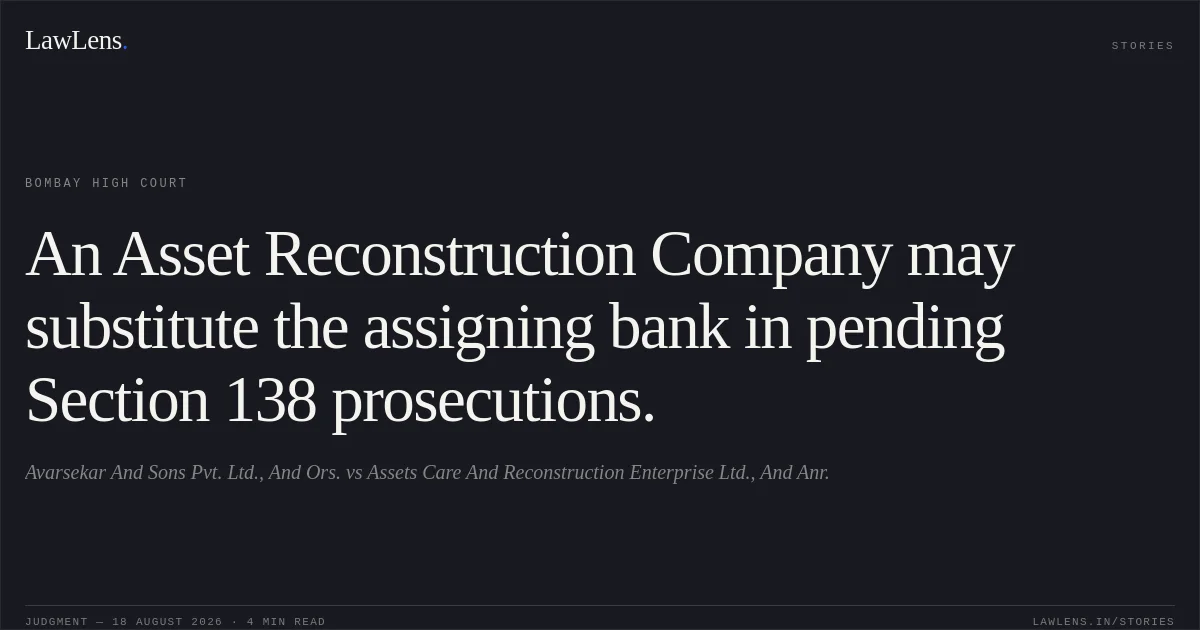
The Bombay High Court held that an ARC which acquires a bank’s financial asset, including the dishonoured cheques and related enforcement rights, may be substituted as complainant in a pending prosecution under Section 138 read with Sections 141 and 142 of the NI Act.
¶ 19The ARC was treated as a holder in due course under Section 9 of the NI Act read with Section 5(2) and (3) of the SARFAESI Act, notwithstanding that it was not the original payee.
¶ 19The Petition was dismissed, and the Trial Court’s order dated 5 September 2018 and the Sessions Court’s order dated 11 February 2021 permitting substitution were upheld.
¶ 19Original Court PDF
Avarsekar And Sons Pvt. Ltd., And Ors.vsAssets Care And Reconstruction Enterprise Ltd., And Anr.
Click to open original judgment
Original judgment, available to read, download and summarize on LawLens.in