Facts
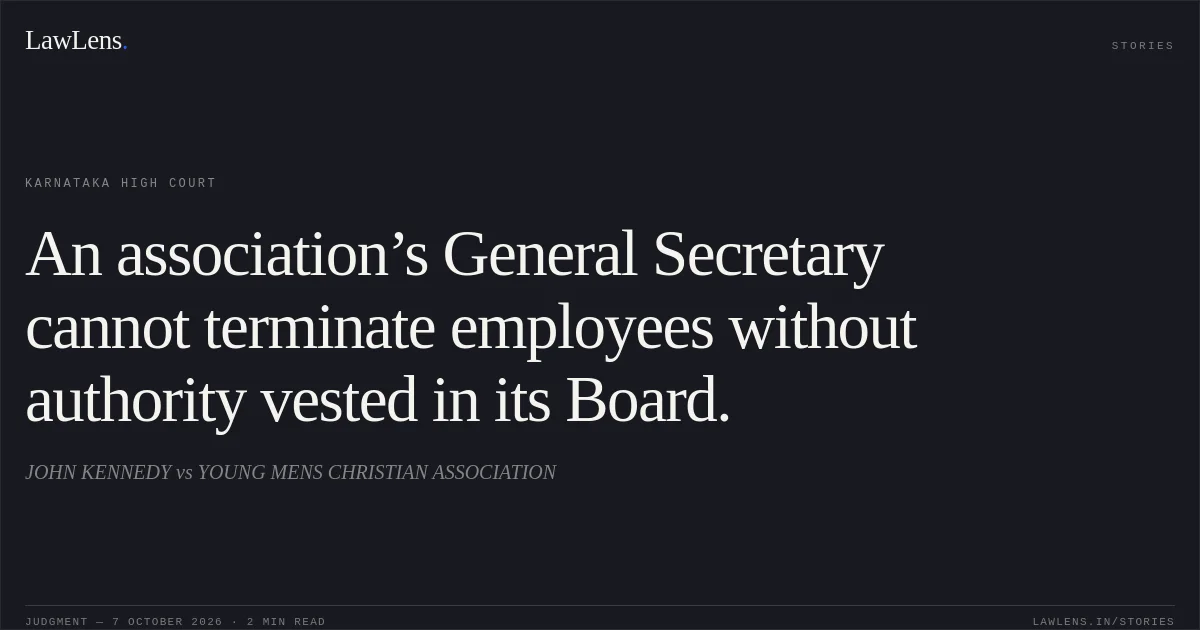
The plaintiff, a YMCA employee who had served as a Senior Secretary, challenged his suspension dated 25 April 2023 and termination dated 31 October 2024, alleging that the General Secretary acted without authority of the Board of Directors and contrary to the Association’s bye-laws and personnel policies
Source reference: p. 3–5, 17–18The trial court found the suspension and termination procedurally improper but kept the termination in abeyance and directed the plaintiff to approach the Board for fresh consideration
Source reference: p. 8–10, 23The plaintiff appealed, seeking the orders to be set aside and full relief granted
Source reference: p. 10–12Issues
1. Whether the trial court was correct in finding that the suspension and termination orders were illegal and perverse
Source reference: p. 142. Whether, having found the orders improper, the trial court was correct to keep the termination in abeyance rather than set it aside
Source reference: p. 14–153. Whether the trial court’s judgment and decree required modification or interference
Source reference: p. 15Law Applied
The appeal was brought under Section 96 of the Code of Civil Procedure
Source reference: p. 2The Court applied the Association’s bye-laws, rules and regulations, written constitution, and Personnel Policy Book, which it construed as vesting disciplinary decision-making authority in the Board of Directors rather than the General Secretary
Source reference: p. 18–21It also applied the principles of natural justice, holding that disciplinary action required a proper inquiry and compliance with the Association’s governing procedures
Source reference: p. 22–23The judgment refers to a Supreme Court order concerning interim relief in a contract of service, but provides no case name or citation; it records that the Supreme Court had observed that an injunction in such a contract could not be granted
Source reference: p. 16Reasoning
The evidence showed that the General Secretary issued the suspension and termination orders without prior Board approval, and the Association did not establish that the Board had met in full quorum and taken the decisions as required by its rules
Source reference: p. 18–21The Court also found that the subsequent ratification relied upon by the Association did not cure the procedural defect, and that the record disclosed no proper inquiry, in breach of natural justice
Source reference: p. 22–23Because the Association itself was a party, represented by its General Secretary, the Board did not need to be separately impleaded; accordingly, the trial court erred in directing the plaintiff to return to the Board instead of setting aside the defective orders
Source reference: p. 23–25Holding
The appeal was allowed and the trial court’s decree modified. The suspension and termination orders were held illegal as contrary to the Association’s governing rules and policies
The Association was directed to restore the plaintiff to the position he held on the date of suspension, stated in the decree as Secretary, and to pay salary, emoluments, facilities, and other monetary benefits until superannuation; any pension or gratuity payable under applicable rules was also to be granted. The monetary benefits were directed to be paid within four weeks of receipt of the order, with no order as to costs
Source reference: p. 26Acts & Sections Cited
1 provisions across 1 statute referred to in this judgment. Each provision opens on LawLens.
Code of Civil Procedure, 19081
Original Court PDF
JOHN KENNEDYvsYOUNG MENS CHRISTIAN ASSOCIATION
Click to open original judgment
Original judgment, available to read, download and summarize on LawLens.in