Facts
The wife sought transfer under Section 24 of the Code of Civil Procedure, 1908, of the husband’s divorce petition, C.P. No. 259 of 2025, from the Family Court, Cuttack, to the Family Court-I, Bhubaneswar.
Source reference: p. 1–2Her petition for restitution of conjugal rights, C.P. No. 333 of 2025, was already pending before the latter court.
Source reference: p. 1–2The husband ultimately did not oppose the transfer, provided both proceedings were tried together and disposed of expeditiously.
Source reference: p. 1–2Issues
Whether the husband’s divorce proceeding should be transferred to the Family Court-I, Bhubaneswar, where the wife’s restitution petition was pending
Source reference: p. 1–2, 7Whether the two matrimonial proceedings should be tried together, and what directions were appropriate to facilitate their expeditious disposal
Source reference: p. 2, 5–7Law Applied
Section 24 CPC empowers the court to transfer proceedings where the ends of justice require it. In matrimonial transfer matters, the wife’s convenience is generally a relevant consideration (*N.C.V. Aishwarya v. A.S. Saravana Karthik Sha*, 2022 SCC OnLine SC 1199).
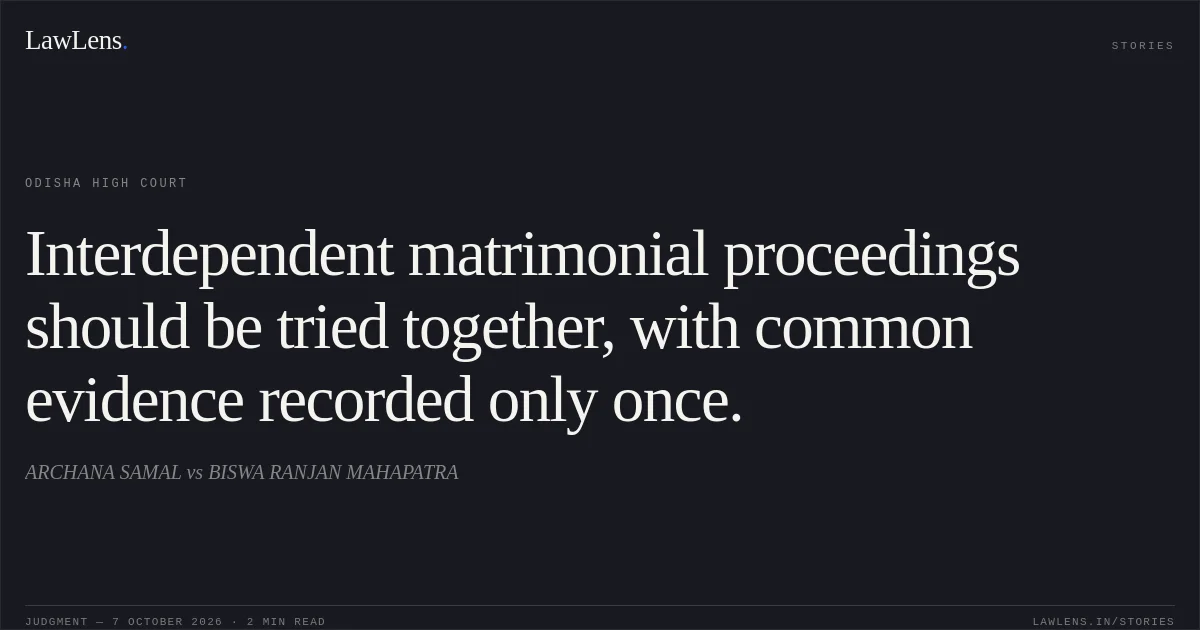
Source reference: p. 3–4Where proceedings between the same parties raise common questions of fact or law and their outcomes are interdependent, they should ordinarily be tried together to avoid duplicated proceedings and conflicting decisions (*N.C.V. Aishwarya*, supra).
Source reference: p. 4*Guda Vijayalakshmi v. Guda Ramchandra Sekhara Sastry*, (1981) 2 SCC 646, supports joint or consolidated consideration of closely connected matrimonial proceedings and confirms that Section 21A of the Hindu Marriage Act, 1955 does not exclude the broader power to transfer or consolidate proceedings where justice requires.
Source reference: p. 4–5Reasoning
The wife’s restitution petition was pending in Bhubaneswar, while the husband’s divorce petition concerned the same marriage and involved closely connected matrimonial issues.
Source reference: p. 2, 5–7Applying the principles of the wife’s convenience and avoiding multiplicity and conflicting decisions, the Court found transfer and joint trial appropriate.
Source reference: p. 2, 5–7The husband’s no-objection position further supported the order.
Source reference: p. 2, 5–7To make the joint trial effective, the Court directed that common evidence ordinarily be recorded once and read in both proceedings, while permitting virtual appearances with the Family Court’s permission, subject to physical attendance when required for effective hearings.
Source reference: p. 2, 5–7Holding
The transfer petition was allowed.
The Family Court, Cuttack, was directed to transmit C.P. No. 259 of 2025 to the Family Court-I, Bhubaneswar, which was directed to try it together with C.P. No. 333 of 2025, ordinarily using common evidence, and to endeavour to conclude both proceedings by the end of June 2027, absent legal impediment.
Source reference: p. 5–7The parties were directed to cooperate and avoid unnecessary adjournments; the interim order was vacated and the related interlocutory application disposed of.
Source reference: p. 7–8Acts & Sections Cited
3 provisions across 2 statutes referred to in this judgment. Each provision opens on LawLens.
Code of Civil Procedure, 19081
Hindu Marriage Act, 19552
Original Court PDF
ARCHANA SAMALvsBISWA RANJAN MAHAPATRA
Click to open original judgment
Original judgment, available to read, download and summarize on LawLens.in