Facts
Petitioner No. 1 had earlier lodged a complaint against respondent No. 2, her husband, alleging offences under Section 498-A read with Section 34 of the IPC and Sections 3 and 4 of the Dowry Prohibition Act. After investigation, a closure report was prepared. Respondent No. 2 then alleged that the petitioners had initiated that case using forged documents, resulting in registration of the FIR challenged in this petition.
Source reference: para. 2The petitioners sought quashing under Section 528 of the Bharatiya Nagarik Suraksha Sanhita, 2023, on the basis of a compromise. The compromise applications were verified by the Principal Registrar, and respondent No. 2 had no objection to quashing.
Source reference: paras. 1, 3–4, 7Issues
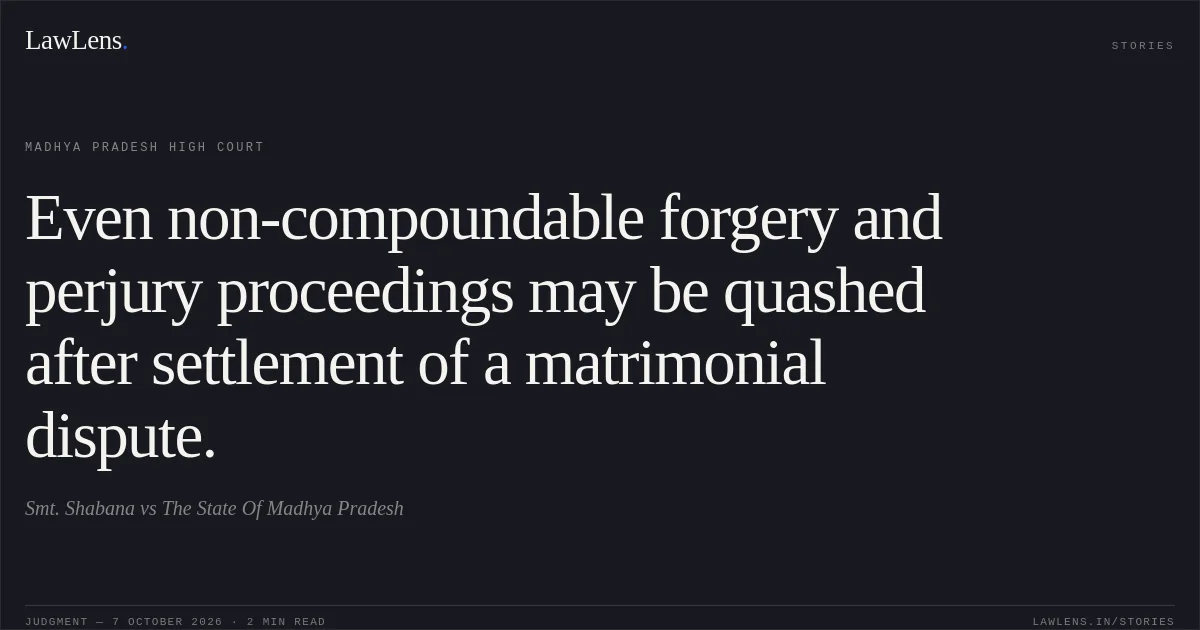
Whether the High Court should exercise its inherent jurisdiction under Section 528 of the BNSS to quash the FIR and consequential proceedings for non-compoundable offences under Sections 467, 471 and 193 of the IPC on the basis of the parties’ compromise.
Source reference: paras. 1, 3–7Whether, in view of the verified compromise and respondent No. 2’s lack of objection, continuation of the criminal proceedings would serve any purpose.
Source reference: paras. 4, 7Law Applied
Section 528 of the BNSS, 2023, preserves the High Court’s inherent power to make orders necessary to secure the ends of justice.
Source reference: para. 1Relying on Gian Singh v. State of Punjab, (2012) 10 SCC 303, the Court reiterated that quashing criminal proceedings on the basis of a settlement is distinct from compounding under Section 320 of the CrPC. The High Court may quash even non-compoundable proceedings where the dispute is appropriately settled, continuation would be futile, and quashing would secure the ends of justice; the nature and circumstances of each case must be considered.
Source reference: para. 5Reasoning
The Court noted that the parties had amicably resolved their dispute, that the compromise had been verified, and that respondent No. 2 did not oppose quashing.
Source reference: paras. 3–4, 7Applying Gian Singh, it concluded that, in these circumstances, continuing the proceedings for the alleged offences under Sections 467, 471 and 193 of the IPC would serve no purpose and that giving effect to the compromise would meet the ends of justice.
Source reference: paras. 5, 7Holding
The High Court allowed the petition and quashed the FIR registered at Crime No. 221/2024 at Police Station M.I.G., Indore, under Sections 467, 471 and 193 of the IPC, together with all subsequent proceedings arising from that crime number against the petitioners.
The petition was disposed of on the terms of the compromise.
Source reference: para. 8Acts & Sections Cited
8 provisions across 4 statutes referred to in this judgment. Each provision opens on LawLens.
Bharatiya Nagarik Suraksha Sanhita, 20231
Indian Penal Code, 18604
Code of Criminal Procedure, 19731
Original Court PDF
Smt. ShabanavsThe State Of Madhya Pradesh
Click to open original judgment
Original judgment, available to read, download and summarize on LawLens.in