Facts
The plaintiff sued for a permanent injunction concerning land recorded in his ownership and possession; the defendants admitted his ownership but claimed a right of way over the land, asserting that it was their only access to their house and that they had used it for many years
Source reference: p. 3–6The trial court decreed the suit, but the first appellate court reversed that decree, relying on a document described as a police compromise
Source reference: p. 8–9, 16In this second appeal, the plaintiff challenged the appellate court’s findings on the alleged easement and the compromise
Source reference: p. 9–10Issues
Whether the first appellate court’s finding that the defendants had a right of passage by necessity was unsupported by the pleadings and evidence
Source reference: p. 10Whether the first appellate court could base its finding regarding the defendants’ right of passage on a compromise made before the police
Source reference: p. 10Law Applied
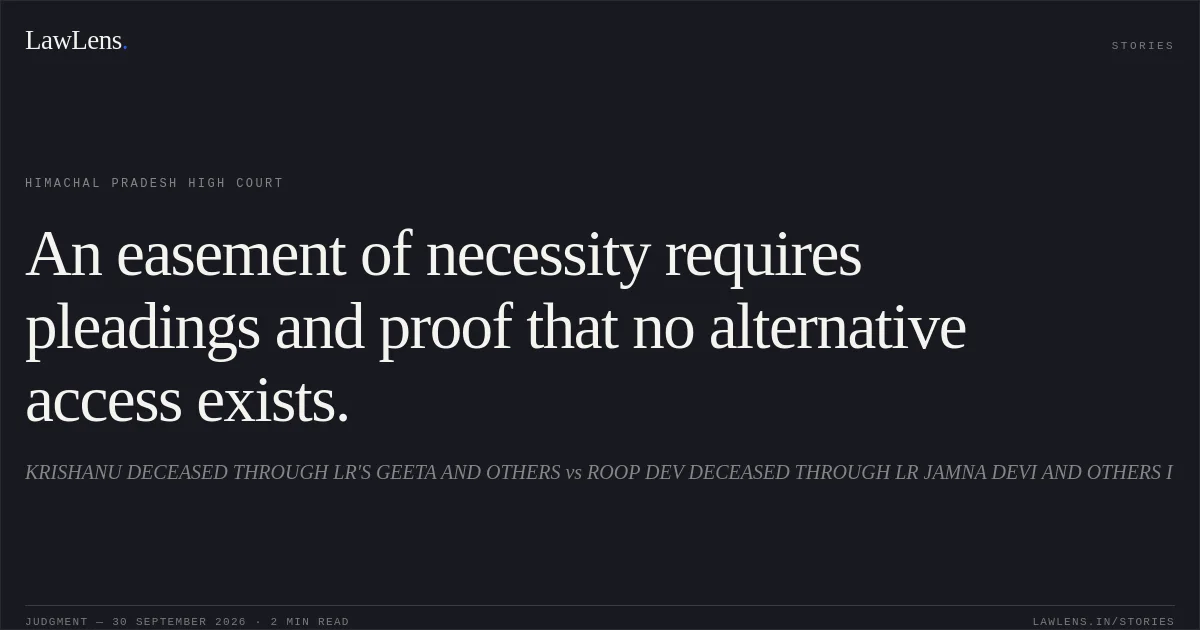
The court’s reasoning turned on the requirements for establishing an easement of necessity: the claimant must plead and prove the essential facts supporting the claimed necessity, including the absence of another passage.
Source reference: p. 16–18A document relied on to establish a right must sufficiently identify the subject matter to connect it to the disputed right.
Source reference: p. 16–18The appellants invoked Sections 13, 15 and 47–51 of the Easements Act, but the judgment does not set out or apply those provisions individually
Source reference: p. 9No precedent was cited.
Source reference: no citationReasoning
The court found the defendants’ pleadings and evidence insufficient to establish that the disputed path was their only access.
Source reference: p. 16–18The defendants’ spot map did not depict the situation adequately, and the Local Commissioner reported two passages at the site—one motorable and one pedestrian; defence witnesses also acknowledged a Panchayat-maintained passage
Source reference: p. 16–18The alleged compromise was vague and did not describe the land or passage in dispute, so it could not support the first appellate court’s finding of a right over the plaintiff’s land
Source reference: p. 16–18Holding
The High Court answered both substantial questions of law in the plaintiff’s favour
set aside the first appellate court’s judgment and decree, and restored the trial court’s decree permanently restraining the defendants from interfering with the suit land
Source reference: p. 18–19The appeal was allowed
Source reference: p. 19Acts & Sections Cited
8 provisions across 2 statutes referred to in this judgment. Each provision opens on LawLens.
Code of Civil Procedure, 19081
Indian Easements Act, 18827
Original Court PDF
KRISHANU DECEASED THROUGH LR'S GEETA AND OTHERSvsROOP DEV DECEASED THROUGH LR JAMNA DEVI AND OTHERS I
Click to open original judgment
Original judgment, available to read, download and summarize on LawLens.in