Facts
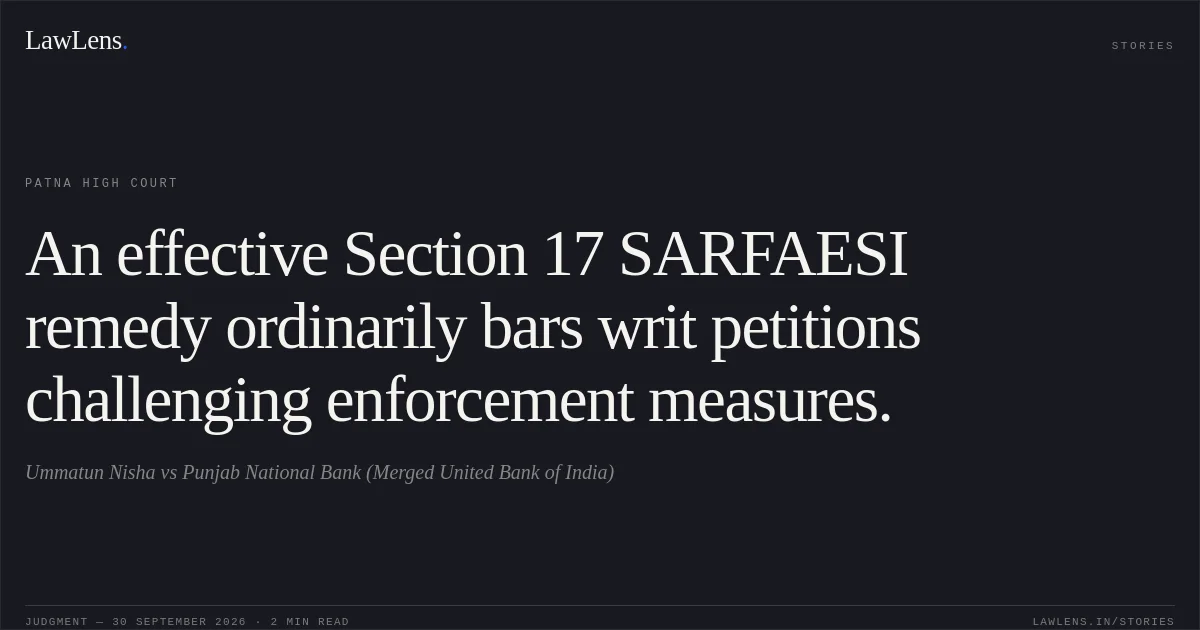
The petitioner challenged the District Magistrate-cum-Collector’s order dated 11 January 2019, passed under Section 14 of the SARFAESI Act in Case No. 67 of 2016, authorising possession of secured property.
Source reference: p.2–3She claimed that the property included her dwelling house and co-shares, and that she was neither the borrower nor a guarantor.
Source reference: p.2–3She sought to set aside the order or restrain the respondents from taking possession.
Source reference: p.2–3The Court disposed of the writ petition on the ground that an alternative statutory remedy was available, without determining the underlying property dispute.
Source reference: p.5–6Issues
1. Whether the petitioner’s challenge to the possession-related action under the SARFAESI Act could be entertained under Article 226 when a statutory remedy was available.
Source reference: p.3–62. Whether the petitioner’s claim that she was a non-borrower whose property was affected entitled her to relief in the writ petition.
Source reference: p.2–3, 5–6Law Applied
Section 17(1) of the SARFAESI Act permits any person, including a person other than the borrower, aggrieved by measures under Section 13(4) to apply to the Debts Recovery Tribunal within the prescribed period.
Source reference: p.3–4The Court applied the rule that the High Court will ordinarily not entertain a petition under Article 226 where an effective statutory remedy is available, with particular rigour in matters involving recovery of bank dues; it relied on United Bank of India v. Satyawati Tondon, (2010) 8 SCC 110, Celir LLP v. Bafna Motors (Mumbai) (P) Ltd., (2024) 2 SCC 1, and PHR Invent Educational Society v. UCO Bank, 2024 INSC 297.
Source reference: p.4–5Reasoning
Although the petitioner asserted that she was not the borrower or guarantor and that her dwelling house was included in the property sought to be taken into possession, the Court treated Section 17 as an effective remedy available to an aggrieved person.
Source reference: p.2–4Applying the authorities on exhaustion of statutory remedies, it declined to examine the merits of her claim or the scope of the Collector’s order in the writ proceeding.
Source reference: p.4–6Holding
The Court held that the writ petition was not maintainable because an alternative and effective statutory remedy was available.
It disposed of the petition, leaving the petitioner at liberty to approach the appropriate forum and directing that the question of limitation be considered by the concerned authority.
Source reference: p.6Acts & Sections Cited
3 provisions across 1 statute referred to in this judgment. Each provision opens on LawLens.
Securitisation and Reconstruction of Financial Assets and Enforcement of Security Interest Act, 20023
Original Court PDF
Ummatun NishavsPunjab National Bank (Merged United Bank of India)
Click to open original judgment
Original judgment, available to read, download and summarize on LawLens.in