Facts
The prosecution alleged that on 24 March 2009, BESCOM Vigilance officials found an unauthorised electrical connection supplying a house under construction in Ujjini Village and alleged theft of 1½ kW of electricity.
Source reference: p. 3A charge sheet was filed, and the appellant was tried and convicted under Section 135 of the Electricity Act, 2003. The trial court imposed a fine of ₹1,22,472.
Source reference: p. 4In his appeal under Section 374(2) CrPC, the appellant argued, among other things, that the prosecution had not established that the house belonged to him and had not examined the mahazar witnesses.
Source reference: p. 3–5, 7–8The prosecution case was supported by three witnesses; five documents and one material object were marked.
Source reference: p. 4Issues
Whether the appellant had established grounds to interfere with the trial court’s judgment of conviction and sentence
Source reference: p. 6Whether the prosecution evidence was sufficient to sustain the conviction where the prosecution had not produced material establishing the appellant’s ownership of the house under construction
Source reference: p. 7Law Applied
The appeal was brought under Section 374(2) of the Code of Criminal Procedure, which provides for an appeal against conviction.
Source reference: p. 2The charge and conviction were under Section 135 of the Electricity Act, 2003, concerning theft of electricity.
Source reference: p. 3–4The Court applied the requirement that a conviction must be supported by cogent, convincing, and legally acceptable evidence; it cited no precedent.
Source reference: p. 7Reasoning
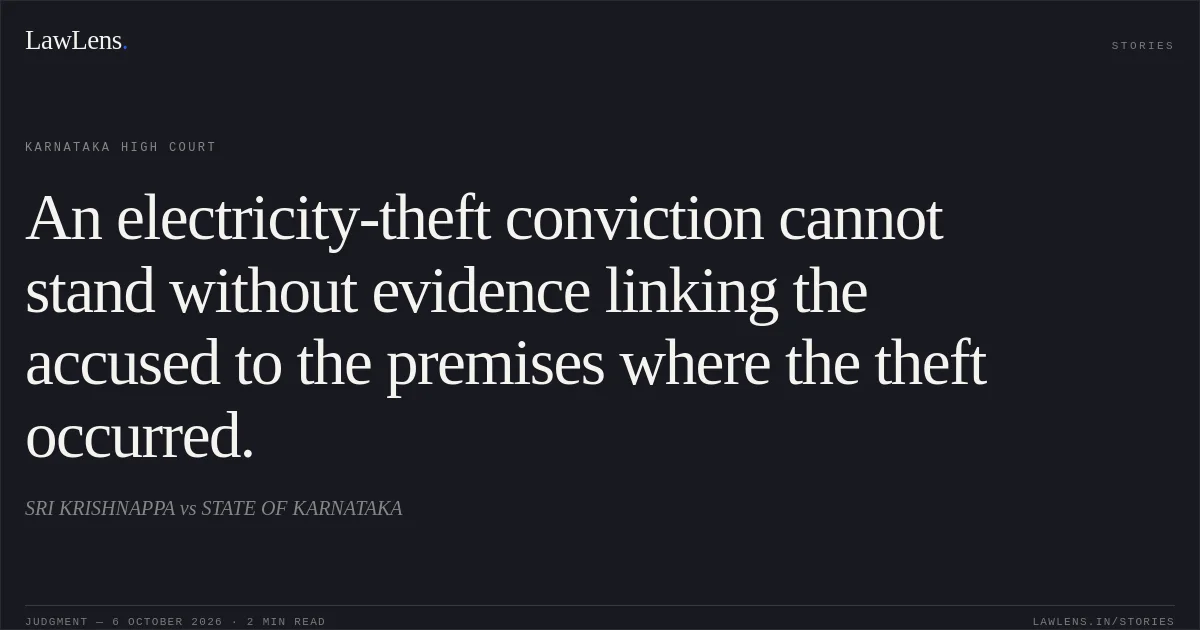
The Court found that the investigating officer had produced no document showing that the appellant owned the house where the alleged unauthorised connection was found, and had not explained the omission.
Source reference: p. 7It also noted the appellant’s contention that the mahazar witnesses were not examined.
Source reference: p. 5Concluding that the record lacked cogent and legally acceptable evidence to support the conviction, the Court held that the trial court’s decision could not stand.
Source reference: p. 7Holding
The Court answered the question whether grounds existed to interfere in the affirmative.
The Court allowed the appeal, set aside the conviction and sentence, and acquitted the appellant of the offence under Section 135 of the Electricity Act, 2003.
Source reference: p. 8It directed the trial court to refund any fine deposited and ordered cancellation of the appellant’s bail bond.
Source reference: p. 8Acts & Sections Cited
4 provisions across 2 statutes referred to in this judgment. Each provision opens on LawLens.
Code of Criminal Procedure, 19732
Electricity Act, 20032
Original Court PDF
SRI KRISHNAPPAvsSTATE OF KARNATAKA
Click to open original judgment
Original judgment, available to read, download and summarize on LawLens.in