01Facts
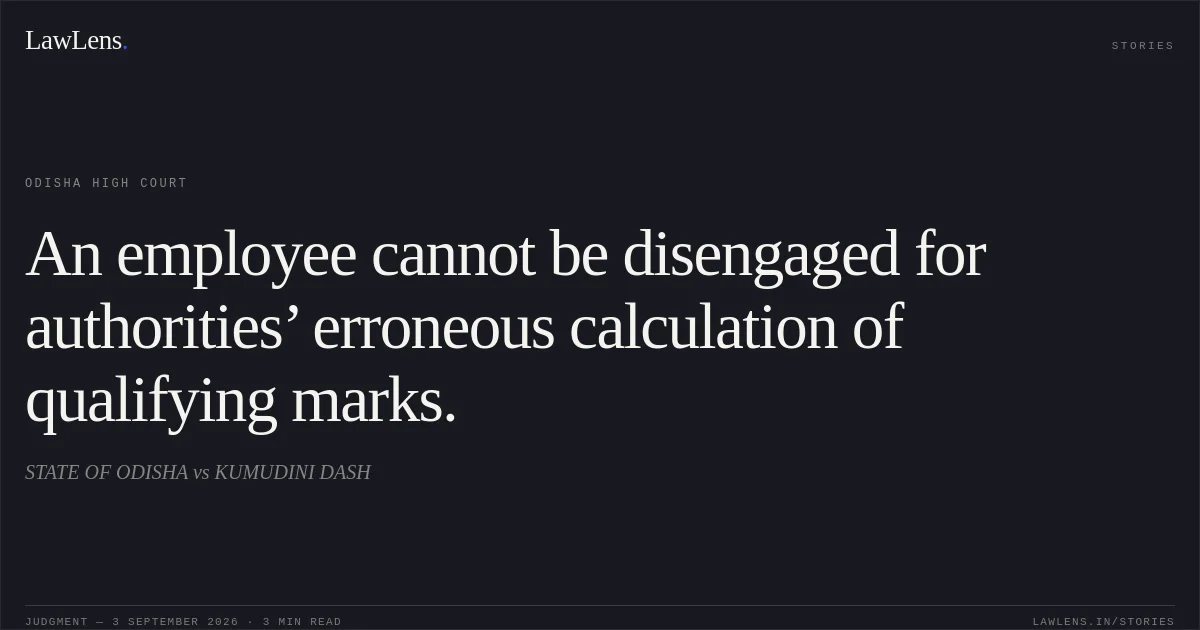
Respondent No. 1, Kumudini Dash, was engaged as a Sikshya Sahayak at Govindpur Nodal U.P. School, Bhadrak.
p. 2 · ¶ 3During verification of her educational certificates, the authorities found that, while calculating her percentage for appointment, marks obtained in an extra-optional subject had been included.
pp. 2–3 · ¶ 3–5Although her certificates were genuine, she was disengaged by order dated 9 October 2008 on the ground of erroneous calculation of marks.
pp. 2–3 · ¶ 3–5She challenged the disengagement before the High Court.
p. 3 · ¶ 4The learned Single Judge held that she was not responsible for the authorities’ mistake and directed her immediate reinstatement with arrear salary by judgment dated 22 December 2023.
p. 3 · ¶ 4The State filed the present intra-court appeal, contending that the relevant vacancies had subsequently been filled by other candidates.
pp. 3–4 · ¶ 5, 7The record also showed that one of those candidates had been directed to be engaged against a supernumerary post until a regular vacancy arose.
p. 5 · ¶ 802Issues
i.Whether the respondent’s disengagement was legally sustainable when her certificates were genuine and the alleged ineligibility resulted solely from the authorities’ method of calculating marks by including marks obtained in an extra-optional subject.
pp. 2–5 · ¶ 3, 5–7ii.Whether the respondent could be reinstated and continued as a Sikshya Sahayak notwithstanding the State’s contention that the relevant posts had subsequently been filled by other candidates.
pp. 3–7 · ¶ 5, 7–1503Law Applied
The Court applied the principle that a candidate should not suffer for an error committed by the appointing authorities, particularly where the candidate’s certificates are genuine and the disputed calculation concerns the authorities’ interpretation or application of the eligibility criteria.
pp. 5–7 · ¶ 8, 14–15It relied on Tarunakanti Sethi v. State of Orissa and Others, 110 (2010) CLT 545, which held that marks obtained in an extra-optional subject should not mechanically be deducted when calculating eligibility on the basis of +2 marks; such marks may properly be counted, especially where the additional subject is relevant to the engagement.
pp. 4–5 · ¶ 6The Court also recognised the remedial principle that an employee who suffered without fault could be accommodated against a supernumerary post until a regular vacancy arose, as reflected in the coordinate Bench’s order in W.A. No. 110 of 2009.
pp. 5–6 · ¶ 8The appeal was considered under Clause 10 of the Letters Patent, Article 4 of the Orissa High Court Order, 1948, and Rule 2 of Chapter VIII of the Orissa High Court Rules, 1948.
p. 104Reasoning
The Court noted that the respondent’s certificates had been verified as genuine and that the alleged defect arose only from the authorities’ calculation of her marks by including the extra-optional subject.
pp. 2–3 · ¶ 3Applying Tarunakanti Sethi, the Court held that the State’s own submission—that the precedent squarely applied—undermined the justification for disengagement.
pp. 4–5 · ¶ 6–7, 15The respondent was therefore not at fault and could not be deprived of service on account of the appointing authority’s error.
pp. 5–7 · ¶ 8, 14–15The State’s objection that the posts had been filled was rejected because the engagement of Respondent Nos. 3 and 4 did not legally prevent the respondent’s reinstatement; in particular, one such candidate had herself been accommodated against a supernumerary post pursuant to an earlier judicial direction.
pp. 5–7 · ¶ 8–14The Court further noted that the respondent was stated to be continuing in service and performing duties without receiving salary, and that the State had not effectively controverted this position.
p. 6 · ¶ 905Holding
The Division Bench found no merit in the State’s appeal and held that the respondent’s disengagement could not be sustained because she had suffered due to an error for which she was not responsible.
p. 7 · ¶ 14–15The Court upheld the learned Single Judge’s direction for her reinstatement with arrear salary and dismissed W.A. No. 704 of 2024.
p. 7 · ¶ 16The authorities were expected to implement the impugned judgment as early as possible, preferably within eight weeks from the date of the appellate judgment.
p. 7 · ¶ 16Original Court PDF
STATE OF ODISHAvsKUMUDINI DASH
Click to open original judgment
Original judgment, available to read, download and summarize on LawLens.in