Facts
The applicant was employed as the Manager of the Anand branch of Micro Leasing and Funding Limited (“MLFL”).
Source reference: paras. 2.1–2.9, pp. 1–4The complainant alleged that MLFL, through its agents and officials, induced him and other investors to deposit substantial amounts under investment schemes promising returns, but subsequently failed to repay the amounts and closed its operations.
Source reference: paras. 2.1–2.9, pp. 1–4An FIR, C.R. No. I-62 of 2015, was registered at Anand Town Police Station for offences under Sections 406, 420, 120-B and 114 of the IPC and Sections 4, 5 and 6 of the Prize Chits and Money Circulation Schemes Act, 1978.
Source reference: para. 1, p. 1Although the applicant was admittedly only a branch manager and not a director or promoter, he was charge-sheeted and Criminal Case No. 645 of 2016 was instituted before the Chief Judicial Magistrate, Anand.
Source reference: paras. 3–6, pp. 4–6The applicant invoked Section 482 of the CrPC seeking quashing of the criminal proceedings, contending that the company’s directors were responsible for the financial operations and that he was himself an investor who had suffered loss.
Source reference: paras. 3–5, pp. 4–5Issues
1. Whether the criminal proceedings against the applicant, who was merely a branch manager and neither a director nor promoter of MLFL, disclosed the ingredients of the alleged offences or could otherwise be sustained.
Source reference: paras. 8–10, pp. 6–72. Whether continuation of Criminal Case No. 645 of 2016 amounted to an abuse of the process of law warranting exercise of the High Court’s inherent jurisdiction under Section 482 of the CrPC.
Source reference: paras. 1, 10–11, pp. 1, 7Law Applied
The Court applied Section 482 of the Code of Criminal Procedure, 1973, which empowers the High Court to quash criminal proceedings to prevent abuse of the process of law and secure the ends of justice.
Source reference: para. 1, p. 1It considered the alleged offences under Sections 406, 420, 120-B and 114 of the IPC and Sections 4, 5 and 6 of the Prize Chits and Money Circulation Schemes Act, 1978.
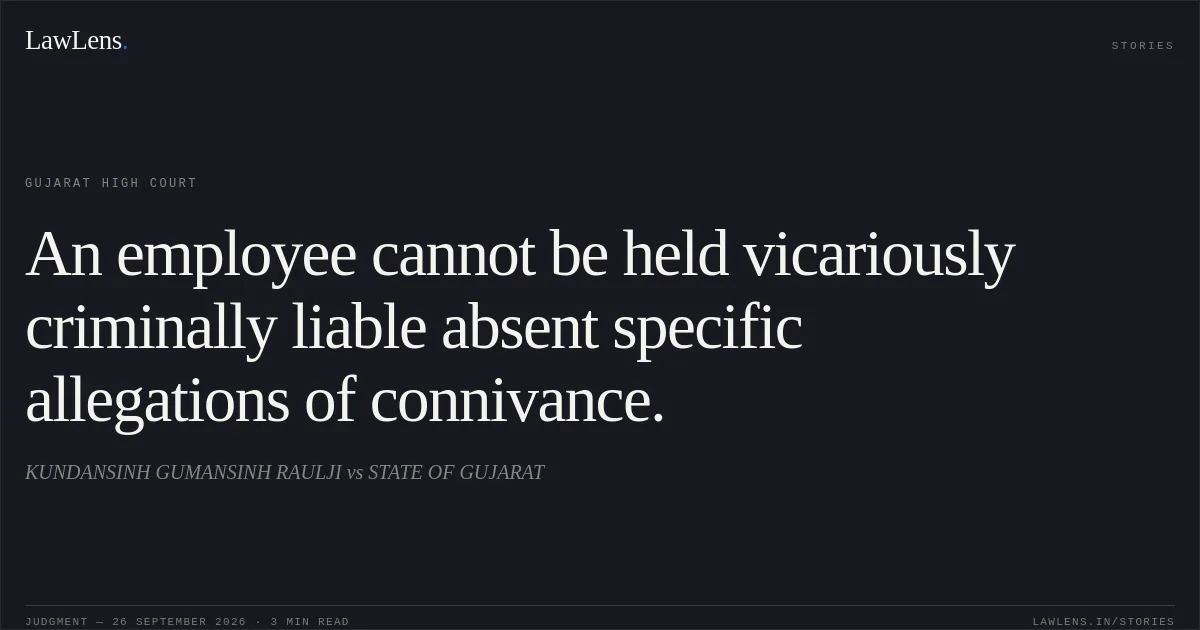
Source reference: para. 1, p. 1The Court also applied the principle that criminal liability is ordinarily personal and that an employee cannot be made vicariously liable for the acts of a company or its directors merely by virtue of holding employment, absent specific material showing participation, conspiracy, or a statutory basis for such liability.
Source reference: paras. 8–10, pp. 6–7Relying on State of Haryana v. Bhajan Lal, AIR 1992 SC 604, the Court held that proceedings may be quashed where their continuation would constitute an abuse of the process of law.
Source reference: para. 10, p. 7Reasoning
The FIR and charge-sheet identified the applicant as the Manager of MLFL’s Anand branch but did not disclose that he was a director, promoter, key managerial person, or participant in any conspiracy with the company’s directors to mobilise funds fraudulently.
Source reference: para. 8, p. 6The Court noted that the company’s directors were responsible for the relevant financial activities and that the applicant’s conduct, even if undertaken at their direction, did not by itself establish dishonest intention, entrustment-related misconduct, conspiracy, or personal responsibility for the company’s failure to repay investors.
Source reference: para. 9, p. 6The SEBI order dated 21 November 2014 also showed that MLFL and its directors and past directors had been restrained from soliciting money from the public, supporting the conclusion that the principal responsibility lay with the company’s management rather than the applicant, who was only a branch employee.
Source reference: para. 9, p. 6Since the materials did not disclose the applicant’s independent criminal involvement, the Court held that continuing the prosecution against him would amount to an abuse of process within the principle stated in Bhajan Lal.
Source reference: para. 10, p. 7Holding
The Court answered the issues in favour of the applicant.
It held that the FIR and charge-sheet did not disclose sufficient material connecting the applicant, merely as a branch manager, with the alleged offences or with any criminal conspiracy, and that his prosecution amounted to an abuse of the process of law.
Source reference: paras. 8–10, pp. 6–7The application under Section 482 CrPC was allowed, and Criminal Case No. 645 of 2016, arising from C.R. No. I-62 of 2015 registered with Anand Town Police Station, together with all consequential proceedings, was quashed and set aside.
Source reference: para. 11, p. 7The rule was made absolute.
Source reference: para. 11, p. 7Acts & Sections Cited
7 provisions across 3 statutes referred to in this judgment. Each provision opens on LawLens.
Code of Criminal Procedure, 19731
Indian Penal Code, 18603
Original Court PDF
KUNDANSINH GUMANSINH RAULJIvsSTATE OF GUJARAT
Click to open original judgment
Original judgment, available to read, download and summarize on LawLens.in