Facts
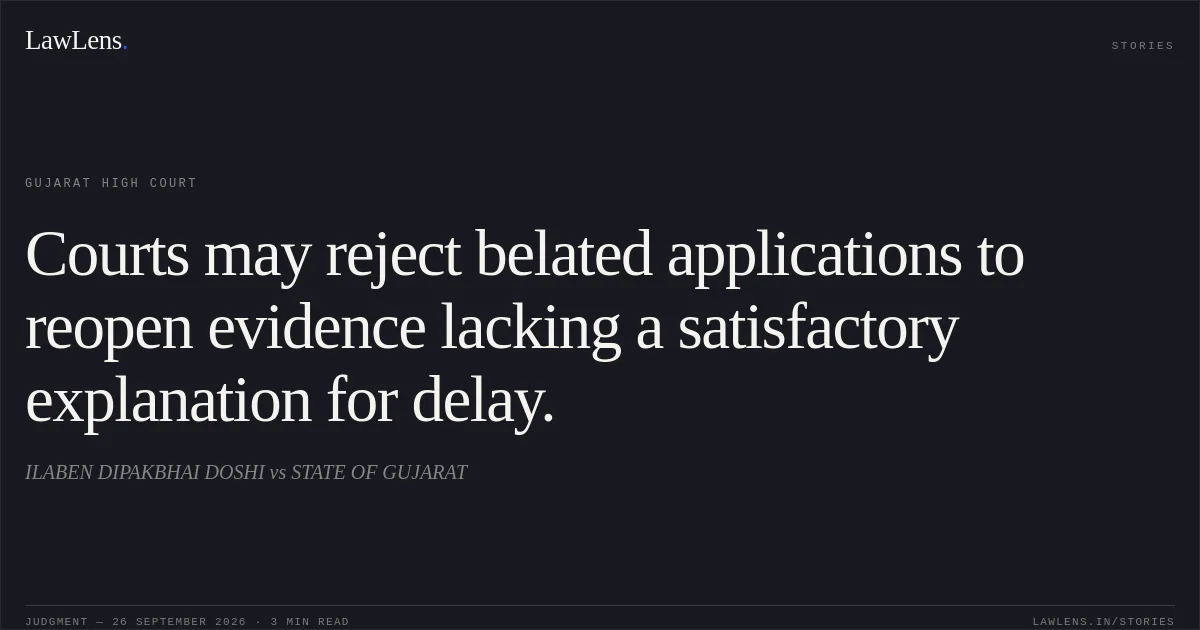
The petitioner, a partner of a partnership firm, was an accused in Criminal Case No. 6439 of 2025 pending before the 2nd Additional Judicial Magistrate First Class, Morbi, concerning a cheque allegedly issued by the partnership firm.
Source reference: pp. 2–4The petitioner contended that the firm had not been joined as an accused and sought permission to reopen her defence evidence to produce the partnership deed, income-tax records, and examine the complainant’s wife, the Income Tax Officer, and witness Manish Kaila.
Source reference: pp. 2–4The Trial Court rejected the application below Exhibit 39 on 9 July 2026, observing that the application was general, failed to disclose the proposed evidence, and was filed after the matter had reached the stage of judgment despite adequate prior opportunity.
Source reference: pp. 4–5The petitioner filed Criminal Revision Application No. 121 of 2026 and sought stay of the Trial Court’s order.
Source reference: pp. 4–5The Revisional Court rejected the stay application below Exhibit 5 on 7 August 2026, principally considering the prolonged pendency of the proceedings since 2022.
Source reference: pp. 4–5The petitioner thereafter invoked the High Court’s jurisdiction seeking quashing of both orders and permission to lead further defence evidence.
Source reference: p. 1Issues
Whether the Trial Court erred in rejecting the petitioner’s application to reopen her defence evidence under the principles governing Section 311 of the Code of Criminal Procedure, despite the proposed evidence allegedly being material to a just decision of the case.
Source reference: pp. 5–6; para. 8Whether the Revisional Court erred in refusing to stay the Trial Court’s order and whether the High Court should interfere with the concurrent discretionary orders of the courts below.
Source reference: pp. 4–7; paras. 5–9Whether the petitioner’s contention that the cheque was issued by the partnership firm, which was not joined as an accused, warranted reopening of the evidence at the stage when the matter had reached judgment.
Source reference: pp. 2–3, 5Law Applied
The Court applied the principles underlying Section 311 of the Code of Criminal Procedure, which confer a wide power on the court to summon or examine a witness, or recall and re-examine a witness, at any stage where the evidence appears essential for a just decision of the case.
Source reference: p. 6; para. 8The power must, however, be exercised judicially and with due caution, and is not available as a means to cure unexplained procedural delay or prolong proceedings.
Source reference: pp. 5–6; paras. 6–8The Court relied on Gaurav Chauhan v. Gurmeet Singh, 2026 SCC OnLine HP 5817, for the principle that the determinative consideration is whether the proposed evidence is essential for the just decision of the case, while the timing and circumstances of the application remain relevant.
Source reference: p. 6; para. 8The High Court also applied the limited scope of interference with discretionary orders where no illegality, perversity, or jurisdictional error is demonstrated.
Source reference: p. 7; para. 9Reasoning
The High Court held that the petitioner’s original application below Exhibit 39 was vague and did not specify the evidence she intended to lead.
Source reference: p. 4; para. 5Although the proposed evidence was later identified in the revision petition, the petitioner offered no cogent explanation for failing to produce it during the nearly three-year pendency of the case or why the proposed witnesses could not have been examined earlier.
Source reference: pp. 5–6; para. 6The Court accepted that delay alone cannot justify refusal to reopen evidence where the evidence is essential for a just decision; however, the record disclosed no circumstance preventing the petitioner from seeking the evidence at the appropriate stage.
Source reference: p. 5; para. 6In these circumstances, the Trial Court’s concern that the application was filed only at the stage of final adjudication, possibly after engagement of a new advocate and resulting in further delay, was found reasonable.
Source reference: p. 6; para. 7The Revisional Court’s refusal to stay the proceedings and the Trial Court’s refusal to reopen evidence therefore did not suffer from illegality, perversity, or jurisdictional error.
Source reference: p. 7; para. 9The Court did not grant relief on the petitioner’s argument regarding non-joinder of the partnership firm.
Source reference: no citationHolding
The High Court answered the issues against the petitioner.
It held that, in the absence of a satisfactory explanation for the belated request and considering that the trial had reached the stage of judgment, the courts below acted within their discretion in refusing to reopen the defence evidence and declining to stay the proceedings.
Source reference: pp. 5–7; paras. 6–9Finding no illegality, perversity, or jurisdictional error, the Court rejected the Special Criminal Application and declined to quash the orders dated 9 July 2026 and 7 August 2026.
Source reference: p. 7; para. 9Acts & Sections Cited
1 provisions across 1 statute referred to in this judgment. Each provision opens on LawLens.
Code of Criminal Procedure, 19731
Original Court PDF
ILABEN DIPAKBHAI DOSHIvsSTATE OF GUJARAT
Click to open original judgment
Original judgment, available to read, download and summarize on LawLens.in