Facts
The petitioner was suspended on 29 April 2010 for alleged dereliction of duty.
Source reference: no citationHis earlier writ petition was transferred to the Public Services Tribunal and registered as Claim Petition No. 127/DB/2022.
Source reference: para. 4During the proceedings, the District Development Officer, Dehradun, passed an order dated 2 February 2024 reinstating the petitioner after his acquittal in the criminal prosecution, but treated the period from 5 February 2010 to 27 June 2010—143 days—as absence from duty and denied him salary/admissible dues for that period.
Source reference: para. 4The Tribunal, by judgment dated 20 May 2025, disposed of the claim petition in terms of the order dated 2 February 2024, while setting aside the punishment order dated 7 July 2011 and the appellate order dated 10 June 2014.
Source reference: para. 4It expressly held that the petitioner would be entitled to admissible dues/salary except for the period from 5 February 2010 to 27 June 2010.
Source reference: para. 4The petitioner’s subsequent request for payment of salary for the excluded period was rejected by order dated 29 July 2026, leading to the present writ petition.
Source reference: paras. 3, 5Issues
Whether the petitioner was entitled to salary or admissible dues for the period from 5 February 2010 to 27 June 2010 after the Tribunal had disposed of his claim petition in terms of the order dated 2 February 2024 and expressly excluded that period from payment?
Source reference: paras. 4–6Whether the High Court should interfere with the order dated 29 July 2026 rejecting the petitioner’s claim for payment for the excluded period?
Source reference: paras. 3, 6–7Law Applied
The Court applied the principle that an administrative authority must give effect to the operative and final directions contained in a judicial or tribunal order.
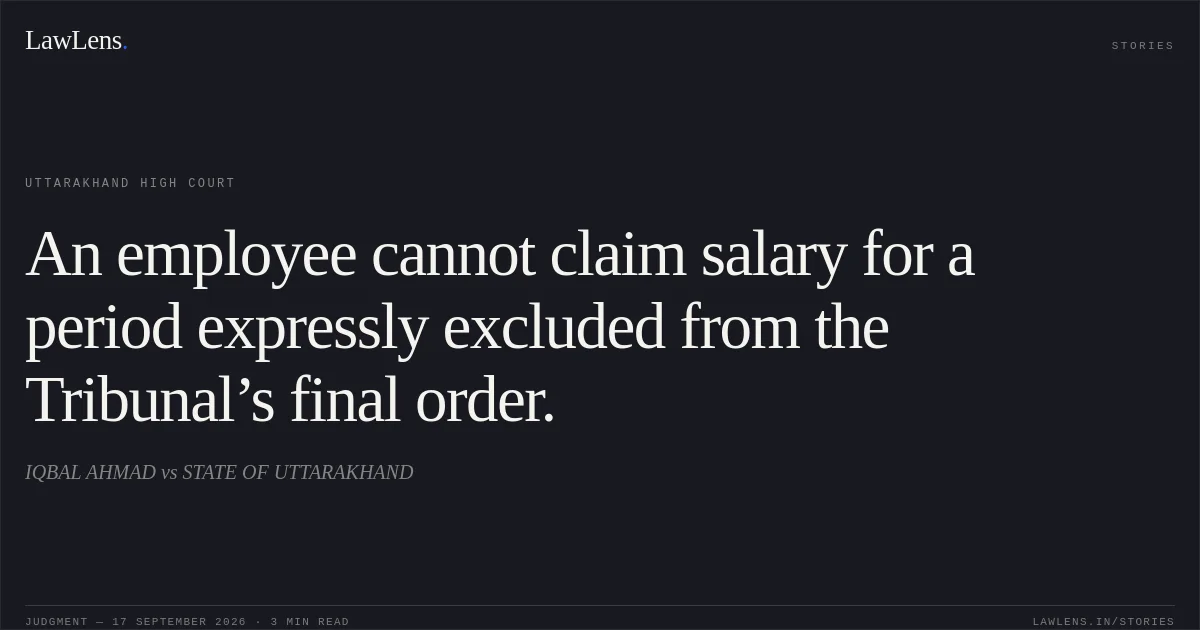
Source reference: no citationWhere the Tribunal disposes of a claim petition in terms of a specific departmental order and expressly excludes a particular period from payment, the employee cannot subsequently claim salary for that period contrary to the Tribunal’s order.
Source reference: no citationThe Court relied on the binding effect of the Tribunal’s judgment dated 20 May 2025 and the scope of judicial review, under which interference is unwarranted where the authority has correctly implemented the Tribunal’s directions.
Source reference: para. 6No specific statutory provision or precedent was cited in the judgment.
Source reference: no citationReasoning
The High Court distinguished between the setting aside of the punishment and the petitioner’s entitlement to salary for the disputed period.
Source reference: no citationAlthough the Tribunal set aside the punishment and appellate orders, it disposed of the claim petition in terms of the District Development Officer’s order dated 2 February 2024, which expressly treated the 143-day period as absence from duty and denied payment for it.
Source reference: para. 4The Tribunal’s judgment further confirmed that salary/admissible dues were payable only for periods other than 5 February 2010 to 27 June 2010.
Source reference: para. 4Consequently, the authority acted correctly in rejecting the petitioner’s later claim for that period, and there was no legal basis for the High Court to reopen or alter the effect of the Tribunal’s order.
Source reference: para. 6Holding
The Court answered the issues against the petitioner.
It held that the petitioner was not entitled to salary or admissible dues for the period from 5 February 2010 to 27 June 2010 because that exclusion formed part of the order in terms of which the Tribunal had disposed of his claim petition.
Source reference: para. 6Finding no ground for interference, the High Court dismissed the writ petition in limine.
Source reference: para. 7Original Court PDF
IQBAL AHMADvsSTATE OF UTTARAKHAND
Click to open original judgment
Original judgment, available to read, download and summarize on LawLens.in