Facts
The appellant was prosecuted in Case Crime No. 15 of 2009, Police Station Nawabganj, District Pratapgarh, for an offence under Section 308 IPC, arising from an allegation that, due to a dispute concerning a manure pit, he assaulted the complainant’s daughter-in-law with a lathi, causing her to fall unconscious.
Source reference: p.1, paras. 2–4The victim sustained contusions on the right shoulder and thigh, swelling near the right ear, and a scalp injury; she remained admitted in hospital for approximately thirteen days.
Source reference: p.1, para. 4By judgment dated 4 March 2011, the Additional Sessions Judge convicted the appellant under Section 308 IPC and sentenced him to two years’ rigorous imprisonment with a fine of ₹5,000, with three months’ additional rigorous imprisonment in default.
Source reference: p.1, para. 2In appeal, the appellant did not challenge the conviction and sought only the benefit of Section 4 of the Probation of Offenders Act, 1958.
Source reference: p.2, para. 5The District Probation Officer’s revised report stated that the appellant supported his elderly mother, wife, and five daughters, had weak financial circumstances, and had no previous conviction or adverse complaint apart from a continuing property dispute.
Source reference: pp.2–3, paras. 8–10Issues
Whether the appellant, whose conviction under Section 308 IPC was not challenged, should be released on probation of good conduct under Section 4 of the Probation of Offenders Act, 1958?
Source reference: p.2, para. 5; p.5, paras. 15–16Whether the High Court, in exercise of appellate jurisdiction, could grant the benefit of probation and modify the custodial sentence while maintaining the conviction and fine?
Source reference: p.4, para. 14; p.5, para. 16Law Applied
The Court applied Section 4 of the Probation of Offenders Act, 1958, which permits release of an offender on probation of good conduct where the circumstances justify such relief, subject to the execution of bonds and compliance with conditions.
Source reference: p.4, paras. 13–14Section 11 of the Act empowers the High Court to grant probation when the matter comes before it in appeal.
Source reference: p.4, paras. 13–14Relying on Lakhvir Singh v. State of Punjab, (2021) 2 SCC 763, the Court recognised that probation may be extended even in a Section 307 IPC case where the offender’s circumstances, conduct, and absence of adverse material justify reformative treatment.
Source reference: p.3, para. 11Under Sunita Devi v. State of Bihar, 2024 SCC OnLine SC 984, courts are required to consider the reformative provisions of Section 360 CrPC and Sections 3, 4, and 6 of the Probation of Offenders Act before imposing sentence.
Source reference: pp.3–4, para. 12Chellammal v. State, 2025 SCC OnLine SC 870, further establishes that, although probation is not an absolute right, the court has a mandatory duty to consider its applicability where the statutory conditions are attracted and must record reasons if probation is refused.
Source reference: p.4, para. 13Reasoning
The Court treated the absence of any previous conviction or significant adverse material against the appellant, together with his family responsibilities, weak financial condition, and the favourable revised probation report, as circumstances supporting reformative relief.
Source reference: pp.2–3, paras. 8–10Although the appellant had been convicted under Section 308 IPC, the Court noted that the conviction was not challenged and focused on the appropriate sentence.
Source reference: pp.3–5, paras. 11–15Applying the reformative principles underlying Section 4 of the Probation of Offenders Act and the authorities requiring consideration of probation, the Court concluded that the appellant was suitable for release on probation of good conduct.
Source reference: pp.3–5, paras. 11–15The Court accordingly preserved the conviction but substituted the custodial sentence with probation, while retaining the fine.
Source reference: p.5, para. 16Holding
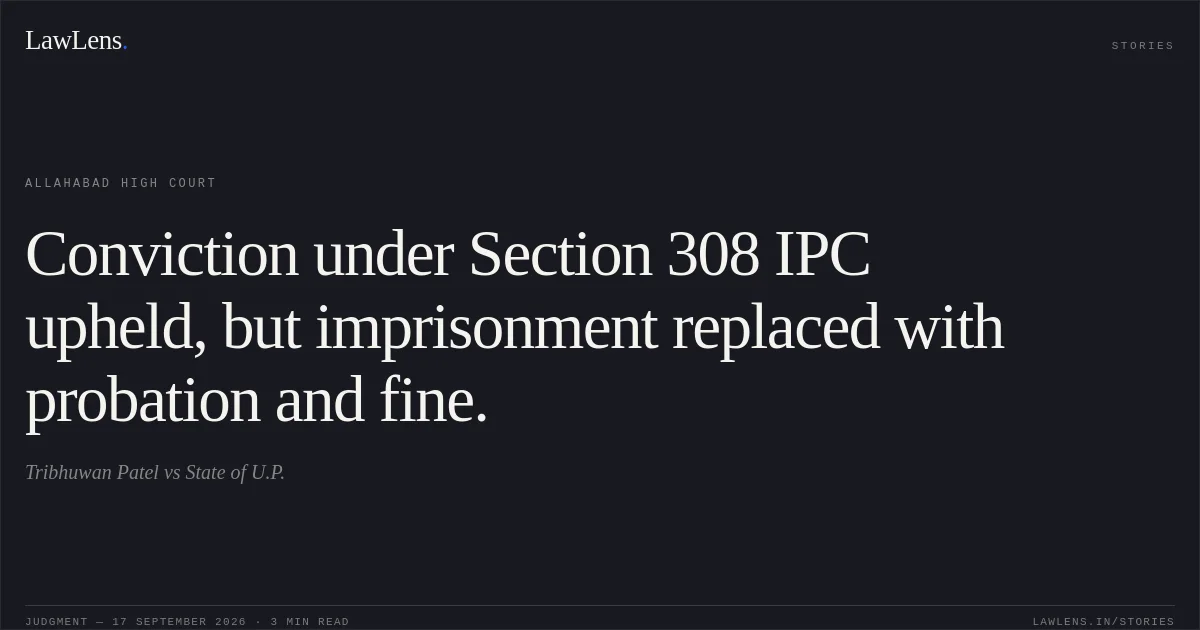
The appeal was disposed of without disturbing the appellant’s conviction under Section 308 IPC.
The sentence was modified by granting the appellant the benefit of Section 4 of the Probation of Offenders Act, 1958.
Source reference: p.5, para. 16He was directed to be released on probation of good conduct upon executing a personal bond and two sureties in the like amount, undertaking to appear and receive sentence if called upon during a period of two years and to maintain peace and good behaviour.
Source reference: p.5, para. 16The appellant was further directed to deposit the fine amount within four weeks; the fine sentence was therefore maintained.
Source reference: p.5, para. 17Acts & Sections Cited
7 provisions across 3 statutes referred to in this judgment. Each provision opens on LawLens.
Indian Penal Code, 18602
Probation of Offenders Act, 19584
Code of Criminal Procedure, 19731
Original Court PDF
Tribhuwan PatelvsState of U.P.
Click to open original judgment
Original judgment, available to read, download and summarize on LawLens.in